


AI
10. June 2026
Is your marketing team using AI legally in 2026?
Answer the 8 questions and get a quick assessment of whether your marketing team is prepared for the EU AI Act, or whether there are areas that require action.
Indhold
To vigtige datoer Tag testen Få overblik over reglerne Hvad gælder allerede? Hvad gælder fra 2. august 2026? Hvilket indhold skal mærkes? Gælder det bagudrettet?If anyone on your marketing team uses, for example, ChatGPT, Copilot, Midjourney, Canva AI, or similar tools, there is a good chance that you are already covered by the EU AI Act.
This is because the law is not only about companies that develop AI. It also applies to companies that use it.
This article aims to help you assess whether your marketing team is ready—for example, take our test below.
Two important dates
- 2 February 2025: The first rules in the AI Act entered into force. This includes, among other things, prohibited AI practices as well as the requirement that employees who use AI must have the necessary AI competencies (AI literacy).
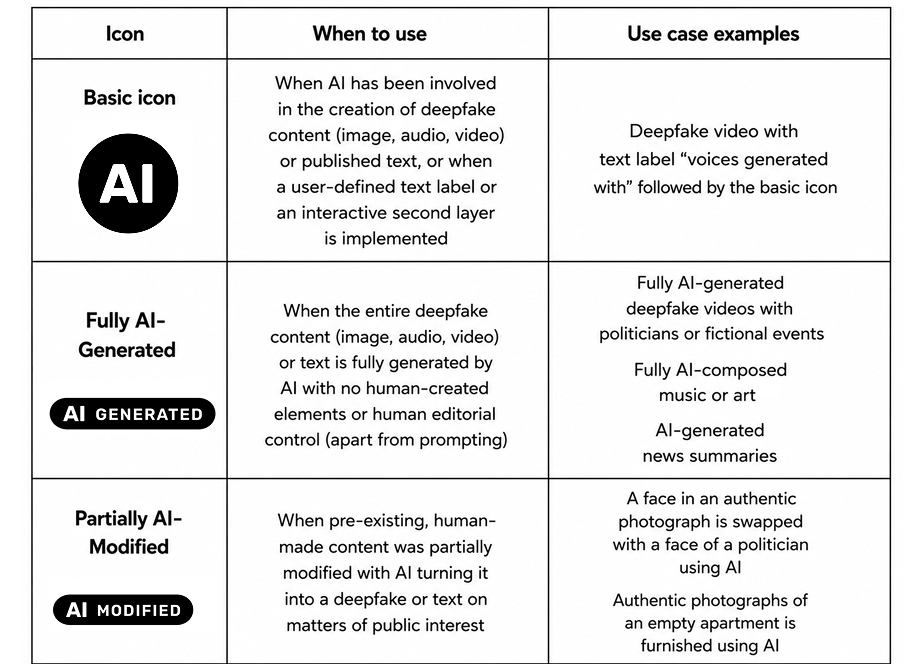
- 10 June 2026: The EU published a voluntary Code of Practice showing how companies can, in practice, comply with the transparency requirements in the AI Act (you can also create your own icons). See their overview below (translated into Danish):
- 2 August 2026: Most requirements in the AI Act begin to apply. For marketing departments, it is particularly relevant to have a handle on transparency requirements, chatbots, and AI-generated content that can be mistaken for reality.
Test: Is your marketing team using AI legally in 2026?
The assessment consists of 8 questions and takes 1–2 minutes to complete.
Have you trained employees in the responsible use of AI, and can you document it?
*The test provides an indication of how well your marketing team is prepared for the AI Act. It cannot stand alone as a legal assessment, and the rules are continuously evolving.
Why these questions specifically?
The questions are based on the areas that the AI Act makes particularly relevant for companies using AI in marketing:
- Employees’ AI competencies
- Overview of AI tools
- Labelling of AI-generated content
- Transparency around chatbots
- Documentation and accountability
Read more in the Danish Agency for Digital Government’s own guidance.
What is already in force?
Although many of the AI Act’s requirements will only take effect from August 2026, parts of the legislation have already entered into force.
This includes, among other things, the requirement for AI literacy. In short, this means that employees who use AI in their work must have the necessary competencies to do so responsibly.
At the same time, certain AI practices are already prohibited. For marketing departments, it is particularly worth noting that, as a general rule, AI must not be used to analyse employees’ emotions based on, for example, facial expressions or voice in the workplace.
That is precisely why several of the questions in the test concern employees’ AI competencies, transparency, and responsible use of AI.
What applies from 2 August 2026?
For most marketing departments, it is especially the transparency requirements in the AI Act that will become relevant from 2 August 2026.
This means, among other things:
- Users must be informed when they are interacting with an AI chatbot or AI assistant.
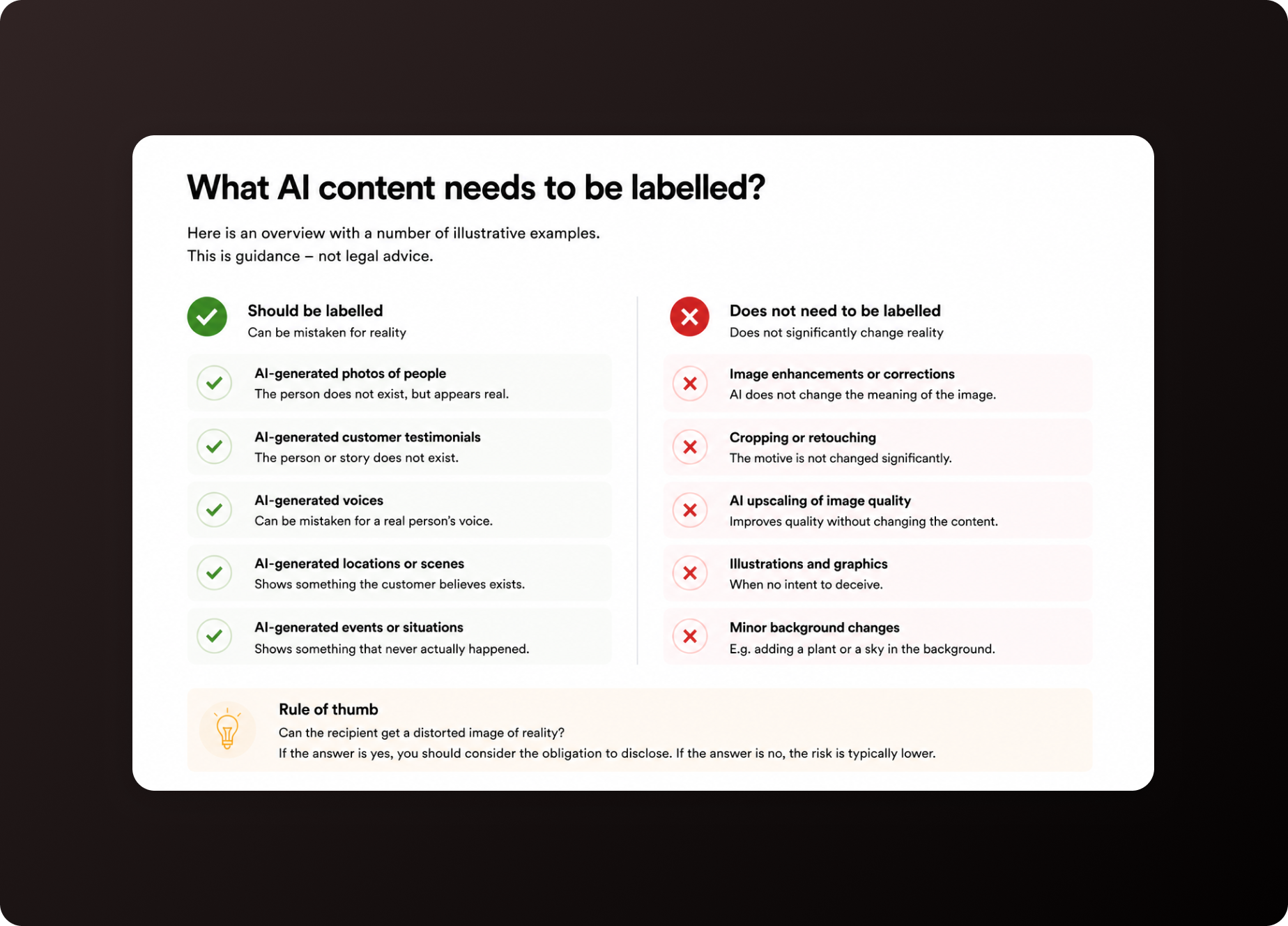
- AI-generated or AI-manipulated images, videos, and audio files that can be mistaken for reality (deepfakes) must be disclosed as such.
- Companies must be able to assess when AI-generated content requires disclosure—and when it does not.
This does not mean that all AI-generated content must automatically be labelled.
An AI-generated person, voice, or video that appears real is different from, for example, image enhancement, colour correction, or an illustration that no one would mistake for reality.
Therefore, it is not only about using AI. It is about using AI transparently.
What about AI-generated texts?
Many believe that all AI-generated texts must be labelled. That is not the case.
The AI Act primarily targets text generated with the purpose of informing the public about matters of public interest. This could, for example, include topics such as:
- Politics
- Health
- Climate and the environment
- Social issues
Even here, exceptions apply. If a human has reviewed, edited, and taken editorial responsibility for the content, the disclosure obligation will typically not be relevant.
For most marketing departments, this means that ordinary:
- Blog posts
- Product descriptions
- Cases
- Nyhedsbreve
- LinkedIn posts
do not automatically need to be labelled simply because AI was involved in the writing process.
Rule of thumb: The AI Act focuses far more on transparency around deepfakes, synthetic people, voices, and chatbots than on ordinary marketing copy.
Does the labelling obligation apply retroactively?
As a general rule, there is no requirement to go back and label previously published AI content (except, of course, chatbots).
However, if AI-generated content continues to be published, republished, or used after 2 August 2026 in a situation where the transparency requirement applies, you should assess whether it needs to be labelled.

What should you do now?
If the test has revealed gaps in your processes, start here:
- Ensure that your chatbot or AI assistant clearly states when the user is interacting with AI
- Make sure that employees who use AI have the necessary competencies
- Get an overview of which AI tools marketing uses
- Define how you handle AI-generated content that may require disclosure (and write it down in internal guidelines)
If you need guidance, we offer expert AI advisory services.

Written by






Do not hesitate – we are always ready for a chat
Should we help you with AI?
We are always happy to have a no-obligation conversation about how AI can create value for your business.