


AI
11. June 2025
How to rank in Google AI Overviews
You simply need to do the same work as if you wanted Featured Snippets in Google. So the secret is a text structure that makes it easy to skim, write strong content, and use schema markup for articles, FAQs, images, etc.
You can put away flowery language and convoluted linguistics and write in bullet points if you want to appear in Google AI Overviews because you know what?
They do not care about your beautiful prose.
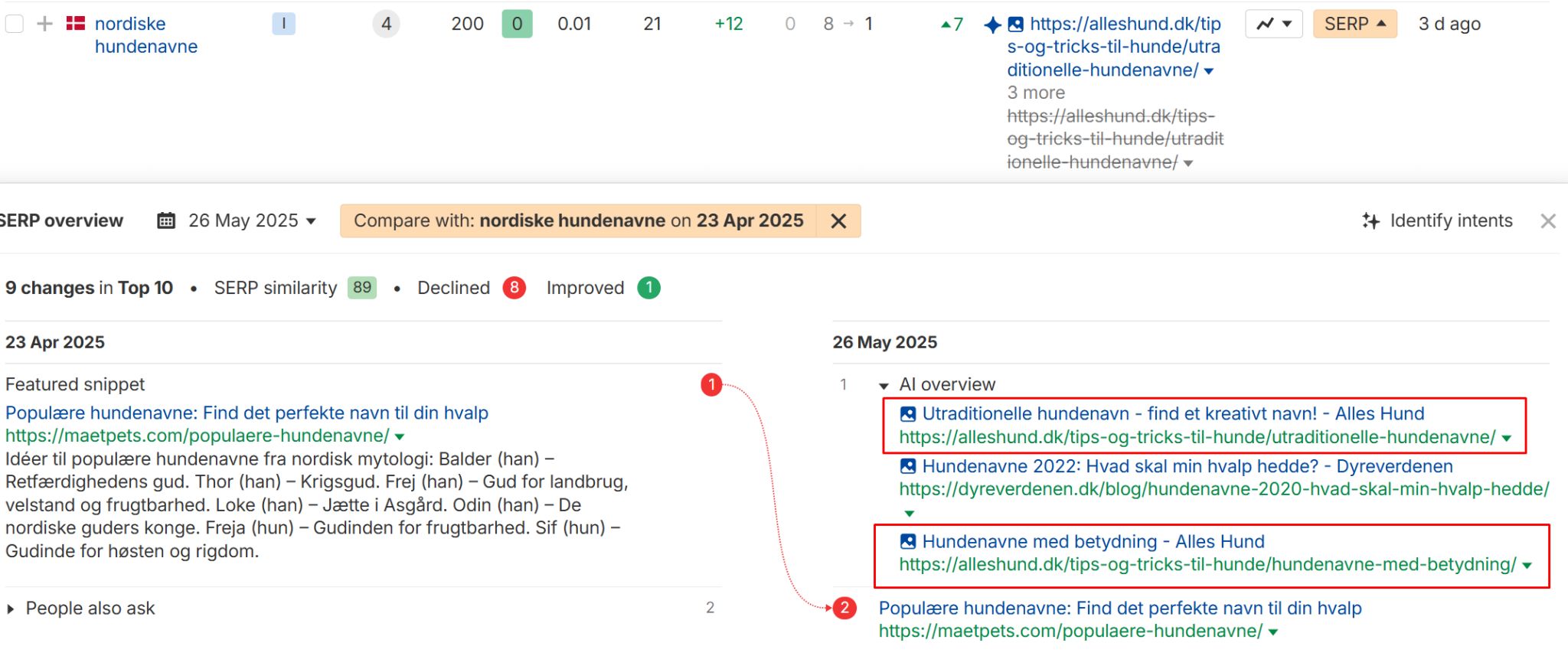
And we have data showing why your texts which you thought were “SEO-optimised” do not necessarily perform in AI Overviews.
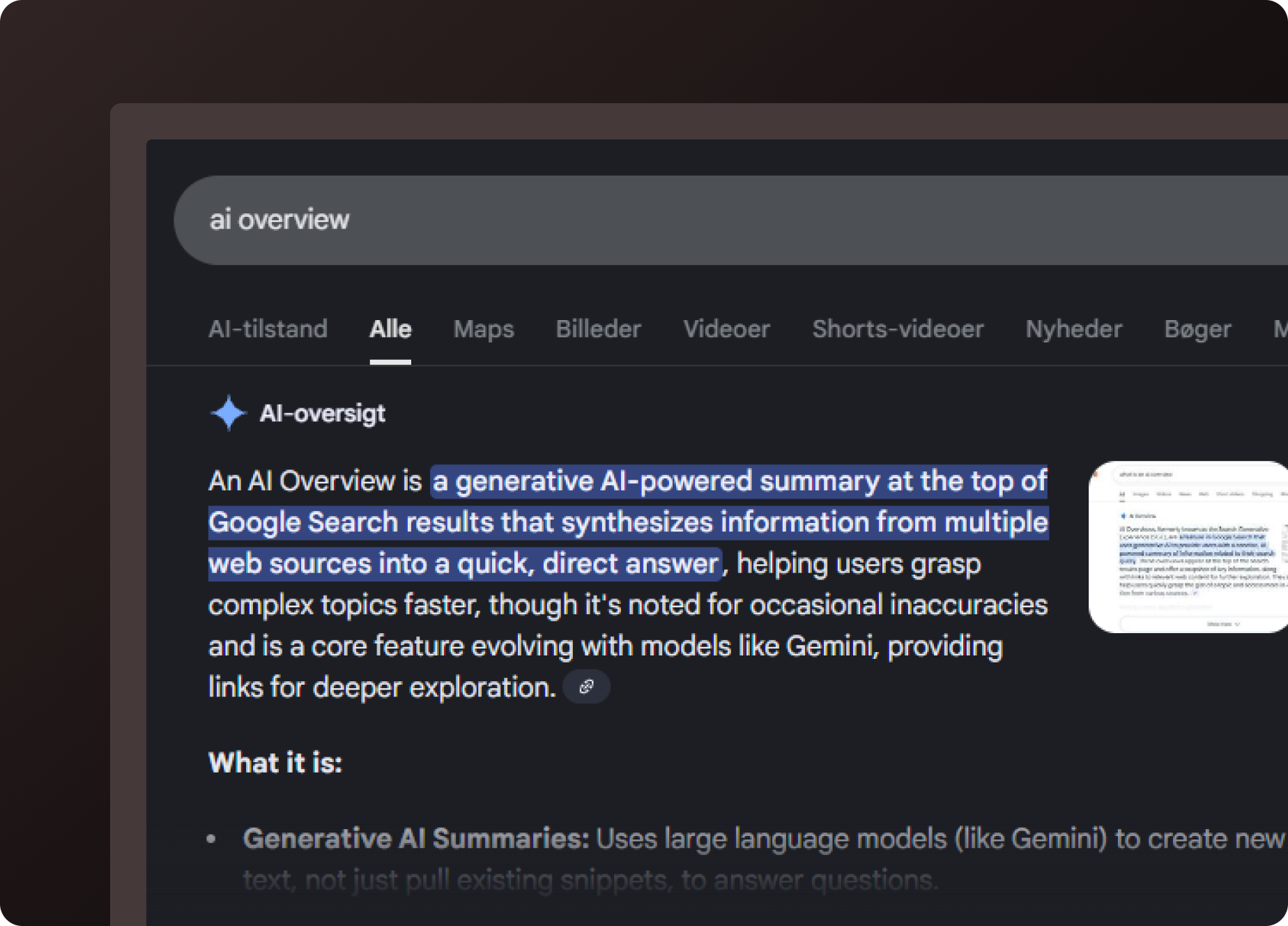
Read this article if you want to learn more about what Google AI Overviews are.
How to appear in AI results
It is actually not fancy at all to appear in Google AI Overviews results, also known as “GEO” (Generative Engine Optimization) with new terms..
You simply need to do the same work as if you wanted Featured Snippets in Google.
So the secret is a text structure that makes it easy to skim, simple content, schema markup, and even more structure.
If you ranked before AI → you probably still rank.
- Did you rank for Featured Snippets? → Good news.
- Did you rank for PAA (People Also Ask)? → Good news.
- Did you already rank for AI Overviews? → Good news.
Why?
Because AI Overviews are built on the same logic as the old Google tricks:
Structured + simple + precise = gold.
Your texts must be easy to navigate
This is where many go wrong. They write overly long, convoluted texts. And yes, it must still be readable but:
AI does not read.
It scans.
And when you hide your key points in long blocks of text with sentences that could have been written by a philosophy student with WordThesaurus in overdrive… you will not be cited.
❌ Here is what AI hates:
- Long, winding sentences
- Unclear points hidden in meta text
- Text blocks without formatting
- Content without structure
✅ Here is what AI LOVES:
Tables
- Because it is organised
- Because comparison is easy
- Because fact extraction is fast and precise
Bullet lists
- Because it is easy to parse
- Because it is scan-friendly
- Because information becomes clear

Short paragraphs
- No fluff
- Max 3–4 sentences
- One point per paragraph

Use headings that make sense
Your headings should tell the reader quite precisely what, as a reader, you can expect from the text below. Assume people read your headings and look at your images, and based on that they should be able to understand your content.
Fortunately, this is also how an AI thinks, so it is compatible.

AI (and people) understand better:
👉 “How to implement it”
Than:
❌ “Methodological considerations regarding implementation”
(… yes, we have seen that kind of thing IRL)
Approach to creating strong content for Google AI Overviews
1. Identify your most important questions
Find out:
- Which questions your target audience asks
- What is already being shown in AI Overviews
- Where your competitors are being mentioned
You can use tools such as:
- ChatGPT to simulate searches
- AlsoAsked
- Semrush
2. Review your existing content
Find the most important articles, guides, and landing pages.
Check:
- Are they structured?
- Are there bullet lists?
- Is the information scan-friendly?
- Do you have tables where it makes sense?
If the answer is “no” → add it to your to-do list.
3. Rewrite your texts the way AI wants them
You do not need to throw everything in the bin. Start with:
- Shorter sentences
- Bullet lists instead of text blocks
- Tables for comparisons
- Headings that match the search intent
And test it.
Remember, Google does not penalise AI-generated content, but it does penalise poor content that is not informative or does not help the reader. Read more about this here.
4. Test your texts
You can use ChatGPT or Claude as a “Google simulator”:
- Give it a question you want to be found for
- Insert two versions of your content—the old and the optimised (where you have used short sentences, bullet points, tables, and better headings).
- Ask ChatGPT or Claude: “Which of these would you use as a source for an AI Overview?”
Spoiler: The simple version wins.





Do not hesitate – we are always ready for a chat
Shall we help you get featured in AI Overviews?
We analyse your site and provide our recommendations on how to increase the likelihood of being shown in AI Overviews.