


Lead generation
8. September 2026
4 tactics that make it easier for visitors to convert
You will get 4 concrete tactics to make your website easier to understand, navigate, and convert on. Tactics that helped one of our clients increase their conversion rate from 5.7% to 14.7%.
Indhold
Små greb kan gøre en stor forskel 1. Gør sproget modtagerrettet 2. Giv det vigtigste indhold mest opmærksomhed 3. Vis de mennesker, kunden skal have tillid til 4. Gør siden nem at skimmeSmall changes can make a big difference
The four tactics may seem relatively simple, but they share something important: They make it easier for visitors to understand whether your solution is relevant, find the information that matters for the decision, and take the next step.
As a concrete example, I can mention that we recently increased a client’s conversion rate by 158% using these exact 4 tactics.
Of course, that does not mean the four tactics will automatically deliver the same result on your website. The conversion rate depends, among other things, on traffic, target audience, the solution, and your starting point. But the example shows how much you can gain by taking a critical look at the experience you give the visitors you already have.
Here are the 4 concrete tactics 👇
1. Make the language audience-focused
Try opening one of your most important pages and look at the first headings and paragraphs: How much is about you, your product, and what you can do? And how quickly does it become clear what the customer gets out of it?
It is a classic trap to start from what we ourselves know best:
“We offer…”
“Our solution can…”
“We have many years of experience with…”
The information is not always irrelevant, but the problem arises when the visitor has to translate it themselves into: What does that mean for me?
That is why I always recommend doing that translation for them:
If a feature, for example, automates a manual process, the feature is relevant. But it is probably the time employees save – or the errors the business avoids – that makes the feature interesting.
Try it yourself
Take the three most prominent messages on an important page. Read them through the customer’s eyes: Does it quickly become clear what you can do for them, or are the messages mostly about you?
2. Give the most important content the most attention
Once you know which messages matter most to the visitor, it should also be visible on the page.
So ask: What should the visitor understand first? That could be:
- which problem you solve,
- what the customer gets out of the solution,
- or why your approach is relevant.
Product details, documentation, and technical specifications can still be important, especially in a complex B2B buying journey. But the visitor should not have to go through it all to understand the main point.
Use headings, placement, and visual highlights to create a clear hierarchy where the most important content is also the easiest to spot.
Try it yourself
Scroll quickly through the page without reading the body text. Can you still understand the key points based on headings, highlights, and other visual cues alone? If not, the hierarchy is worth revisiting.
3. Show the people the customer needs to trust
Especially in B2B, purchases are rarely only about comparing features and prices. Customers are also choosing the people who will advise them, implement the solution, or work with them.
Even so, the people often end up on a separate “About us” page, far from where the potential customer is actually considering getting in touch.
Instead, consider where people can support the buying journey. If the next step, for example, is to book a meeting, showing the person you may end up speaking with can make the contact feel more concrete.
This is not only relevant for conversion; it can also strengthen the signals of experience, expertise, and credibility that both users and search engines use to assess content. Google groups these qualities under the term E-E-A-T, which stands for Experience, Expertise, Authoritativeness and Trustworthiness.
One way to make expertise more tangible is to give your specialists their own employee or CV pages, where their role, experience, and professional specialisms are clearly presented. For example, we do this ourselves:
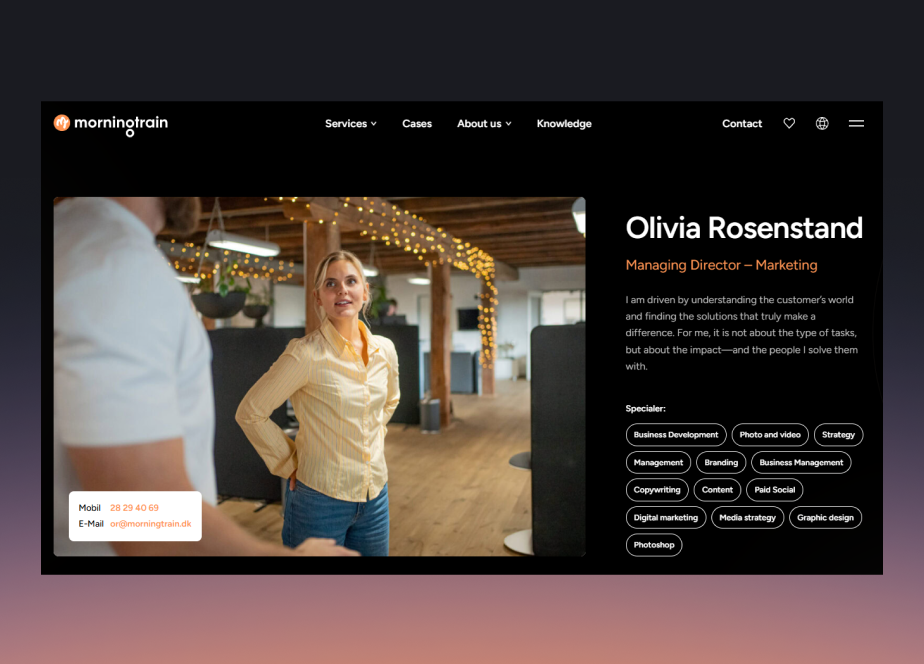
The point is not to fill every page with portraits; the point is to use people where they can reduce uncertainty in the buying journey, and where their concrete experience or expertise strengthens the credibility of the content.
Try it yourself
Find the places on the website where you ask the visitor to get in touch, book a meeting, or send an enquiry. Is it clear who will meet them on the other side, and why the customer can trust their expertise in particular?
4. Make the page easy to scan
There is a difference between information being on the page and the visitor actually finding it.
Long blocks of text, many equally weighted messages, and a lack of visual breaks can make even good content heavy to get through. And you cannot assume the visitor starts at the top and reads every single word.
So make it easy to scan your way to what is relevant.
Use descriptive headings, break up longer text, and make sure one section is not trying to say five things at once. A heading like “Benefits”, for example, helps less than a heading that already tells the reader what the most important benefit is.
That does not mean all pages have to be short. A complex B2B solution can easily require a lot of information. But the visitor should be able to choose where it makes sense to go deeper.
Try it yourself
Give yourself ten seconds on one of your most important pages. What do you manage to understand? If the main message only becomes clear once you have read everything, the page demands too much from the visitor.

Written by





Do not hesitate – we are always ready for a chat
Let’s have a chat about your digital project
Let’s go into detail so we can find solutions together that match your needs.