


AI
3. July 2025
Structured data for AI Overviews
If you want to increase your chances of being featured in AI Overviews, we recommend starting by implementing structured data for your FAQ sections, how-to guides, articles, product pages, and information about your organisation or author. Read more about structured data and AI Overviews rankings in the post here.

Content
What is structured data What is AI Overviews What does it do Examples on mark-up Implementation FAQWhat is structured data?
Structured data is a way to tell search engines and AI exactly what is what on your website. It is a piece of code – typically written in JSON-LD – that enables machines to understand the content’s structure and purpose.
FYI: Structured data is also known as “Schema markup”
Although it is not something your visitors see on the page itself, it plays an important role behind the scenes. It helps search engines interpret your content correctly—and it can make a real difference to how you appear in search results and various AI-generated answers—and therefore also if you want to rank in Google AI Overviews.
Examples of things you can tell AI models with structured data:
- Here is a recipe
- Here is an FAQ
- Here is a product with price and stock status
- Here is the author – and yes, they actually know something about the topic
What are AI Overviews—and what does structured data have to do with it?
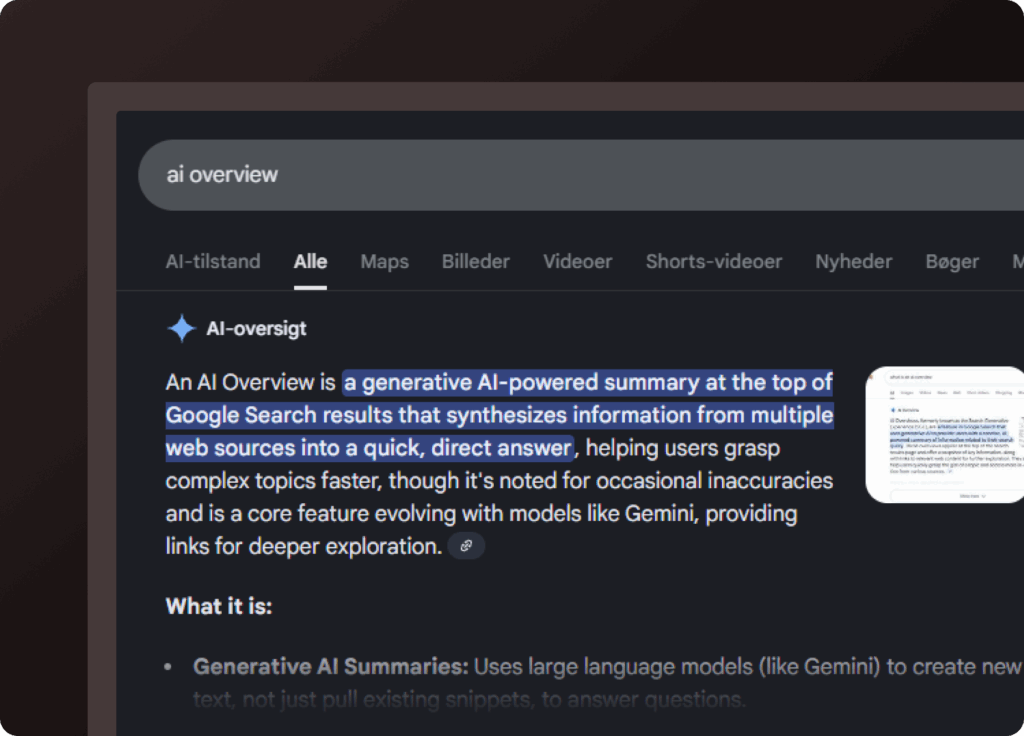
Google AI Overviews is the new way Google displays answers. You may have already seen them: At the top of the search results, an AI-generated answer appears with links to sources.

Here, Google does not rely only on classic SEO—it also uses structured data when it needs to find and understand information.
If your structure is in order, your chances of becoming part of the AI answer are much higher. Not a guarantee—but a major advantage.
👉 Read and understand what Google AI Overviews are here
How does structured data help you in practice?
It makes your content easier for algorithms to read and easier to select as a trustworthy source. For example, it can:
- Improve your chances of being mentioned in AI Overviews
- Give you Rich Snippets in search results (e.g., stars, FAQs, recipes, etc.)
- Increase click-through rate because your listing takes up more space and provides more information
- Create better context around your content types (e.g., guides, videos, or product data)
It is not about “cheating” your way to anything. It is about helping machines understand you – on your terms.
Examples of structured data that works well with AI
You do not need to mark up everything. Start with what makes sense for your site:
| Type of structured data | Why it works well with AI |
|---|---|
| FAQ markup | Provides clear, concrete answers that AI can easily use in overviews |
| How-to markup | Step-by-step format is easy for AI to understand and reproduce |
| Article & author data | Supports credibility and authority (E-E-A-T) |
| Product markup | Shows key information such as price, stock status, and reviews |
| Video and image | Complements text content and makes it more complete for AI |
Google itself has a pretty good overview here but feel free to ask us if you do not feel like digging.

How do you implement it?
You have several options:
- CMS plugins – If, for example, you use WordPress, plugins such as RankMath or Yoast can help you get started
- Manually – You (or your developer) can add JSON-LD directly into the header
- Templates – Use, for example, schema.org as a base
- Check it – Use Google Rich Results Test or Schema Markup Validator to validate your setup
And remember: This is not a “set it and forget it” exercise. New pages = new markup.
Best practice:
- Start with what is most relevant – FAQs, articles, products
- Keep it updated – if you change content, the markup must change too
- Keep it simple -you do not need to mark up everything under the sun
- Avoid spam – no fake prices or clickbait questions in your FAQ
- Use it strategically – think: What do I want Google to understand?
A final word on structure and the future
We do not know exactly where AI Overviews is heading. But we do know that the type of content that is easy to interpret, both for people and machines, will become more valuable.
Structured data is a way to prepare. Not with panic, but with calm and consideration.
It is a bit like tidying up the garage. Annoying right now. Worth its weight in gold when you need to find something.
FAQ: Structured data and AI
<strong>Er struktureret data nødvendigt for at komme med i AI Overviews?</strong>
<strong>Giver det mere trafik til min hjemmeside?</strong>
<strong>Kan jeg implementere det selv?</strong>
<strong>Er det kun vigtigt for store sites?</strong>
Is it only relevant for B2C companies