


Data insights
12. November 2021
What does KPI mean?
KPI is an abbreviation of “Key Performance Indicator”, which refers to all kinds of quantitative metrics that can be used to assess a given performance.
Content
What is it Definition Thoughts you can make What should KPIs be? Clever KPIs What do they mean to youWhat is a KPI?
KPIs are metrics set within an organisation or a team to track progress in a given department or team, and to identify what you are succeeding with and what you need to work on improving.
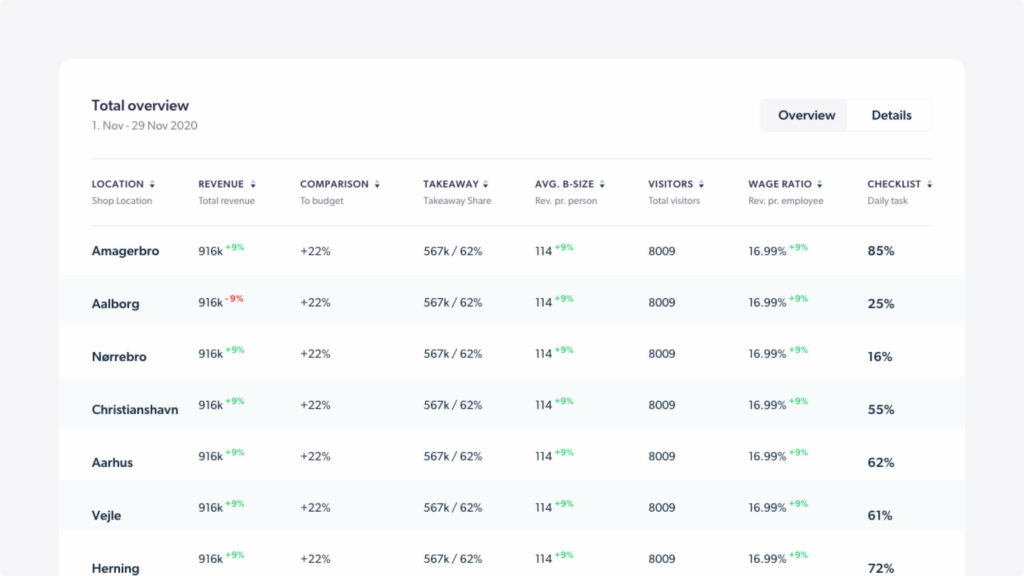
Examples of commonly used KPIs
- Sales targets
- Revenue targets
- Number of visits
- Number of enquiries/leads
- Conversion rates
- CPA (acquisition cost per lead)
- CAC (acquisition cost per customer)
- Churn rates (primarily subscription businesses)
KPI definition
In other words, a KPI is a measurable metric. A KPI must always be expressible as a quantitative value, precisely so you can accurately assess whether you have reached your goals or not.
However, it is important to remember that a KPI is an indication of performance—not the full picture. A KPI should always be considered alongside a qualitative assessment. For example, a revenue target may not be met due to illness, resignations, parental leave, the loss of a major customer, and much more. It may even be because the target was set too ambitiously.
Considerations you should make about KPIs
- What do I want to achieve?
- Who should help achieve it?
- Is it easy to measure my KPIs?
- Do my KPIs align with my employees’ work?
- Are my KPIs easy to understand for each employee?
- Do employees actually have influence over achieving the KPI?
- Do I have enough data for my KPI to be accurate?
- What do I want employees to chase?
- What negative outcomes can my KPIs have (e.g., sales targets can make people chase sales quantity instead of quality)?
- How and when do we follow up on the KPIs?
What should a KPI be?
A good leader should understand that you should select only a few overarching KPIs at a time (2–3). If you have too many metrics, you risk employees pursuing different objectives.
Next, it is important to understand that KPIs should not be set in stone. Instead, they should be selected based on the primary focus of the department or team for the coming period.
You should reconsider your KPIs 2–3 times during the year to ensure you are looking at the metrics that actually reflect the change you want to see in the organisation.
If you want to scale, and therefore scale the volume of the business, you should choose KPIs such as:
- Revenue
- Number of new customers
- Number of leads (MQL/SQL)
If you want to increase the profitability of your business, you can choose KPIs such as:
- CAC
- CPA
- Conversion rates
- Customer retention (churn rates)
Are your KPIs SMART?
When setting KPIs, you should always assess whether they use the SMART model.
- Specific -> Is the goal specifically defined? If the goal is not specific and easy to understand, it becomes difficult for each employee to pursue in a busy day-to-day.
- Measurable -> Is the goal actually measurable? Here, I am not thinking about whether you can theoretically measure the objective, but rather whether you have the technical setup and skills to easily track the KPI.
- Achievable -> Is the goal achievable? Can we even reach the goal with the resources, budgets, and timeframe allocated to achieving it? If not, the KPI will be outright demotivating for everyone involved.
- Realistic -> Is the goal realistic? You are welcome to have ambitious goals, but within a certain level of realism. If the goal is not realistic, it is more of a dream than a KPI.
- Timely -> What is the timeframe for achieving the goal? Again, is the timeframe realistic for achieving the goal? If the timeframe is too long, you risk the goal becoming too difficult for each employee to feel connected to.
What do KPIs mean for your organisation?
KPIs can serve as a shared and clear direction—if used correctly.
The most important letter in KPI is the I. REMEMBER that a KPI is merely an indication of performance or development—and even an arbitrary (random) one at that. Without a qualitative assessment of a KPI, short-term and potentially outright incorrect decisions may be made.
But because KPIs are easy to understand and relate to, they can quickly become a crutch for management, where all organisational decisions are based on what the quantitative metrics (KPIs) show.
Instead of viewing a KPI in binary terms—did we reach the goal, yes or no—they should open up qualitative questions:
- What was the reason we reached our goal?
- Can employees realistically influence the goal?
- Why did the salesperson not reach their goal?
- Is the person okay?
- Does he/she have the best conditions to succeed?
- Were there external factors that played a role?
- Were there societal developments that had an impact?
- Was there something internal that affected a given KPI?
And many more…
The qualitative answers should be the decisive factor when decisions are made—not the quantitative metrics; those should instead serve as indicators of what you should look into further.