

Lead generation
24. November 2021
What are leads?
A lead is a term for a person who has shown interest in a company and, in one way or another, has expressed that interest—for example, by calling the company.
Content
Brief description What is lead generation MQL vs. SQL Conversion events B2B vs. B2C MQL strategies Leadgen. toolsWhat is lead generation?
The term “lead generation” refers to activities that can increase the number of relevant people (leads) who contact a company.
In lead-generating companies, enquiries are often referred to as “conversions”, as a person has been converted from a “website visitor” to a “potential customer”. From there, the person can be converted again from a “lead” to a “customer”.
The many different terms within lead generation cover lead tracking, lead qualification, lead scoring, as well as how far along the person is in the buyer journey and how the lead should be nurtured.
What is the difference between MQL and SQL?
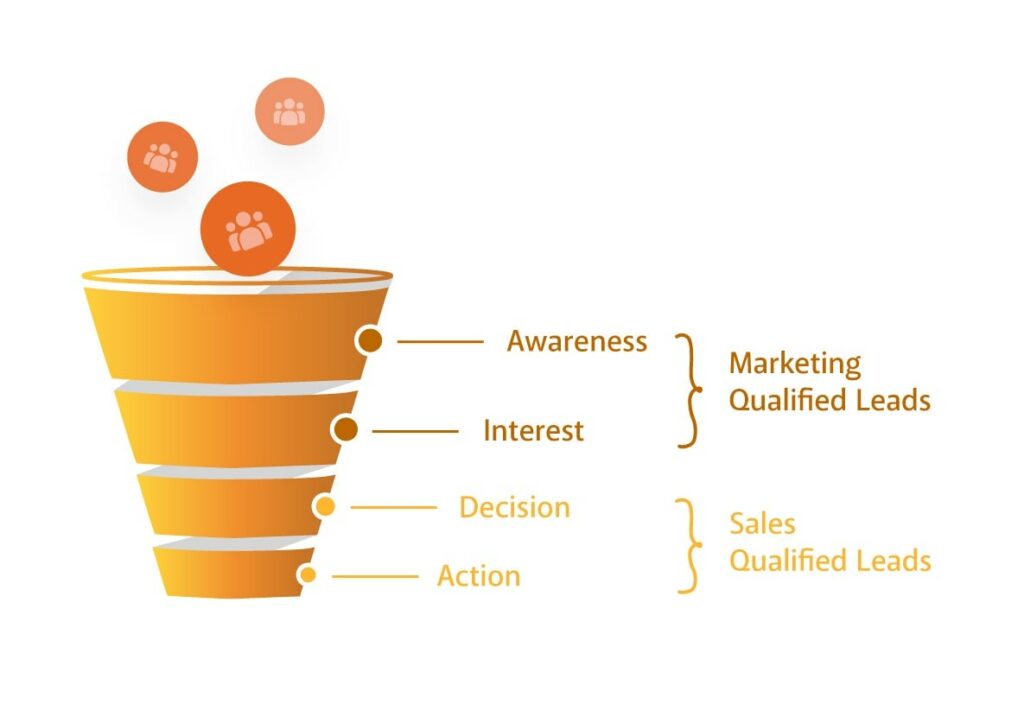
MQL is an abbreviation for Marketing Qualified Lead, and SQL is an abbreviation for Sales Qualified Lead. The difference between the two is how far the person who performed the given converting action is in their decision-making process.
Depending on how far along the person or the lead is in their decision, the lead should be handled differently.
An MQL is not far along in their decision-making process, and therefore you should “only” nurture them through various marketing initiatives—hence the name marketing qualified leads. In other words, they are ready to be nurtured through marketing.
For example, you can do this by sending them email content, white papers, guides, or exposing them to retargeting campaigns.
An SQL, on the other hand, is a qualified lead that is ready to be handled by someone in a sales role (SALES qualified lead – got it? 😉).
With an SQL, you are dealing with a person who is further along in their decision-making process, and the person is ready to be helped towards a purchase decision by someone from sales.
Read more about MQLs here.
The conversion event makes all the difference
Based on the definition above, we can conclude that the difference between an MQL and an SQL is most often which conversion event a person has completed. If a person has contacted you, it is an SQL. But if the person has downloaded an e-book, white paper, or signed up for your newsletter, it is an MQL.
Examples of conversion events for MQL and SQL, respectively
MQL:
- Newsletter subscription
- Download of white papers
- Download of an e-book
- Webinar attendance
- The person has watched x% of some video content
SQL:
- Phone call
- Contact form submissions
- Emails to sales
- Demo booking
- Free analysis or assessment requested
What is the difference between B2B and B2C leads?
The biggest difference between B2B and B2C leads is the length and complexity of the solution and the decision-making process.
In business-to-business, larger and more complex solutions are typically sold to a number of stakeholders, and you are often only in dialogue with a small number of them. In B2C lead generation, the decision-maker and end consumer are most often the same person.
Because B2B solutions are typically on a significantly larger scale than B2C solutions, B2B leads are potentially far more valuable than a B2C lead. The higher lead value makes it commercially viable to allocate more resources and budgets to generating more B2B leads.
In addition to higher lead value and increased complexity, B2B companies operate with smaller and more specific target audiences than B2C companies do.
Therefore, B2B companies typically have more conversion actions that can be taken on their website, so there is a conversion action that makes the visitor ready to convert on that specific company’s website.
The rules of the game are very different: B2C lead generation is about achieving volume in the number of enquiries, whereas B2B lead generation is about hooking the few relevant leads.
MQL strategies are B2B lead generation’s loaded weapon.
It is rare for B2C companies to try to generate MQLs, as the value of each lead is typically too low to justify spending a long time nurturing these lukewarm leads. The volume of SQLs in the B2C industry is often so large that it is better business to focus only on handling the enquiries that are ready to buy.
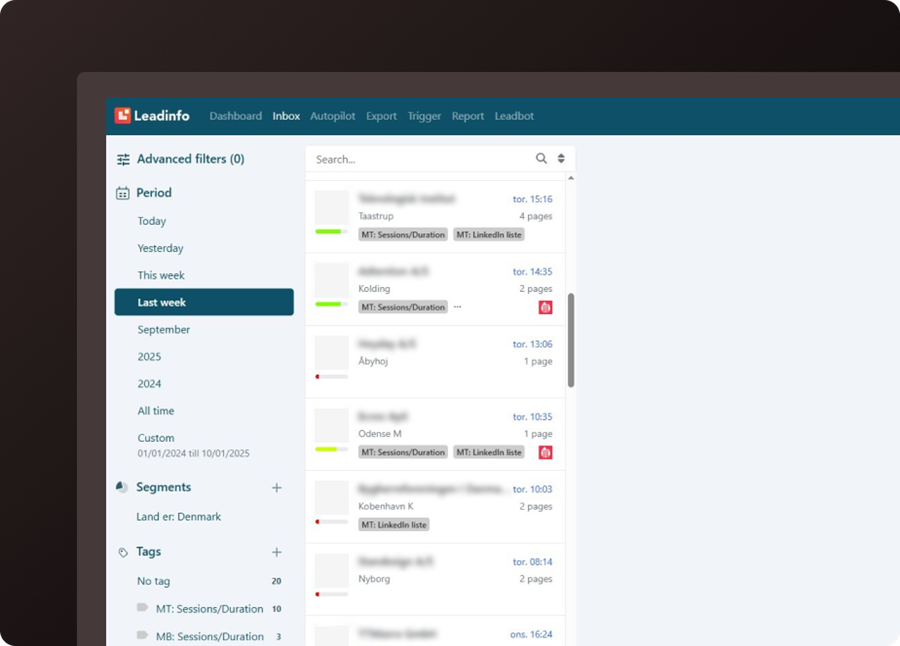
MQL strategies are therefore a popular methodology in B2B lead generation, to give a sales department as much to work with as possible. This may be necessary in a B2B case where you serve a niche market, to work with lead qualification through, for example, lead scoring.
In addition, there are the high lead values in the B2B industry. When an average customer is worth several hundred thousand kroner, it can be worthwhile to hook potential customers as early as possible in their decision-making process, in order to nurture and educate them to make the right decision—even if you need to nurture them for 6–12 months before they are ready to decide.
Lead generation tools
- Lead ads on advertising platforms
You can run lead ads on platforms such as LinkedIn, Facebook, YouTube, and other social media channels. A lead ad is an ad type that does not send people to your website, but instead makes it possible to fill out a kind of contact form directly on the platform they are on. This is a popular strategy for generating more MQLs. - Inbound marketing
A strategy where you do things that make people want to contact you, as opposed to outbound marketing. This could be by writing interesting content, positioning yourself in search engine results with SEO or Google Ads, and much more. - Push marketing
A strategy where you push your message out to your target audience. You can do this via banner ads, TV, ads on social media, and much more. The strategy works best if you have something unique to offer the target audience, such as a free trial period, a no-obligation demo, or an analysis, etc. - Marketing attribution model
A method that helps you define when a specific marketing channel has generated a sale or lead. It is an important factor in assessing how the marketing budget should be distributed across the different channels. - Conversion rate optimisation on the website (CRO)
An initiative where you implement more calls to action (CTAs) and possibly several different types of conversion actions. In addition, you can generally work with conversion rate optimisation by improving the user journey and the overall website experience.