


Lead generation
22. March 2022
What is conversion rate optimization?
Conversion rate optimization (CRO) is a process that increases the likelihood that your visitors will complete a conversion. This could, for example, be signing up for a newsletter, filling out a contact form, making a purchase in the webshop, or clicking a CTA button when they visit your website.

Description of conversion rate optimization
It is a marketing effort focused on getting more out of your website traffic by improving the user experience (UX).
It is based on your data to improve your website’s ability to get visitors to take a desired action. The process involves first observing visitor behavior on the site and analyzing the data; then you formulate hypotheses about what can be improved and test whether your assumptions are correct.
Conversion rate optimization is often abbreviated to CRO, which stands for Conversion Rate Optimization.
For your website to perform at its best, it must be maintained and optimized like any other machine. That is why you work with conversion rate optimization.
Read about average conversion rates by industry here.
How does conversion rate optimization work?
Conversion rate optimization works by using your analysis and assumptions to redesign and change specific elements to increase the chances that your visitors convert into leads or customers before they leave the website.
Changes may include, for example, changing the color of the button you want visitors to click, making your USPs more visible, or adding a direct link from the homepage to the most visited page.

It could also be adding a pop-up banner explaining how to sign up for a newsletter. In other words, there is no single optimization you must implement; it depends specifically on your website, your goals, and your customers’ behavior.

The most important thing to understand when doing conversion rate optimization is how your visitors use your website and therefore how you optimize their user experience so they can more easily find what they are looking for.
A typical place to start is to check whether your website is optimized for both desktop and mobile. A feature that works extremely well on desktop may be very small and unusable on a mobile device. Similarly, visitors may use your website differently on mobile than on desktop. Could it therefore be more optimal to have a different homepage when the site is accessed from mobile?
Calculating conversion rate
To measure your conversion rate optimization, you calculate your conversion rate by dividing the number of conversions achieved by the number of visitors.
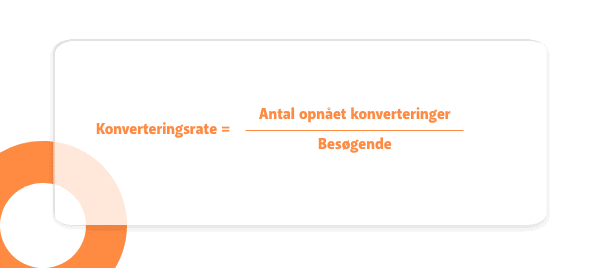
Once you have found your conversion rate, you can start setting goals and optimizing your conversions.
It is important to remember that conversion rate optimization is not about getting as many people as possible to convert, but rather converting as many of the right users as possible. There is no value in converting a lot of visitors if they are not relevant to your business.
An example of this could be a B2B company that offers product samples in exchange for signing up for their newsletter. This initiative has a good chance of increasing their conversion rate, but it may also add many B2C customers to their database who most likely will not convert into customers. Therefore, a high conversion rate from visitor to lead is not the same as a good conversion rate from lead to customer.
Yes, here it is again…
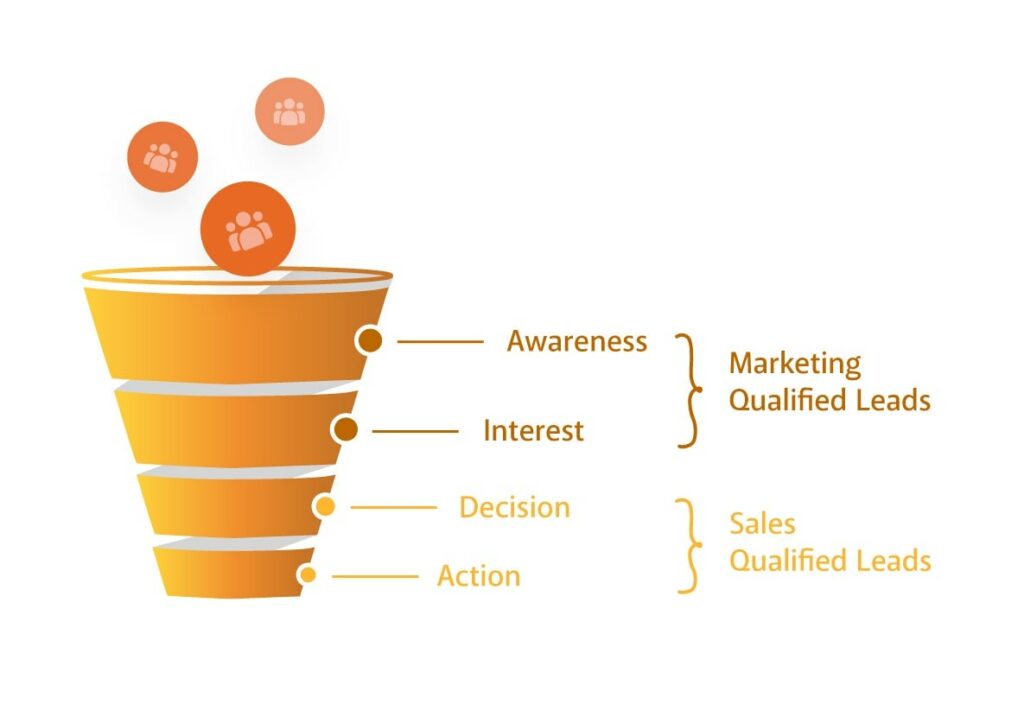
Conversion rate optimization exists at multiple levels of the funnel. First, we need to convert website traffic into leads. If you work with MQLs, they must also be converted into sales-qualified leads and from there, they must be converted into customers.
You can and should work with CRO at all levels.
How do you optimize your conversion rate?
There are many ways to get started with conversion rate optimization. Here is a method built around 5 steps to get the process off to a strong start:
- Step 1: Set one or more goals for the optimization process what do you want to achieve?
- Step 2: Collect relevant data about what you want to optimize and create a basis for comparison.
- Step 3: Analyze the data and identify trends.
- Step 4: Formulate hypotheses for how you can optimize the identified trends.
- Step 5: Test your assumptions. For example, it is beneficial to run split tests to compare visitor behavior.
By following the 5 steps above, you can quickly get started optimizing your conversions—then it is simply a matter of testing your assumptions.
Tools for conversion rate optimization
Before you get started, you need some tools to help you analyze and optimize. There are several different tools available that you can choose from.
Tools for measuring traffic and behavior on your website
Hvilket tracking værktøj skal du vælge?
Testing tools
Tools for heatmaps and user recordings (used to gather large amounts of insights)
Tools for collecting user feedback