


Content
25. January 2022
What is a USP?
USP is an abbreviation of Unique Selling Proposition, which refers to the unique value a product, company, service, or brand can offer its customers/users. USPs are most often used in sales and marketing activities as a tool to simplify and clarify what you, as a customer, get out of the product/service.
Why use USPs?
You may know USPs from websites and online shops, where they are listed at the top of the homepage. The USPs are placed at the top precisely to quickly describe the value attributed to potential customers if they choose to become customers.
It is an effective way to communicate with your website visitors so they understand as quickly as possible “what’s in it for me?”

Why should I care?
When all is said and done, what your customers buy from you is, in reality, the value you provide them whether it is the status they feel they gain from buying a consumer product, process optimisation, or increased revenue. It all comes down to “what’s in it for me?”.
So when you have visitors on your website/shop, users put themselves first (just as you do when you are a customer), and they try to decode whether you can provide them with the value they are looking for.
This is where USPs come into play…
With the right USPs, you can quickly and precisely explain to your target audience the value they get from you, instead of them having to figure it out from all your content.
Just consider the following:
- When you are buying a product yourself, would you rather read 2,500 words on a website to understand whether it is the right product and supplier for you?
- Or would you rather read 3–5 bullet points that can quickly clarify the same thing for you.
How to create good USPs
1. Let customers define them
Good USPs are communicated from the customer’s perspective and are based on customer feedback about the value they experience from the product. You can identify your USPs by talking to customers about the product/service, or by getting feedback from the sales or customer service department.
Keep in mind: you may think you provide a certain kind of value, but ultimately customers know the real value you offer them.
2. Communicate them clearly
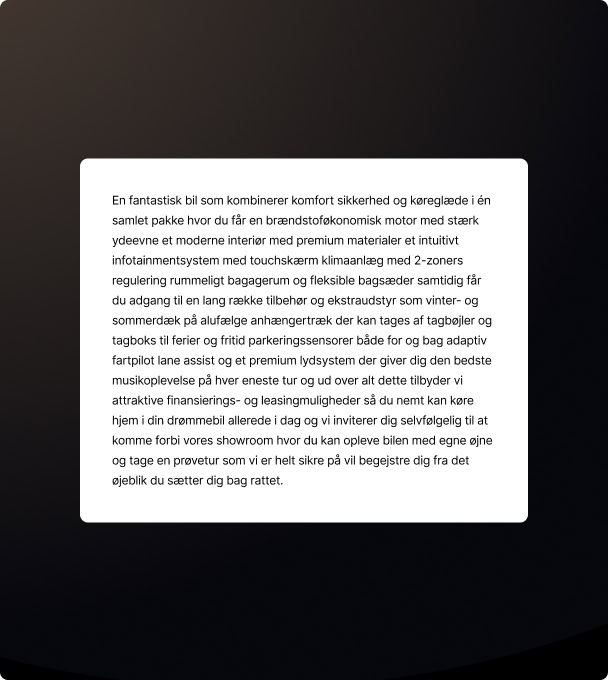
USPs are meant to simplify the value creation you offer, with the aim of selling a product to more customers. Therefore, they must be communicated in a way that customers actually understand.
It is more important that your USPs are understandable than that they sound clever, like something pulled from a CBS textbook.
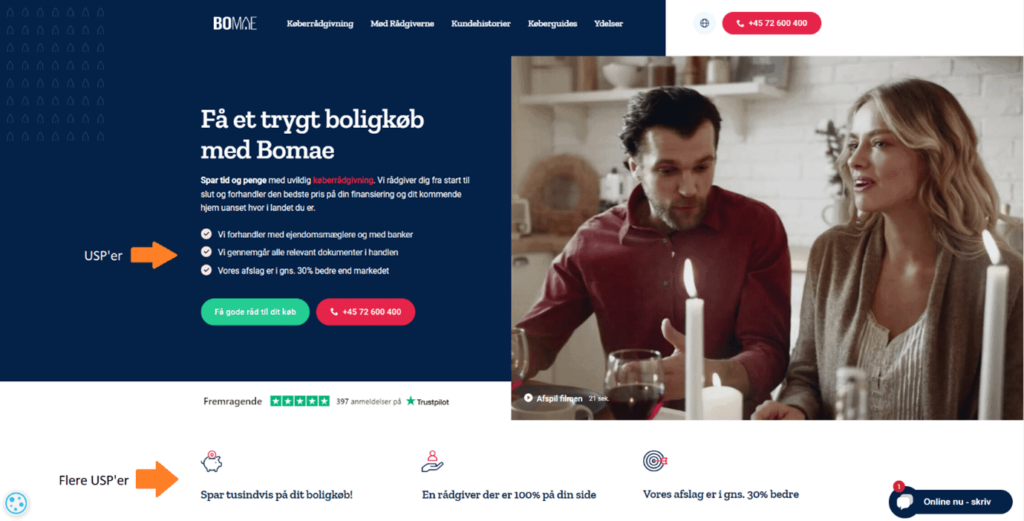
In other words, you should phrase them briefly and precisely, in a way that gives the visitor a clear picture of the value. Numbers and percentages can be effective in a USP because they provide a context/framework the user can relate to.
Example:
- “Our discount is on average 30% better than the market”
3. Define different USPs
Your customers will have different focus areas in terms of the value they want to receive. Therefore, I recommend having 3–4 USPs that cover different parts of the value you/we offer.
Consider the following:
- Are there financial savings?
- Are there time savings?
- Do you provide reassurance? For example, legal certainty or GDPR compliance?
- Do your customers rate you highly?
USPs at product and company level
You should differentiate between your USPs at product level and company level.
I apologise in advance that the examples will be a strange jumble of B2C and B2B examples.
Product USP examples
Your product-specific USPs should describe “why buy this product”. In other words, your product USPs should help the user understand what they get out of this specific product:
- “Smoother skin”
- “14% fewer sick leaves”
- “25% time saved”
You can also choose to use your product USPs to guide the user in your product catalogue. That is, you can create USPs that tell the user which products they should choose in which situations:
- “Good for dry and irritated skin”
- “For scanning food products”
- “Effective on rough surfaces”
Company USP examples
At company level, your USPs should tell the user what they get out of doing business with YOU specifically. In other words, you should shift the focus away from the product you offer and instead place the emphasis on you as the supplier.
- “Support in 17 languages”
- “Next-day delivery”
- “50 years of experience”
- “4.8 TrustScore on Trustpilot”
Notice what happens when we communicate the company’s USPs on the homepage and product USPs on the product/service pages. Suddenly, you are communicating to your customers:
- You get help choosing the right product.
- You know what value the product provides you.
- and you know the benefits of buying the product from this supplier.