


Lead generation
20. November 2023
What is SEO?
SEO or search engine optimization is a marketing method that helps make your website more visible across different search engines, including Google and Bing. Search engine optimization is about increasing your website’s traffic through organic search results and, ideally, achieving a top position on Google.

Content
Short description Ranking factors Why SEO is important Benefits of SEO SEO analysis Your potential with SEOIt is considered a major part of your inbound marketing, and the primary goal is to drive traffic to your website. Search engine optimization is a long-term marketing method with more influencing elements than the term itself suggests. That is why search engine optimization is not something you can “just do” overnight.
What does SEO mean?
It is simply the abbreviation of the English term Search Engine Optimization (søgemaskineoptimering in Danish).
So, to avoid further confusion, search engine optimization will be referred to as SEO throughout this blog post.
I hope you are ready to dive a little deeper into what it means to do SEO, because it is truly a great thing for you if you want to compete with your biggest competitors. So, if you have become a bit more curious, read on.
To fully understand SEO, you first need to understand what a search engine is.
What are Google’s ranking factors?
When Google needs to find something on the internet, it has hundreds if not thousands of parameters (ranking factors) in its algorithm that it scans through to find the content that is most relevant to the specific user who has made a particular search.
Here are some of the most important ranking factors Google uses to evaluate different websites, broken down into categories:
- Domain factors: Domain age and history, keywords in the domain name, which ccTLD it uses (is it .dk, .com, or something else), etc.
- On-page content factors: Keywords (in the title tag, page headings, in the text, and in the URL), content creation, images, links (both to your pages and to other websites).
- Website (and business) credibility: “Contact us” details that match your local business schema and other places online (such as Google My Business or social media), user reviews (on the site, on Google, and on other sites such as Trustpilot), physical address.
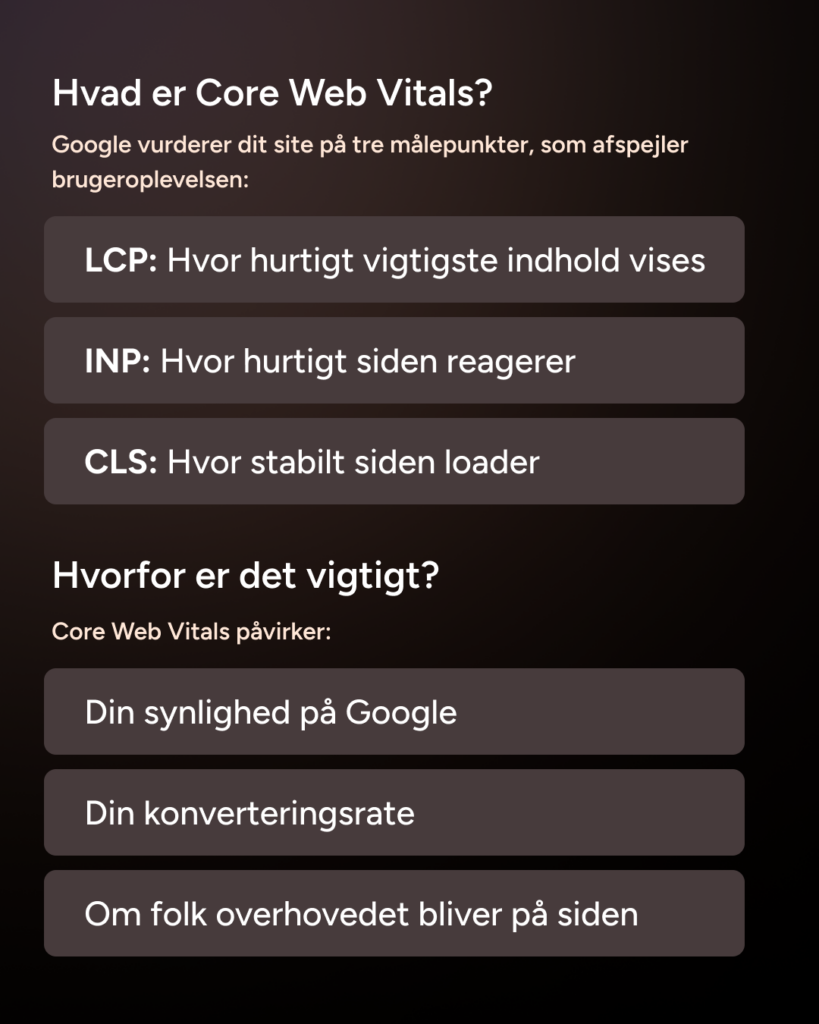
- Technical factors: Structured data (local business or organization schema as the most important), core web vitals (how user-friendly your website is—mostly related to speed), mobile optimized (how your website looks on a mobile screen), sitemap, SSL certificate (do you have https in your website’s URL), website architecture (navigation and how all pages are linked together).
- Domain authority factors: Backlinks (links from other websites) and their anchor text, the PageRank of the website linking to you, and how relevant it is to your topic, link type (dofollow or nofollow), where links are placed on the website, etc.
- User engagement: CTR in SERPs, amount of direct traffic (people who type your website address directly into the browser), dwell time (how long a user stays on your page after finding you in the SERPs).
- Brand awareness signals: How popular your business is on different social media platforms (do you have profiles, how many likes do you have, and is your content engaging), brand name searches, brand mentions.
In other words: It is a complex algorithm. But all it really asks of you is to be relevant to your searchers and help them with a good user experience and content that is easy to understand.
Why is SEO important?
There are many potential customers and sales to be gained by outranking your competitors on Google.
Search engine optimization is one of the strongest marketing channels you, as a business, can use.
The internet is here to stay, and that creates major marketing opportunities. And when I say major opportunities, I mean enormous ones, because every second 40,000 searches are made on Google. This gives you the opportunity to claim a slice of that huge pie, with help from SEO, among other things.
The impact of improved search engine rankings is measurable, and over time the investment will most often pay for itself several times over.
Hvad er forskellen på kanalerne (SEO, Google Ads & Social)?
Vælg kanal nedenfor og læs mere om hvad de forskellige kanaler er, og hvad de er gode til.
SEO
SEO is an abbreviation of ‘Search Engine Optimization’, a term that covers all the efforts you can make to rank higher in search engine results without having to pay for the traffic it generates.
Advantages:
- An effective tool for supporting lead generation
- Good for top-of-funnel thought leadership initiatives
- You meet and influence the target audience throughout their entire buying journey
Disadvantages:
- Rankings can take a long time
- Mastering SEO requires many different technical skills
Google Ads (search ads)
Google Ads is paid advertising on Google’s search engines and search network. Most people who refer to Google Ads are thinking of search ads, which are the text ads you see in Google’s search results.
Advantages
- Can generate results almost from “day 1”
- You get many data points to optimize from
Disadvantages:
- A technically challenging exercise
- You can easily burn through a lot of money if you do not know what you are doing
Paid Social
Paid social refers to working with paid advertising on social media, or “SoMe”, as some call it.
These can be channels such as Facebook, LinkedIn, YouTube, Instagram, etc.
Advantages:
- You can target audiences based on demographic data
- You can reach people with visual elements such as graphics, images, and video—not just text
- You can reach a broader audience because you are not limited to what people have searched for in a search engine
Disadvantages:
- The target audiences receive your message at a time when they (perhaps) did not ask for it
- You compete for the target audience’s attention with many other messages.
What are the benefits of SEO?
The biggest benefit of ranking for a specific keyword is that you can get “free” traffic to your website month after month.
One of the biggest differences between SEO and other marketing opportunities is that SEO is more effective in the long term than other channels.
When you choose to turn off your email campaign, stop posting on social media, or pause your ads, you also lose your connection to your audience.
If your website is optimized and has a strong ranking, you can relax and put SEO work on the shelf for a while. Customers will still be there, because you are available and visible on Google.
How do I do an SEO analysis?
You have 2 options:
- Have an SEO specialist do it for you.
- Or jump in and do it yourself (do not worry I will help you get started)
When you do your analysis, keep the ranking metrics in mind:
- Trust in the domain
- The content on your website (language, quality, length, keywords)
- Your website’s credibility
- Technical factors (speed, sitemap, structured data, SSL, and much more)
- The website’s link profile
- User engagement (click-through rates, direct traffic, dwell time, etc.).
- Brand awareness signals

Option one may be more expensive, but it will be fast, and you will get an SEO strategy that focuses on the specific weak points on your website that will deliver the best results.
If you do it yourself, you should always consider that any lack of experience may lead you to make changes to your website that may not have much impact on your search engine rankings.
That said, here is what you should do if you still want to do the analysis on your own.
Step 1. What are you trying to sell?
Start by making a short list of keywords you want to show up for (start with 5–10 keywords) this is usually your product or service in short, what you are trying to sell or make money from.
Keep this list short and specific. Think of the words your customers might search for right before they order a product or service these are called purchase-intent keywords. Here is an example: “cheap plumber hillerød”, “flower delivery aarhus”, “dyson hair dryer offer”, etc. Note that “flowers” or “hair dryer” is not a keyword we are interested in. They would be too general and would not match our target audience.
Step 2. Check what ranking your business has when you search for your selected keywords
Open a browser (preferably in incognito mode). Enter your keywords one by one and see where your business appears.
The results you get here are not very accurate, because you can still get personalized results based on your location and search history. If you want accurate data on your rankings, you need an SEO tool.
The cheapest and most accurate option for this is Google Search Console, but it is also very technical and takes time to learn in order to interpret the data correctly. Alternatively, you can use a keyword research tool.
This will give you an idea of how much work needs to be done on your website.

Step 3. What do you want to achieve?
When you review the results for the keywords on your list, note the competitors shown above you. Those that appear in the top 3 positions are usually doing something right in Google’s eyes and can give you an idea of how to approach your own website.
- Make a short list of these competitors and check their websites.
- How are they different from you? How do they present their business and product? How can their customers get in touch with them? What results do you get when you Google their brand? How different are the results from your own brand?
This competitor analysis will give you ideas for improving your website’s content.
The next step is then to check your website’s health.
Step 4. Is your website healthy?
Analyzing on-page health is about finding UX improvement opportunities on your website.
Here, we focus mainly on the technical SEO elements, for example:
- broken links (both internal and external)
- broken images, missing alt text, or images that are too large in file size
- thin content
- multiple H1 tags or missing H2 and H3 tags,
- missing title tag
- URLs that are too long
- missing sitemap
- missing SSL
- page load speed that is too slow
- etc.
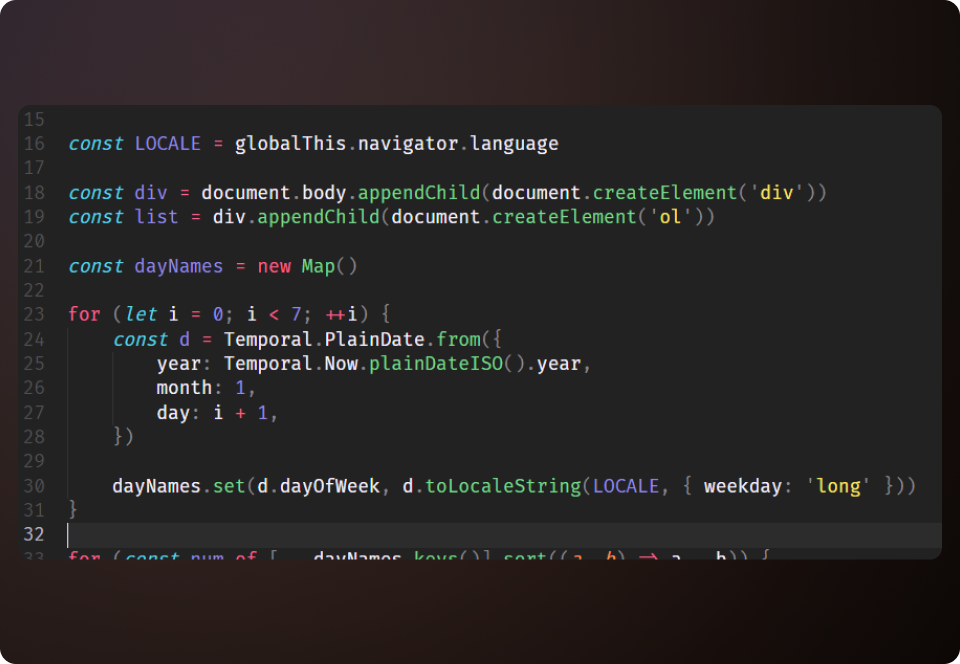
There is no easy way around this—the simplest way to do it is by using a tool. You need fairly extensive technical knowledge of web development and SEO to do it without a tool.
Once you have completed these 4 steps, you should hopefully have a good idea of where your website’s weak points are.
How do you find out how much your business can benefit from SEO?
For most businesses, SEO will be one of the most important online marketing tools, but it varies from business to business how effective SEO is, or how much you need to invest in it to achieve a favorable result. There will also be situations where SEO is not the right solution for example, when the competition is simply too strong or when your target audience is too small.
However, there is a simple way to get an idea of whether SEO is the right choice for you and your business.
Step 1: Estimate the size of your market
Go back to the list of your keywords from the SEO analysis.
Use a keyword research tool to find out how much monthly search volume each of your keywords has. These are all the potential customers looking for the products or services your business offers.
Step 2: Estimate your share of the market
Our estimate is that the following rankings receive the following share of the search market. In other words, you can calculate your potential visits depending on the position you achieve.
Step 3: Calculate potential customer growth
Now you have a rough idea of how many additional potential searches you could drive to your website per month if you reached page 1 for the selected keywords. You can compare this number with your current monthly visitors, which you can find if you have a Google Analytics account.
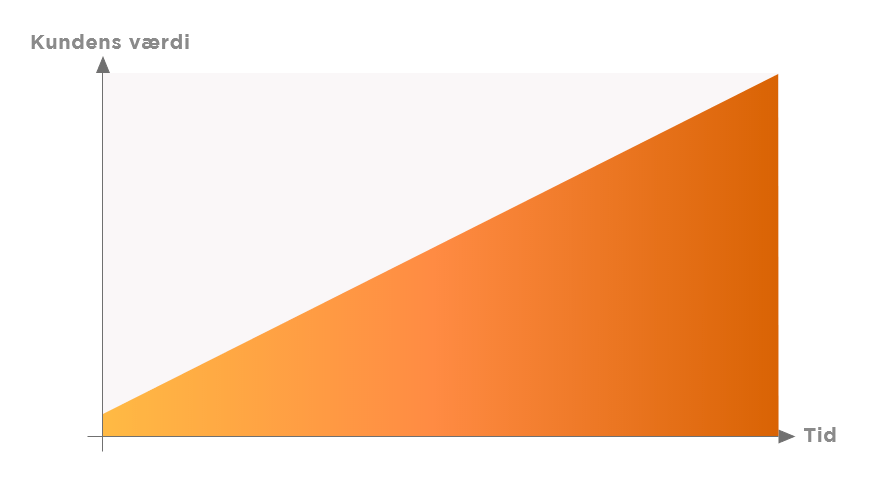
Based on this brief analysis, you can quickly determine whether SEO can add value in the form of more visitors to your business.
Once your SEO is in place, what is the next step?
Once your SEO is in place, you are a long way ahead, and most other SEO agencies will consider you to have reached the finish line. But we would like to help you go the extra mile the one that truly increases your bottom line.
SEO itself “only” ensures that you get a lot of visitors to your website. But what if your website is not particularly appealing and does not sell your services well enough?
You can compare the situation to having a shop located on Strøget in Copenhagen, but the shop is not very inviting, so all visitors leave again without buying anything.
In that case, it does not matter whether you have 100, 1,000, or 10,000 visitors daily or monthly. Some of those visitors need to become customers before the effort creates value.
That is why you need to examine the full buying experience your potential customers have on your website. If you can see that your SEO efforts are bringing in a number of visitors but you do not have many sales, you need to work with conversion rate optimization.
This means you need to optimize your website technically, visually, and functionally to increase the likelihood that your visitors convert into paying customers. This is the entire purpose of your online marketing efforts.