

Content
27. March 2017
Write for people and search engines – at the same time
I am writing this blog post to show that this is not necessarily the case. This blog post is a practical walkthrough of how, as a copywriter, you can write for both search engines and people.
Content
Introduction Checklist Keyword density Tech matters Technical factors Good content Be “linkable” Graphical material ConclusionFrom a purely SEO and online marketing perspective, many people believe that you cannot write for people and search engines at the same time that one excludes the other.
A lot has changed since 2010, when keyword density was a major part of what search engines (and, to an even greater extent, SEO professionals) focused on.
Even back then, Google was already heading down a user-first path, and today it has shifted so much that there are many parameters more important than your exact search keywords (and how many times you use them in your text).
This is not only a good thing for us humans – non-search engines – who read the text; it is also a key point from the search engines’ side and a significant upgrade from Google.
Google regularly releases new updates to its algorithms, which determine the importance of the aspects that make your link rank highly. Some of the most important updates you should know about are the Google Panda and Google Penguin updates.
I will return to these later in this blog post, but I can already reveal that the updates have changed the SEO game for good. They have taught us that SEO is never constant on the contrary, it is dynamic and always evolving.
The best SEO performance today may be outdated tomorrow.
Read about how to create the best texts for Google AI Overview here.
Remember that…
1. Keyword density is no longer everything.
2. Technical SEO work (URL, Alt tags, title tags and meta descriptions) is important for Google’s understanding.
3. On-site metrics are becoming increasingly important.
4. Think content, content, content it is the search engines’ foundation and goal to showcase the gold.
5. Make your page linkable.
6. Use visual assets.
1. Keyword density is no longer everything
There was a time when it was more or less enough to drop your keywords in as many times as possible (sometimes so many times that it hurt readability) to achieve a high ranking on Google.
That is no longer the case. Today, many other aspects also matter primarily the aspects I outline in the next points.
That is not to say your keywords are not important, it is just no longer keywords that are king. You can read more about that in the link.
Essentially, Google rolls out hundreds of major and minor updates every year to ensure that you, as a customer, find content that is relevant to you. In other words, these are updates designed to make Google even better at ranking the best content for users highest.
The updates are not gigantic, but together they create a path of changes across the more than 200 factors that Google includes in its search algorithm.
2. Technical SEO work is still important
If you are not fully familiar with the various SEO techniques, it may sound silly, but the technical qualities within SEO are very important to remember and to have under control if you want to stay on good terms with the search engines.
Therefore, you (or a knowledgeable ally) should familiarise yourself with these areas when building a blog, webshop, or standard website.
“Technical” covers, in our terms, everything that is not directly text, graphics, or link building. “Technical” is typically small snippets of HTML that make it easier for Google (and ideally your users as well) to understand a website.
Google does not understand images in beautiful colours, it needs data inputs for that.
Technical SEO factors
Internal links
Internal links are hyperlinks that point to the same domain the link exists on i.e., a link that sends the reader to another page on the website than the one the user is currently on.
A good example is the references I make to our previous blog posts further down in this post.
Internal links are useful for several reasons for both search engines and your visitors:
– They guide your visitors easily and quickly through your website.
– They establish an information hierarchy for the given website.
– And they improve your ranking power compared to other websites on Google.
Your internal links can be divided into different structures, but to create as much “juice” as possible, it is a good idea to build internal links organised in a silo structure and with a clear common thread in the form of breadcrumbs.
A silo structure essentially means that on your website (or webshop) you link to the various (sub)pages and (sub)categories that exist there.
Example: See the image below, where the front page links to the subpage “Products”, which links to “Garage door”, which links on to “Garage webshop”.
This creates a path all the way down through the site. On the example website, “Products” also links to, among other things, “Sectional doors”, “High-speed doors”, and “Facade doors”, which in turn link to a number of subcategories.

Breadcrumbs – a type of internal structure that shows which main, sub-, and sub-subcategories each subpage/product on your website belongs to.
In this way, a structure is ensured where no subpages are isolated, but everything is recognised as an important part of your site.
Everything is therefore connected, and “breadcrumbs” are also in place, so the structure and thus your ability to navigate the site as a consumer (and my juice distribution) – works both ways.
Breadcrumbs allow you to retrace your steps, in true Hansel and Gretel style.
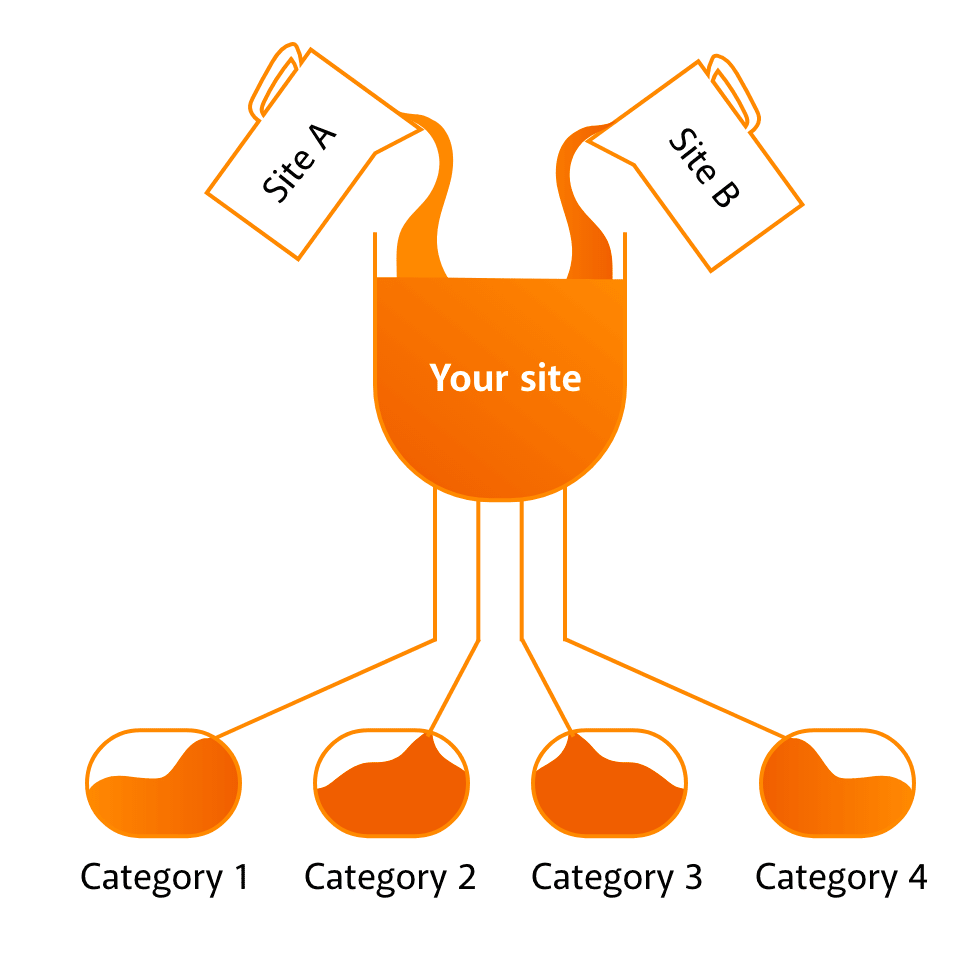
Silo structure—and illustration of link juice and how it spreads
H tags (headings)
H tags are part of your HTML structure, and put very simply, they can be described as a kind of staircase structure or hierarchical division of the content on your page; i.e., headings. It is also a way of telling Google which parts of the text belong together.
H1 is the most essential tag in terms of search engines’ understanding and is always the overall heading of the given subpage. Therefore, it is also a good idea to include your keyword here.
You can certainly add multiple H2s and H3s in a text, but there must always be only one H1.
H2 and H3 (and H4, H5, and H6) function as sub- and sub-subheadings. They should serve as a way of telling Google how your site is structured.
Contact forms, products, or similar elements can appear as H3–H4, while your heading and content/body text should be divided into H1, H2, and H3. You should use H1 to H4 tags actively and in a meaningful structure; it is not necessary to include H5 and H6.
If none of your H tags contain your keywords or semantic variations of them, Google will wonder what the page is about; if, on the other hand, they all contain your exact keyword, we are back to the discussion about keyword density.
If you are used to working in, for example, Word, you can actually use the built-in styles and headings to structure your H tags while you are in the Word document.
The “Heading 1” style functions as an H1, “Heading 2” as an H2, and so on, when you then transfer the text to your website, the headings are also transferred in hierarchical order.
In plain language, H tags are a way to structure your content with different headings and in an order that helps search engines (and your computer) understand the relevance of the content.
Alt tags
Alt tags (alternative or ALT text) are a text description you need to add to the images you use on your website.
The alt tag is the text that is displayed if the image cannot be shown for some reason.
Originally, alt tags were intended as a tool to help blind people have an image on a website “read aloud”. The machine that reads the text also reads the image aloud for those who cannot see the image properly.
In the same way, the alt tag “reads” the image to search engines so they can get the best possible information from the image. A search engine like Google still cannot “see” images, but it understands the text attached to the image and intended to explain what is happening in the image namely the alt tag.
URLs
Your pages’ URLs should support the structure you have built on the site, while also being easy to read and clear.
That is to say, a good URL is one that you, as a reader, can quickly understand. It can optionally map the route, as in SDU’s example, whereas
skips the “programming” category.
Examples of good URLs: https://morningbound.dk/system-udvikling/
or http://www.sdu.dk/om_sdu/fakulteterne/humaniora
Source: Moz
Title tags and meta descriptions
A title tag is another HTML element. The title tag specifies the name of the web page and is shown in the search engines’ results overview (in English: search engine result pages (SERPs)) as the headline you can click to enter the website.
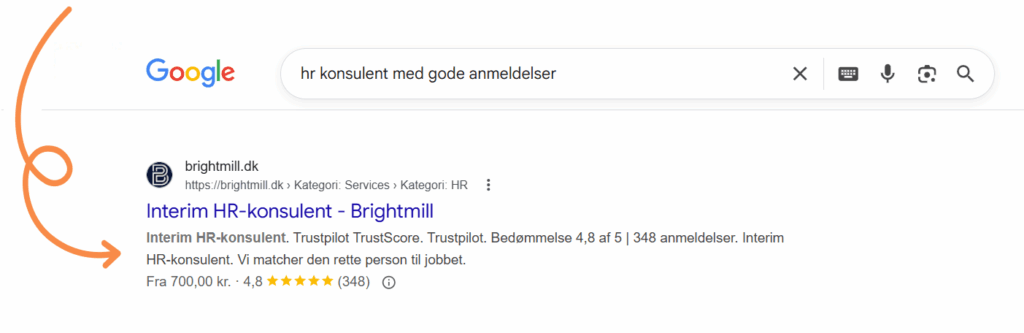
Therefore, it is important to keep in mind that your title tag should be reader-friendly and descriptive, and contain a form of your keyword your title is what indexes you on Google, so it is highly relevant to tell your potential customers (and Google) what your page is about.
Think about it: Do you click on pages with a slightly spacy headline? I believe most of us only click on the headlines and websites we know, or that answer the question we searched for.
The title tag is also the text you can see at the top of the tab in your web browser.
Just look at the headline of this blog post, for example.
Just as important as the title tag, you need a good meta description on your website.
A meta description is the description of your page that is also shown in SERPs.
See the image of Moz’s example.
The meta description should be written for your readers, it should make it clear to them where they will end up. Feel free to make it purchase-oriented (while still audience-focused), you need to make it clear to your readers that you have a product they can buy.

With both your title tag and your meta description, it is important that:
1. You hit a good length. Google typically shows 50–60 characters in a headline and 160 characters in the meta description, remember this includes spaces (to be safe, 53–55 for the title and 150–155 for the description is a good go-to; test it after a week by searching “site:dinhjemmeside.dk/sidesti” on Google. Then you can see what they display).
2. Google (and other search engines) measure in pixels, not actual characters. Therefore, you must be careful which characters you use in your title and description; “m” and “–” take up more space than, for example, a comma or an “l”.
3. Most social media platforms use the title tag and meta description when you share content from your website (tip: With both LinkedIn and Facebook ads, you have the option to edit the texts before you publish the content. And here, it is also a good idea to make an effort). Fun fact: On Facebook, the title tag is called “OG title” and the meta description “OG description”.
4. You must be careful not to use too many keywords, neither search engines nor readers find keyword overuse interesting. At the same time, the title is a ranking factor, whereas the description is “just” for the user’s benefit.
That said, four keywords in a 55-character description will not benefit you in the long run.
5. Give each of your pages a unique title. Individual titles help search engines understand that your content is valuable and unique and it increases CTR (click-through rate).
A solid title structure for a webshop could be:
[Product name] – [Product category] – [Brand name]
Use the most important keyword(s) first. Use the inverted pyramid as an example also in your SEO work: Put the most important information first.
When searching on, for example, Google, not many people spend more than a few seconds scanning through the results, so you need to capture searchers’ interest and remember to keep your target audience in mind at all times, so you actually write for them.
LSI
LSI keywords are an on-page SEO element and stand for latent semantic indexing. LSI keywords are, simply put, keywords that are closely related to words or phrases that are semantically related without being outright synonyms (although you are always welcome to add synonyms in your text – Google loves diversity!).
Do not worry it is not as complicated as it sounds.
It simply means that you need to remember to include any relevant search terms in your SEO work; i.e., words your potential customers may (also) search for.
If your potential customers search for “pizza”, for example, you should remember to include LSI keywords such as “cheese”, “pepperoni”, “delivery”, “food”, etc. to achieve better results.
In other words, terms that both your customers and Google see as related to your industry the more professional terms you can cover, the more interesting your website is, even if you have not necessarily stuffed your exact keyword in 20 times per 100 words (which we have already established you should not do).
A combination of synonyms and LSI terms therefore helps create good diversity within your niche, which benefits you, your readers, and Google a win on all fronts.
At the same time, LSI keywords contribute to an accumulated density, making it easier for you to write in an interesting language that is less keyword-stuffed.
With the help of LSI, you can mention your keywords in a more natural context, rather than having to use the same description of your product every time.
Structured data
Structured data is an element on your website that makes it easier for Google to understand who you/your business are, how your page is structured in terms of information, and which elements are important.
Adding structured data can therefore help increase your visibility and click-through rate on Google by providing information that Google can use for Rich Cards, correctly selected breadcrumbs in the search results (see the image below), etc.
Structured data can include product information, store information, contact details, and other attributes relating to people, companies, places, reviews—in other words, data about you and your business, your webshop/website, and the information you communicate.
Read more about structured data.

3. On-site metrics and bounce rate
Despite the importance of technical factors, you must also remember that it is people – and not necessarily search engines – whose attention you want to capture.
Therefore, you should also focus particularly on your page’s visual layout: graphics, text (both font and readability), external links, videos, etc.
If you have these factors under control, there is also a greater chance that your visitors will stay on your page longer, and therefore your bounce rate will be lower.
The reason Google still weights these factors is that it continues to receive larger and larger datasets through users who are logged in to Google+ (for example via Analytics, Ads, Business, Gmail, or the social network Google+) and elsewhere.
This means that Google finds it easier to measure what people actually want and evaluates its algorithms based on this.
It is not always very precise or immune to manipulation (what if I got 100 friends to “love” my site?), and therefore not the most important factor yet but if you do not include these factors in your considerations, your SEO strategy will fall apart within a few years, when the precision (we believe) will be at a significantly higher level.
Therefore, on-site metrics will become a bigger ranking factor in the future than they are today.
Long tails
If you want to speak to both search engines and the people behind the screen, you should (also) remember to keep niche topics in mind what you can translate as “broad topics”, intended to match your target audience’s interests.
Backlinko, which I link to earlier in the article, divides keywords into the Head, Body, and (Long) Tail categories.
The head keyword is the one-word keyword. There is enormous competition for these keywords, and it is not a very broad search, since you as the searcher do not elaborate on your intent with the keyword. For example, he uses the word “vitamins”.
The body keyword is two- to three-word phrases for example, “buy vitamins online”.
Long-tail keywords are the category with the least competition and the most specificity.
There is not always much traffic on these searches, but this is where you win as a business. To complete the vitamins example, the long tail could be “buy vitamin B pills online”.
Long tails are therefore specific searches that are ultimately gold to win because today we search more and more specifically on search engines, and because we typically do not want to look for very long. A long-tail keyword is therefore more purchase-oriented than a head or body keyword.
When a person searches for more specific long tails, they are often in a decision-making process where there is not far from search to sale.
Therefore, it is also an advantage to write long (relevant) sentences in your content that can answer your readers’ questions and searches naturally without the sentences being there just to be there. Write smart and win!
To make it clearer with a more relevant example within our industry, you can take the word “web design”.
Head: “web design”, body: “web design in Odense”, long tail: “price responsive web design in Odense”
4. Content, content, content
As mentioned earlier, keyword density is no longer the most important factor it is the content on your page.
In fact, the Panda update has meant that we as copywriters should try to write longer content than before in order to achieve higher rankings on Google.
Before Google released the Panda update which, by the way, is not named after the eucalyptus-eating animal, but after Google engineer Biswanath Panda it was often short content of relatively poor quality that won on Google and stayed at the top for months.
Panda changed that.
Now you need to focus much more on creating useful content—often. If you update content frequently, you score good points with Google. And even more so if your site has high-quality content in the form of long texts. Neil Patel explains more about the importance of long blog posts here.
In other words, make sure you create valuable content that is interesting to your potential readers and answers the question they are searching for. Oh, and it all needs to be readable on mobile devices.
The Panda algorithm changed the SEO world. It changed the content strategy, keyword research, and targeting aspects of SEO among other things by focusing on longer content (and long tails), with an understanding that we, as search engine users, want answers to the things (long tails) we search for.
The Penguin update, on the other hand, “punishes” those who use “spammy” or “aggressive” links that try to manipulate search engines’ ranking mechanisms for example by stuffing too many keywords into a text that is not very content-rich (note that this only applies to links from other websites; in your internal linking, you can go all out).
As a direct consequence of the two Google updates, you therefore win if you create an article or a category description on your webshop that answers exactly what your potential customers are searching for.
In other words, you should no longer write in broad strokes, but try to be more specific.
Similarly, today it is much better to create content that is as long as 1,000–2,000 words to go in depth on a specific topic, rather than writing 300–400 words as people used to both search engines and your potential readers appreciate an in-depth article more than a “superficial” one.
It is just as important to point out that Google keeps an eye on you and your website in the sense that Google takes into account how many of your visitors end up returning to your site after visiting you for the first time. Therefore, it is also important that you both keep the content on your website updated and remain dynamic in your SEO work.
Google does not, by the way, penalise AI-generated content, but POORLY developed content.
5. Make your page ‘linkable’
Here, it is particularly important that you focus on the person reading your texts.
Among other things, you need to have your landing pages under control. If your links do not lead to a page with relevant information that is useful to your visitors, they will leave more quickly.
If you do not have a proper landing page, you miss out on natural links and most likely also traffic from social media.
Denmark is not yet a particularly large market for this, but always remember to ask yourself: “Would I link to this?” then you are well on your way. Both in terms of getting others to link naturally when you seek links yourself, and when you want users to do something on your site.
In the same way, you should try to make your page linkable by creating the right angle and getting your page used as a source.
Morten Storgaard’s blog post about on-site metrics also applies here.
6. Use visual assets
When writing for both people and search engines, it is a good idea to think carefully about your choice of font and text size. Easy-to-read text delivers better on-site metrics, and Google will also assess your text as more readable.
It is also always a good idea to make your page more clear and easy to read with great visuals in the form of images, videos, and, for example, infographics to illustrate your points.
Infographics are a fantastic way to present information, statistics, and industry knowledge in a visual and clear way. In fact, the statistics show that visual content (in the form of infographics) is shared and liked three times as much as other visual material (source: Izideo).
You can easily create your own infographics on websites such as vizzlo.com and piktochart.com.

Conclusion
You can absolutely speak to search engines and people at the same time—you just need to learn to keep your target audience and technical concepts in mind while doing so.
In this blog post, you have been given a range of different approaches to embracing the two “target groups”. And you have received confirmation that one does not exclude the other.
One of the most important takeaways here is that good content should function as a concrete answer to a query – and ideally be linkable.
Ultimately, it is about making it clear to your potential customers why you, specifically, are interesting to them. And you do that, among other things, by also telling Google through all the small technical SEO factors.
It is also important to emphasise that, with the help of its many algorithms, Google also keeps an eye on how many of your visitors actually return to your site after visiting you for the first time.
Therefore, it is important that you both keep the content on your website/webshop updated and varied, and that you remain dynamic in your online marketing and SEO work.
Final point: If this post was not enough for you, I can warmly recommend this post by Holly Hartzenberg, which describes the challenge of writing for search engines and people.