


Lead generation
4. July 2025
Timeline and description of Google’s updates over the past 12 years
For all of you who have thought: “I wonder what Google’s core updates over the past 10 years have meant for SEO”, look no further. We have created a timeline of all updates from the past 10 years, including names, descriptions, and whether the update is still relevant to you. Catalogued from newest to oldest.
Content
2025 – AI Mode 2024 – AI Overviews 2024 – Explicit fake content 2023 – MUM 2022 – Helpfull content 2021 – Passage indexing 2021 – Core web vitals 2019 – Bert 2018 – Medic update 2016 – Penguin 4.0 2015 – RankBrain 2015 – Phantom 2 2013 – Hummingbird The future2026 – AI Search Update
What happened?
Google launched a new AI-powered search experience, where the search engine increasingly answers questions itself, summarizes information, and assists users directly within the search results.
Is it still relevant?
Yes — it is expected to significantly reshape SEO and digital visibility in the coming years. The focus is shifting from clicks and keywords to credibility, expertise, and branding.
Read more in the blog post here.
2025 – AI Mode (Search Labs)
What happened?
Interactive AI mode in search results, handling complex, multi-step queries with multimodal input.
Is it still relevant?
Highly current, in testing – defining the future of search behaviour.
2024 – Explicit Fake Content Update
What happened:
Targeting deepfake images/videos – removes or demotes deepfakes
Is it still relevant:
Critical for credibility and media security. So yes, very relevant.
2024 – AI Overviews (formerly SGE)
What happened?
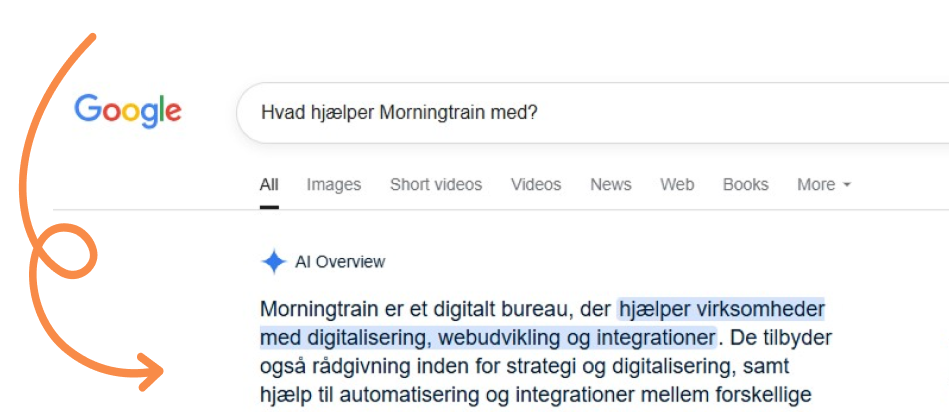
Google began showing AI-generated answers directly in the search results. The content comes from various sources, and the click-through rate on “normal” results dropped.
Is it still relevant?
It will be relevant – in a big way. It changes the game for how you get found. Structured data and semantic depth are the way in. Not keyword stuffing and clickbait.
Read “how to rank in Google AI Overviews”.
2023–24 – Spam Updates & Link Fatigue
What happened?
Google began seriously deprioritising manipulative links and affiliate sites with thin content.
Is it still relevant?
Yes. Links still work, but it is not the goldmine it used to be. Organic authority beats link spamming any day.

2023 – MUM (Multitask Unified Model)
What happened?
Google took BERT, multiplied it by 1,000, and added images, video, and contextual understanding across languages and formats.
Is it still relevant?
Yes – MUM is an important building block in Google’s AI Overviews and multimodal understanding. This means, among other things, that Google increasingly does not need your keyword – it understands what people mean.
2022 – Helpful Content Update
What happened?
Google began rewarding pages that actually help the user – and penalising content written “for SEO’s sake”.
Is it still relevant?
100%. It is a common thread in everything Google does now. If your site is not made for the user, but merely to rake in traffic for yourself, you will be disregarded.
Read “Write for your users and the search engines”.
2021 – Passage Indexing
What happened?
Google could now index parts of a page – e.g., a specific section, not just the entire article.
Is it still relevant?
Yes, especially for long guides. It means that even small sections can rank if they match a search query precisely.

2021 – Page Experience & Core Web Vitals
What happened?
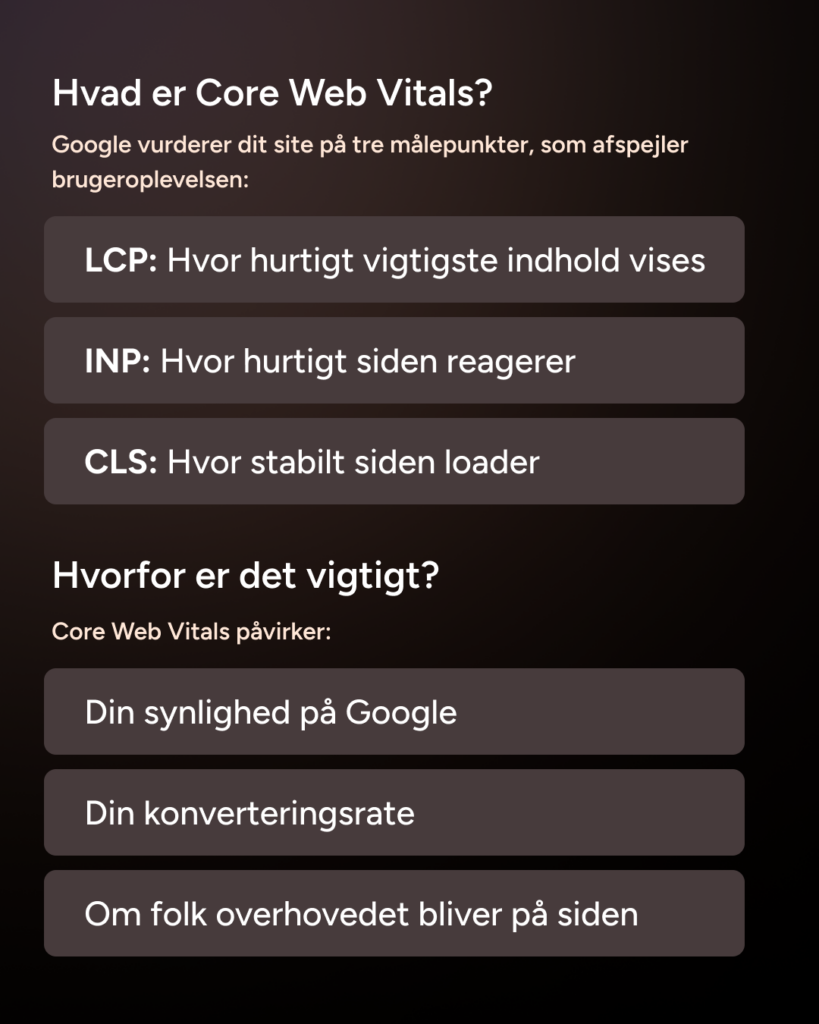
Google began taking user experience more seriously: speed, mobile-friendliness, stability, etc.
Read more about Core Web Vitals here.
Is it still relevant?
Partly. It matters, but it is not everything. Fast pages do not automatically win – but they are not ruled out due to poor performance.
2019 – BERT
What happened?
Another AI update. BERT made Google better at understanding context in sentences. For example, the difference between “bank agreement” and “agreement with the bank”.
Is it still relevant?
Yes, but it has become part of the package. You do not need to “optimise for BERT” – you simply need to write naturally and precisely.
2018 – Medic Update (E-A-T)
What happened?
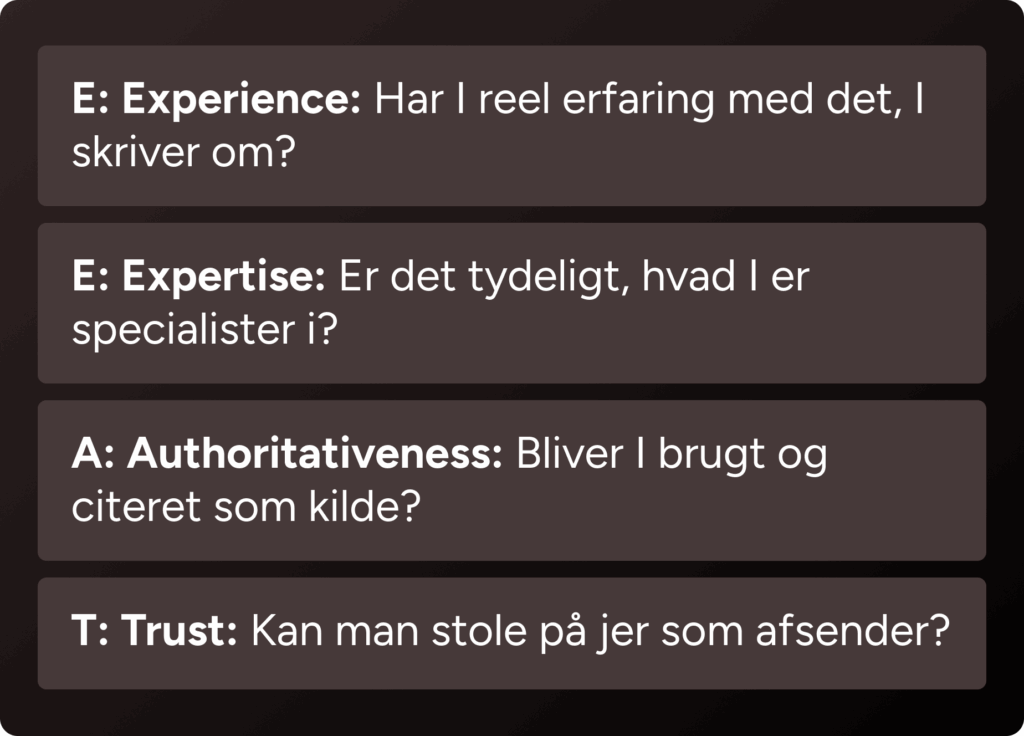
Google began placing more weight on expertise, trustworthiness, and authority – especially for health, finance, and lifestyle content (“Your Money or Your Life”).
Is it still relevant?
Yes. E-A-T has since been expanded to E-E-A-T (an extra E for experience) and applies more broadly than just medical content today. It is about: Can people trust what you say?
2016 – Penguin 4.0
What happened?
Real-time integration into the core system; filters out spam links without penalising entire domains.
Is it still relevant?
It is part of the core’s link evaluation, so it is still VERY relevant.
2015 – RankBrain
What happened?
Machine learning becomes part of the algorithm. RankBrain helps Google understand new searches and intent – even if the query has never been seen before.
Is it still relevant?
Absolutely. It was Google’s first major AI-driven component, and it laid the foundation for everything that came after.
2015 – Phantom 2 (quality update)
What happened:
Focus on demoting pages with low-quality content, especially thin content or over-optimised ads.
Is it still relevant:
Partly still relevant. It introduced quality signals that are still used in the core algorithm.
2013 – Hummingbird
What happened?
Google moved from matching keywords to understanding the meaning behind them. Before: “shoes sale”. After: “where can I find good men’s shoes on sale?”.
Is it still relevant?
Yes. It was the start of semantic search and the whole “write for people” movement in SEO.
Where is Google heading (Maja’s crystal ball)
Now we have to do a bit of guessing, but my honest conclusion is:
Google is no longer a search engine. It is an information engine that tries to understand what people mean – not just what they type.
So if you still think you can “game” your way to results, you have misunderstood the entire direction.
Write better. Create real value. Think in terms of the user’s needs.
And yes – keep your technical foundation in order.
Then Google will understand you.
These core principles have stood the test of time across all updates. Google is trying to eliminate all manipulative tactics and promote a strong user journey, customer experience, and high-quality content.
Brief summary of the updates and their focus
| Year | Update | Description | Focus area |
|---|---|---|---|
| 2013 | Hummingbird | Understood the intent behind searches, not just keywords | Semantics & intent |
| 2015 | Phantom 2 | Demotion of pages with low-quality content | Semantics and intent |
| 2015 | RankBrain | Machine learning to interpret new searches | AI & user intent |
| 2016 | Penguin 4.0 | Filters out spam links without penalising entire domains. | Links and authority |
| 2018 | Medic Update (E-A-T) | Focus on expertise, authority, and trustworthiness – especially in YMYL content | Authority & trustworthiness |
| 2019 | BERT | Understanding context in searches with NLP | Semantics & context |
| 2021 | Page Experience / Core Web Vitals | User experience (speed, stability, mobile-friendliness) | UX & performance |
| 2021 | Passage Indexing | Indexes specific sections – not only entire pages | Content depth |
| 2022 | Helpful Content Update | Devalues content written “for Google” rather than for people | User focus & quality |
| 2023 | MUM | AI model with multimodal input (text, image, language understanding) | AI & context |
| 2023-24 | Spam Updates & link devaluation | Focus on downplaying manipulated links and thin affiliate content | Link quality & content |
| 2024 | Explicit Fake Content | Removes or demotes deepfakes | Fake content production |
| 2024 | AI Overviews | Google generates answers itself based on AI and multiple sources | AI & information extraction |
| 2025 | AI Mode | Interactive AI mode in search results | AI search results |