

Digitalization
7. May 2026
Language versions: Should you choose .com or .dk/en
If you have a multilingual website, you will certainly recognize having asked yourself whether you should place the language version under /INSERT language code or use a local top-level domain (e.g., “.de”, “.se”, or perhaps “.com”). This is our guide to making that choice.
First and foremost: What is a language version?
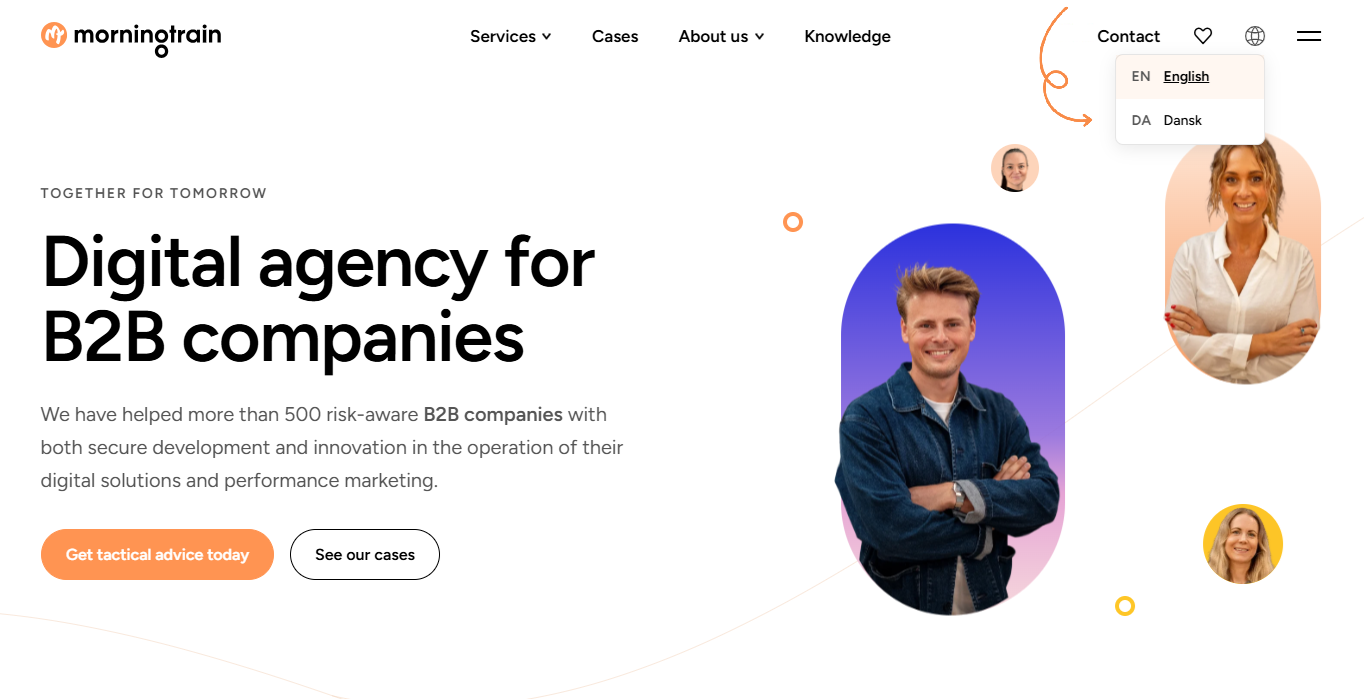
A language version is simply a version of your website that has been translated into one or more languages. It is done within the same installation, so the codebase only needs to be maintained in one place, and only the content needs to exist in multiple versions.
With smart tools, you can run automatic translations of your website, so you do not even need to maintain the content in other languages.
You can read more about what to be aware of regarding language versioning in this post.
When should you make this choice?
When you have a website or an online shop that needs to operate in multiple countries—or simply in multiple languages—you should consider how the URL appears to visitors.
There are two primary paths to take:
- Either you use subfolders. This is where the language version appears after a slash, such as domain.dk/en.
- Or you use a local or international top-level domain such as .se, .de, .co.uk or .com.
If you have more than one language on your site, you need to make this choice, and the choice you make affects:
- User experience
- Your SEO (both locally and internationally)
- Potentially also your conversion rate
Read on in this guide to learn how to choose.
Fordele og ulemper ved begge løsninger
Vælg en løsning nedenfor og bliv klogere på fordelene og ulemperne ved dem.
Undermappe (f.eks. ‘.dk/en’)
In most translation tools, this will be the default setting—so if you do not make an active choice, this is most likely the version you are using.
The idea with subfolders is that your language versions are shown in a slug (subfolder) under your main domain, such as “morningtrain.dk/en/landing-page”.
Advantages:
- The SEO value and authority from the original domain are preserved, so your new language version “inherits” SEO value from the top-level domain and its traffic.
- It does not require you to own other domains.
Disadvantages:
- You will not be perceived as a “local player” in the markets you operate in. For example, the French will see you as a Danish player trying to establish yourself in the French market. This will affect your conversion rate to some extent.
- Local rankings will be harder to achieve, as Google will view you as a foreign player. And Google loves local rankings.
Topdomæne (f.eks. ‘.se’)
The idea behind choosing to display language versions with a unique top-level domain is that you appear more local in the market you are trying to address.
For example, Germans will generally have more trust in a .de website than a .dk/en, as it appears that you are genuinely in Germany. Combine this choice with a local office, and your conversion rate will almost certainly increase.
The same applies to the British with a “.co.uk” and the Swedes with a “.se”.
Advantages
- You use the most recognized domains in the markets you operate in.
- You appear as a company that operates in a market—not merely as one that has translated its website.
- It provides a more international profile.
Disadvantage:
- SEO value must be built up in each market you work in. SEO value for a .de domain does not provide much value to a .se domain. This creates “marketing debt”.
- It requires that you own all the domains you want to use, and some domains—such as .com domains—can be very expensive and difficult to obtain.
When should you choose which option?
Subfolder:
You should go with this option if language versioning is more about making your website and content available in multiple languages than about operating in foreign markets.
You can enter the market faster this way, with fewer limitations, and all language versions pass SEO value to each other.
Top-level domain:
You should choose unique top-level domains if, as a company, you have a strategic vision of being an international business, and it is not “just” a translated version of your website.