


Data insights
15. October 2020
Get your marketing attribution under control
An attribution model is, roughly translated, a way for YOU to define when a marketing channel can be credited for a sale or a lead.The most common mistake is lacking an understanding of attribution models. It is a dangerous mistake to make, as it means you may end up prioritising your marketing spend completely wrong.

Content
History behind What is attribution Cautionary tale Types of attribution Last click First click Linear distribution Position based Time dependent How to change settingContents of this post
- The story behind marketing attribution
- The horror example (if you do not work with attribution models)
- Conclusion
- Okay, but… What exactly is an attribution model?
- Which attribution model should I use, then?
- How to change attribution model in Google Analytics
The story behind marketing attribution
To understand what marketing attribution is, and why it matters, you need to understand the origin of the concept. We will go through it step by step below:
- Digital marketing flourished throughout the 2010s, as marketers suddenly gained access to a wealth of data and insights into their audiences and their campaigns’ performance. This brought about a fundamental shift compared to working with conventional marketing in print, outdoor, and on TV.
- It became common to have a Google Analytics account in every company, and marketers began to develop a fixed routine of geeking out over numbers and comparing them to arbitrary KPIs.
- In the beginning, Google dominated the digital marketing world, and everyone knew you had to invest in Google marketing. Since 2016, we have gained other marketing alternatives such as Facebook, Bing, YouTube, Instagram, Snapchat, Pinterest, Amazon, and many, many more.
- The influx of digital alternatives was, in reality, the starting signal for our need for attribution models. Every single channel has some form of analytics function, and every single channel has an interest in taking credit for the sale or lead generation. But which channel is telling the truth?
- Fast-forward to today. The vast amount of data we have access to has made us number-blind—and (to be completely honest) a bit lazy. We look in our Google or Facebook Analytics and think these are exact sciences, and we invest in the channels that show good conversion numbers. But the truth is that we are looking at numbers made available to us by providers with enormous bias, and the way the data is presented makes it look as if your marketing channels are solo stories competing against each other, instead of being on the same team.
- In the old days, people talked about how many touch points customers needed with a product before taking action. And that is exactly what marketing attribution is about: what the old-school channels (such as TV, newspapers, radio, print, and outdoor) could not document were the knock-on effects of the effort.
So, what is marketing attribution?
Marketing attribution is, in short, about trying to map the customer journey: Did the customer start by seeing a Facebook ad?
Were they subsequently exposed to a banner?
Did they then Google your brand name and click on your website?
When we think about it this way, it is a team effort that creates the lead—not the final Google search.
The horror example (if you do not work with attribution models)
Although this is a hypothetical example, unfortunately we see it every single day. Either it is something we hear from our customers or in our network, or we spot it on LinkedIn. So the odds are that you probably cannot entirely rule out falling into this trap either.
Let us take an example with a marketing employee (let us call her Charlotte) who works in the in-house marketing department of a perfectly ordinary company. Charlotte does her weekly routine check in the company’s Google Analytics account and sees the following:
Good Charlotte has been told time and again that you should invest in what generates the most revenue—and yes, that is a good idea, which we do not disagree with at all.
But if, based on the image above, you conclude that SEO (which roughly corresponds to “Organic Search”) accounts for just under 40% of your revenue, and that certain types of paid advertising (“Generic Paid Search”) simply do not have enough impact, then you are mistaken. And if you also make decisions based on that misjudgement, you risk killing the important synergy effect the two channels have on each other.
Because the truth in this case is that the Google Ads campaigns deserve a larger share of the credit for generating leads than just the portion that can be directly attributed to Google Ads as the last channel in the user journey. Based on figures read under “top conversion paths” in Google Analytics, Google Ads is actually the first touch point in customers’ buying journey with this company about 21% of the time—and on top of that come all the cases where Google Ads is the last channel.
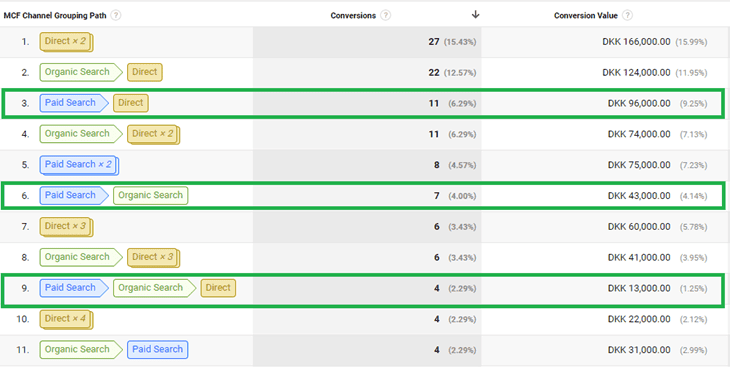
You can find that report in Google Analytics reports > Conversions > Multi Channel Funnels > Top Conversion paths
When you use the wrong attribution model, that means a full 21% of revenue for which Google Ads gets no credit whatsoever. And now Charlotte is going to reduce the ad budget for the channel, “because it is not delivering enough”.
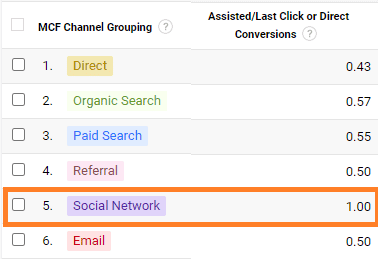
It gets even worse if Charlotte starts looking at conversion numbers for her social efforts because they “do not convert at all”. Again, that is simply not true. The image below shows the relationship between when a channel is responsible for the final conversion and when the channel merely assists the other channels in closing the sale/lead. The closer the decimal number is to 0.00, the greater the channel’s importance for the final conversion action—and the closer the number gets to 1.0, the more the channel functions as a support role for the other channels, which then close the sale/lead.
Keep this logic in mind when you look at Charlotte’s SoMe efforts below. Here, it would be easy to be tempted to give social media far too little credit for lead generation—even though the numbers actually indicate that the SoMe efforts assist with lead generation in 100% of cases.
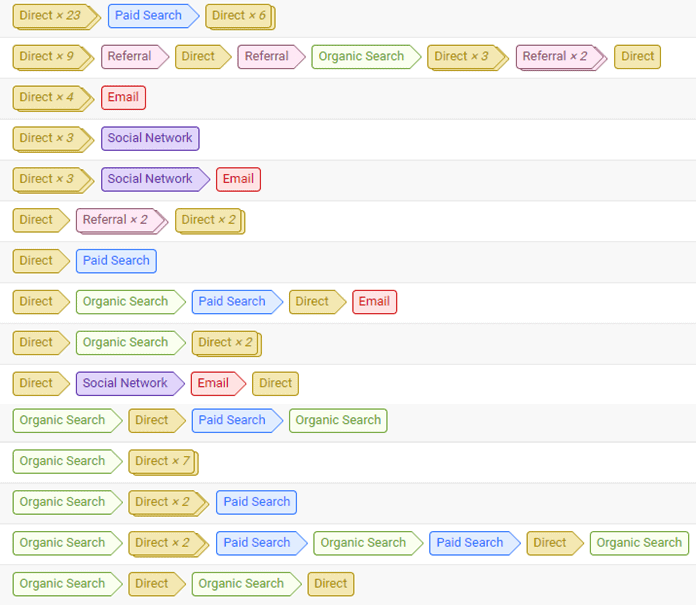
Now I have given you an easy example with fewer steps in the buying journey. Sometimes buying journeys look more like what is illustrated in the model below. The example serves to show you why you should use a marketing attribution model that distributes credit across multiple channels, so you can once again rely on the conversion numbers you have access to in Google Analytics.
Conclusion
The only three things you need to take away from the horror example are:
- Customers’ digital customer journeys have many nuances. Nothing is black and white. And even though it is tempting and easy to simply invest in the channel that immediately appears to be the most effective, you must never underestimate all the other touch points a customer passes along the way.
- Be careful not to look at the numbers for each channel in isolation. For example, the performance of a given TV commercial will often be reflected in more clicks on your Google Ads ads, more direct traffic to the website, and more brand searches. Put differently, the value of one marketing channel will most likely boost the numbers of several other channels.
- Charlotte is just an imaginary person 😛
Okay, but… What exactly is an attribution model?
An attribution model is simply something you define in your preferred tracking tool, which identifies which channel(s) helped create the lead.
- Was it the first marketing channel the customer interacted with?
- Was it the last?
- Or is the value in reality distributed across all the channels involved?
Which attribution model should I use, then?
There are 6 attribution models:
- Last click
- First click
- Linear
- Position-based
- Time-decay
- Custom
We describe the first 5 attribution models below. We will not go into depth with the custom one, as the term simply covers the fact that you can tailor your own model. You only need to understand the first 5 models if you want to know how you can—and should—attribute.

Last click
This model assigns all value to the last channel the visitor interacted with in their decision process (excluding direct traffic). This means that with this model you do not credit the marketing channels that made the customer aware of your product or service, nor the channels that warmed the customer up to you. Only the channel that ultimately kicked the ball into the goal gets credit for the new lead.
This attribution model is the default in Google Analytics. Interestingly, it is the major players in search engine marketing (SEO, Google Ads, and Bing) that benefit most from this model—i.e., primarily Google’s products. 😉
Search engines are often the last step in the journey, because we use social media for inspiration, just as we are influenced by banners and other ads—and when we are ready to buy something, we simply go and search for the product. And then we click on the provider that has influenced us the most.
Example: When you need to replace your car’s windscreen, I would bet my old hat that you go to Google and search for something like “bmw windscreen replacement”. The fact that you then click on “Carglass” is because they have influenced you through their TV ads and jingle. But Google was the last stop on your customer journey before you bought.
The downside of this model is illustrated by the entire Charlotte example above. You end up relying far too much on a Google Analytics account that says “THE ONLY THING THAT WORKS FOR YOU IS GOOGLE MARKETING”. Even though the truth was probably closer to 60% Google marketing, 30% SoMe marketing, and 10% display banner advertising.
NOTE: Organic Search is not the same as SEO. SEO is only part of what is collectively referred to as “Organic Search”, which also covers all brand searches.
We often see companies saying “most of our revenue comes from SEO”—but when we investigate more closely, it turns out that the traffic primarily comes to the homepage, and the only thing the homepage ranks for in Google is the brand. Therefore, it is brand traffic that converts—not SEO. And brand traffic is an accumulated effect of all marketing efforts.
First click
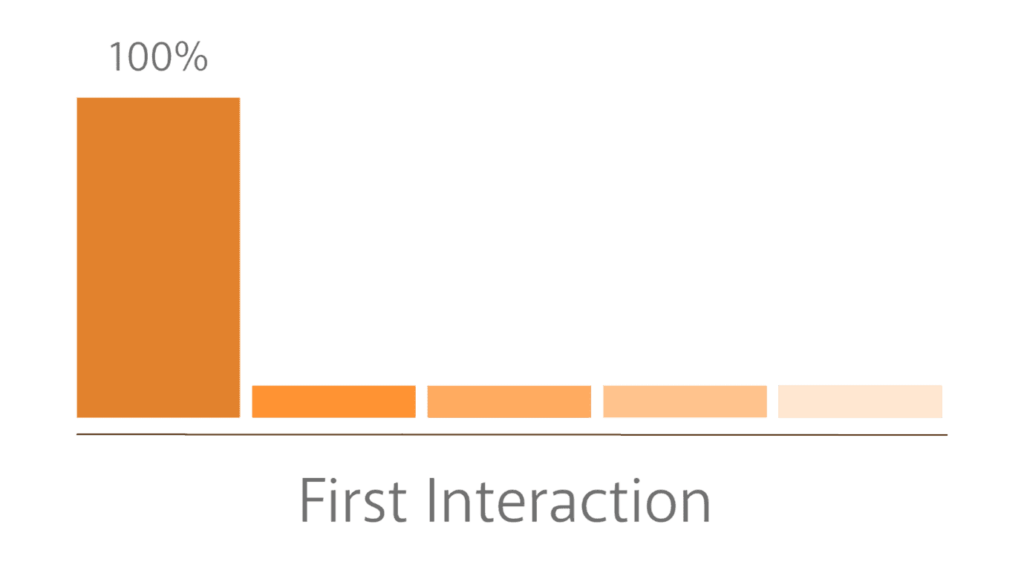
The first-click attribution model assigns all value to the first channel the customer came into contact with.
The advantage of this model is that it highlights the value of the channel that started the user’s buying journey. In most cases, this makes branding efforts look effective, but as with the first-click model, you risk drawing incorrect conclusions—namely that your Google marketing efforts do not have enough impact.
Linear distribution
As the word “linear” indicates, this model assigns equal value to all channels involved in a sale or the acquisition of a lead. This means that revenue as well as the number of leads or sales is divided by the number of channels involved, and the value is then determined for each channel accordingly.
It may seem fair? This model is, at any rate, Karl Marx’s wet dream 😉
However, it is hardly true that all channels provide equal value. In practice, I would argue that the further we move down through the customer’s decision process, the more value a channel provides.
Position-based
This model assigns the most value to the channels at the beginning and end of the customer’s decision process, and then distributes a small amount of value across the channels in the middle. Typically, this means 40% of the value is attributed to the first channel and 40% to the last channel, while the remaining 20% is distributed across the middle.
This model is the most popular among experienced marketers and agencies. That is not because it is the right one, because quite simply there is no model that contains the full truth. My guess is that it is because it is a model that is easy to manage. It makes the most sense for answering questions such as “what started my customer’s decision process?” and “what was decisive in the end for it being me who got the customer/lead?”.
In my view, these are also the most important parameters. There are a whole lot of touch points in between that should not be denied credit for contributing, but they are simply not the ones I would recommend spending more money on.
In the short to medium term, it will be most profitable to increase investments both in starting more customer journeys and in getting more customers to end their journey with a purchase. That is why this model is also my favourite.
Time-decay

The last model we will go through is a model that assigns more and more value to a channel depending on how late it appears in the customer’s decision process.
The model makes sense if your marketing efforts are structured so that you have a series of supporting marketing activities launched to nurture your potential customers, while other activities exist solely to drive sales activation.
By its nature, this model may be the most realistic, as it acknowledges the time perspective in a decision.
Take buying a car as an example:
Here, it is most important that you are running the campaigns that reach the user at the end of the decision process. If you only reach them early, you risk simply nurturing customers for your competitors, because you have spent time explaining financing options and equipment packages—but when a decision had to be made, you were not visible.
As with the last-click model, this model will attribute the most value to your Google marketing efforts—and then you can easily get the mistaken impression that a car buyer simply searches for “audi a3 sportspack 2020” and then requests an offer… well, not quite. There are most likely several more steps leading up to that decision, including a sea of other information searches on Google, as well as exposure to TV and Facebook ads that made the user aware of favourable financing options.
It is not enough to be available when the user is ready to buy. You also need to make yourself attractive long before the choice has to be made, if you want a fighting chance against competitors.
How do you change attribution model in Google Analytics?
It is extremely simple to change attribution model in Google Analytics.
- Log in to your Google Analytics account
- Go to Admin (the small gear icon in the bottom-left corner)
- Navigate to the rightmost column (“View settings”)
- Click “Multi-Channel Funnels settings” (the icon looks like four small bars)
- Add a new attribution model by clicking the large red button
- Click in the field where you can select a model
- Select the model you want to use going forward, and click Save
You have now mastered marketing attribution
There is not much more to say. You are now an Olympic champion in marketing attribution. You know everything about how it should be used and why—now it is just a matter of getting started from here.
Thank you for reading to the end—or just scrolling all the way down to the bottom and skimming the images 😉