

Lead generation
19. October 2022
Find and select target audiences for LinkedIn lead generation
In this post, we take an in-depth look at targeting on LinkedIn and how you should approach it at a tactical and operational level.
Content
Good advice Purpose What is the value of a lead Who do you want to reach Ad spent Your messages Ad flow Pit fallsWhen identifying and selecting target audiences for your LinkedIn lead generation efforts, you should always consider the following:
- What is the objective of your lead campaign?
- What is the value of a lead?
- Which people do you want to reach?
- What is your advertising budget?
- Which messages do you want to communicate?
- How should you structure your advertising flow?
This post is designed as a step-by-step guide on how to create your audience segmentation and selection, as well as what you should consider when running lead generation via LinkedIn.
What is the objective of your lead campaign?
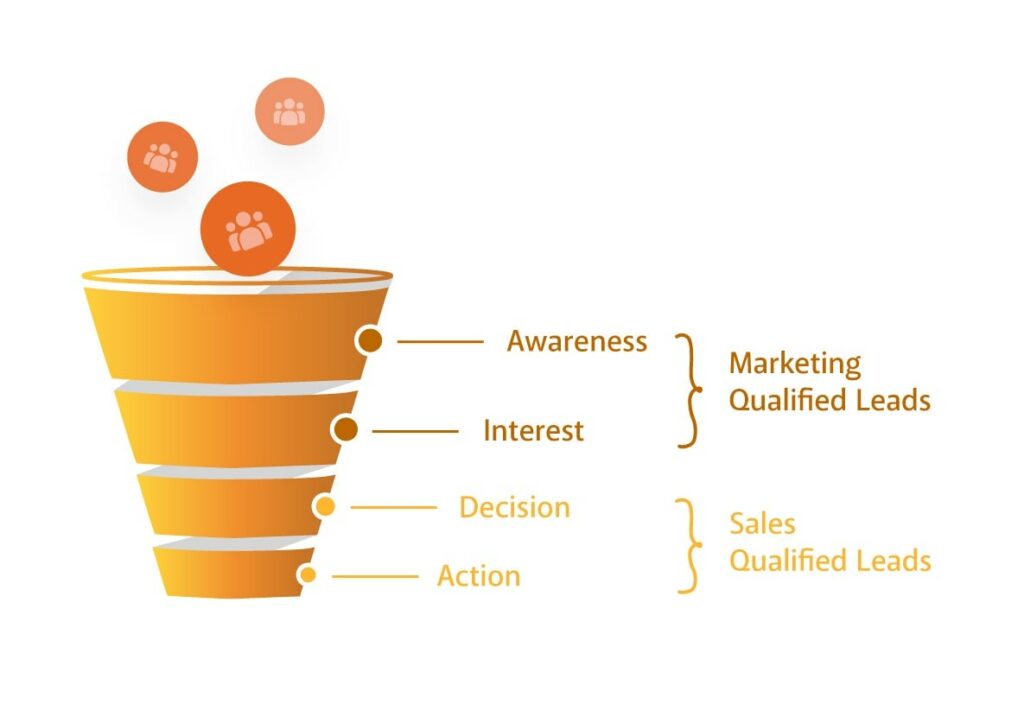
A lead is defined as: “A term for a person who has shown interest in a company and has, in one way or another, expressed this interest for example by calling the company.”
However, besides calling the company, a lead can also come from other actions the person has taken. For example:
- Booked a demo
- Downloaded a brochure/whitepaper/e-book or similar
- Signed up for a webinar
- Signed up for a newsletter
When creating your lead campaign, you should first ask yourself: “What is the objective of the campaign?” Here, I mean what you want recipients to do after seeing one of your ads (e.g., one of the conversions in the list above).
The conversions on the list are examples of what a lead “gets” in return for sharing their contact information with you. In this context, it is important to ask only for the information in the contact form that you can actually use. The more and the more private information your recipients must provide, the less likely they are to complete it.
Conversely, in some situations it can be a way to filter out the least serious leads. However, this depends on how demanding the conversion is.
The type of lead affects who you should target, what type of content can get them to convert, and when you should reach them.
What is a lead worth?
It is also important to determine what a lead may cost for it to be profitable for you to invest in lead campaigns. The cost per lead should not depend only on the business case you calculated in chapter 1, but also on what format the lead takes.
For example, if it is a newsletter sign-up, the value is lower than if it is a contact form submission. This can vary significantly from case to case.
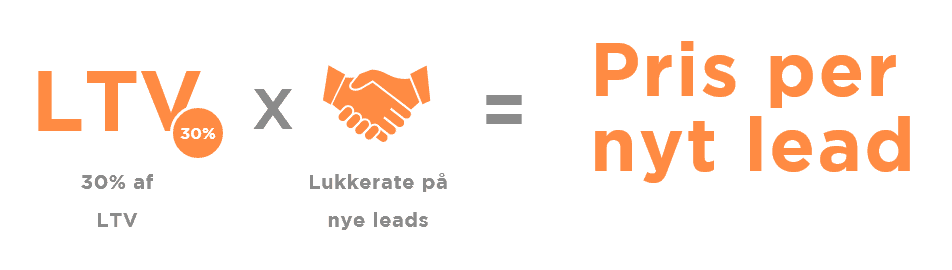
If a large part of your revenue comes from sales via your newsletter, a newsletter sign-up can be relatively valuable. If, on the other hand, you do not generate much revenue from your newsletter, the value is naturally lower.
What a lead is worth to you plays a role in which audiences you can and should choose. For example, if lead values are very high, you can “afford” to target audiences with a high CPM, as the potential means you can still achieve a profitable case.
But if lead values are low, you should target the parts of your audience that you can reach more cheaply although this will also limit the potential.
See below how many impressions (based on CPM), traffic, and downloads you can roughly expect on LinkedIn vs. other social channels.
Note: The results above are an average that we found by analysing across customers, markets, and industries. Every case is different, and so will the numbers be.
Which people do you want to reach?
For this point, it can be valuable to map out your campaign structure visually before you create it in LinkedIn Campaign Manager. That way, you get an overview and can compare it with your budget before you get started.
When selecting -and yes, it is very much about selection, because you rarely have the budget to reach everyone you would like to – you may want to consider the following:
- Which geographic locations do you want to target?
- Demographic data such as age, gender, marital status, etc.
- Work-related factors such as profession, job title, job function, education, seniority, industry, employer (possibly specific companies of interest)
- Interests (here, for example, you can often reach people more cheaply on LinkedIn via groups than by targeting specific job titles)
- Does it make sense to create retargeting audiences where you target people who have previously shown interest in your company? (E.g., by visiting the website, performing specific actions on the website, visiting your social media, and similar). More on this in section 3.7.
It can be a good idea to start from your current customers and create a profile of your typical customer. Consider which people in the decision-making process you want to reach. Do you want to reach the decision-maker? The influencer? The person holding the budget? Then translate this “persona” into an audience based on demographics, work-related factors, and the like.
Feel free to note which audiences you will target with which initiatives, so you have defined who you want to reach at which stage of their decision-making process and with what content. On LinkedIn, the number of audiences also depends on your advertising budget, which determines how many you can reach. You can read more about the ad budget in the next section.
Finally, of course, it also depends greatly on the message who you want to reach with your ads.
What is your advertising budget?
On LinkedIn, you pay at campaign level, and the minimum budget per campaign is DKK 60 per day. LinkedIn is a CPM engine, which means you are billed for the number of impressions. So whether you get traffic and leads or not, it costs you money and the money will be spent, because if the audience is too small to spend the budget, LinkedIn simply increases the frequency so the audience sees your ads multiple times.
This means you pay a minimum of DKK 60/day per audience on LinkedIn. Therefore, your budget and your desired audiences must always be weighed against each other, and it may be necessary to reduce the number of audiences to fit your budget. Even though LinkedIn allows you to group all your desired audiences into one campaign, it very rarely makes sense, as your audience then becomes very large.
In addition, you cannot evaluate which audiences perform well and which do not. If you instead split into several smaller audiences, it is easier to compare the data across them. This could, for example, be split by gender, by job functions, by geography, retargeting, lookalikes, and similar.
Which messages do you want to communicate?
When selecting audiences, you should be very clear about which messages you want to communicate and what you want recipients to do afterwards. The answer to this also influences which audience you should choose. Again: if you want to communicate to the influencer, you need a different message than if it is the decision-maker.
Here, the type of lead plays an important role, as does where recipients are in the buying process when they are exposed to the ads. The further along they are in the buying process, the more high-intent conversions and sharper CTAs (Call to Action) you can use in the ads.
Conversely, it is not a good idea to start with a lead campaign aimed at getting recipients to fill out a contact form if it is the first time they have heard about your product/service.
We therefore recommend that you, for example, start with a traffic campaign where you target relevant audiences in terms of geography, demographics, work-related factors, interests, and similar. In these ads, you start more softly and introduce the recipient to your product/service and the challenges you can solve for them.
Here, it is important to speak directly to the recipient, which you have the opportunity to do precisely because you know fairly accurately who the message is reaching depending on your targeting settings. Because if you communicate to everyone, you communicate to no one. In other words, if your message is too broad and addresses overly general needs, the likelihood that recipients will be captured by your content decreases.
But if you instead speak directly to each recipient’s specific challenges/needs and the ways your product/services can help with those concrete issues, it is easier for the recipient to see your value.
You should also consider different audiences in different parts of your customer journey, so that some of your campaigns target different audiences depending on where they are in the decision-making process.
For example, once your traffic campaign has been running for 2–4 weeks targeting an audience, you can then create a lead campaign targeting people who have previously interacted with your traffic campaign (e.g., by watching x% of your video ad, clicking your ad, or similar).
That way, you know that the people in your lead campaign have previously shown interest in your product/service, and therefore there is a greater likelihood that they are ready for higher-intent conversions such as filling out a contact form. In your lead ads, you can also use slightly more direct language and more sales-oriented messages.
It is important to mention here that we always recommend testing several different ads, as this does not cost you more in ad budget. This makes it a “free” way to test which messages your recipients respond best to and how the messages are presented.
How should you structure your advertising flow?
When the objective of your campaign is to collect leads, as mentioned in previous sections, it can be a good idea not to jump straight into a lead campaign but instead start with a traffic campaign. After that, you can create a new lead campaign using retargeting.
Retargeting means targeting people who have already interacted with your website and/or social media at an earlier point in time. For example, you can target:
- People who have visited your website within the last 30 days
- People who follow you on Facebook/Instagram
- People who have watched X% of the video from your traffic campaign
- People who have performed specific actions on your website
That way, you know that these people have shown some form of interest in your company, and therefore they will likely be more ready to give you their contact details—for example by signing up for a newsletter, booking a demo, and similar.
You can also use retargeting to exclude people who have performed specific actions. For example, you should always exclude people who have already completed the action you want them to take in your campaign.
Once you have created your retargeting audiences, you can also choose to create so-called lookalikes of these people. For example, you target:
- People who resemble people who have visited your website within the last 30 days
- People who resemble people who follow you on Facebook/Instagram
- People who resemble people who have watched X% of the video from your traffic campaign
- People who resemble people who have performed specific actions on your website
- People who resemble people who have previously filled out your lead form
You can then add these lookalike audiences to your original traffic campaign, and in that way you have built an advertising flow that, by and large, can run on its own.
Avoid these pitfalls at this stage
- Avoid putting all audiences into one campaign, so you cannot split-test performance.
- Do not make your audiences too broad. Your budgets certainly will not stretch to reaching everyone you could dream of. Therefore, you need to select a few.
- Be careful not to put all your eggs in one basket. Many focus only on the decision-makers but forget all about the product user, the influencers, etc.
- Avoid a mismatch between your audience and your content/message. It is easy to create your content and then, afterwards, choose the audience regardless of the messages you have developed. But that reduces the likelihood that you reach recipients where they are in the decision-making process.
- Make sure to use multiple audiences for different purposes. Use some generic audiences such as job titles or interests to gain exposure, and then create an audience that isolates the people from that audience who actually showed interest in you. That way, you build your own audience over time, and you find people in your target group that you may not have thought of yourself.
- Remember your budget when choosing audiences. You need a certain frequency per audience if you want any chance of capturing their attention (i.e., they often need to be exposed to your ads more than once).