


Lead generation
10. October 2023
Guide: Optimising B2B marketing campaigns
The campaigns are now up and running, and then the long, hard slog of ongoing optimisation begins. But how do you actually do that? And how should you approach the work? This post contains guidance on what to do in different scenarios, based on how your campaigns are performing.

Content
What to look after Did you get any leads Traffic, but no leads No traffic or leads No impressions Many leads Few but expensive leadsNote:
My examples are based on Google Ads and LinkedIn, but the logic can easily be applied to e.g. Facebook, Instagram, SEO, etc.
What should you look for?
It is important that once the campaigns are running, you spend your time only on what stands out to you.
You can always tinker in an ad account and find 1%, 3% and 15% more by tweaking small things here and there.
These minor adjustments must be weighed against the output, and if you spend a lot of time finding small improvements, then input and output do not align the time would be better spent on the big picture.
My claim is that if you have some experience with LinkedIn or Google Ads, you can easily deliver a better-performing effort than the specialist with 5 years’ experience if, in return, you are significantly better at keeping the overall picture in mind and prioritising accordingly.
When you log in to your ad platform, you will most likely encounter one of the following scenarios:
- Has anything generated leads?
- There is traffic, but no leads
- There are many impressions but no traffic or leads
- There are no impressions or traffic
- There are many leads, but the budget is limited
- There are few leads, but they are expensive
- You are getting leads, but they are not qualified
Under each scenario, I have written what is most likely behind the result you are seeing, as well as how to fix it.

Scenario 1: Has anything generated leads?
If yes, start by “zooming in” on this effort to see whether there is a way to scale this output.
You start here because it is the first indication of whether there is anything in the campaign with potential.
The campaigns that have not performed yet are still just empty hypotheses.
Next, you want to know whether you can isolate the parts that have performed; is it a specific ad that has generated leads?
- Is it a specific audience or keyword that stands out in particular?
- What is the conversion rate?
- Has the campaign received a lot of traffic and few conversions, or is the rate reasonable?
- Is there a landing page that works better than others?
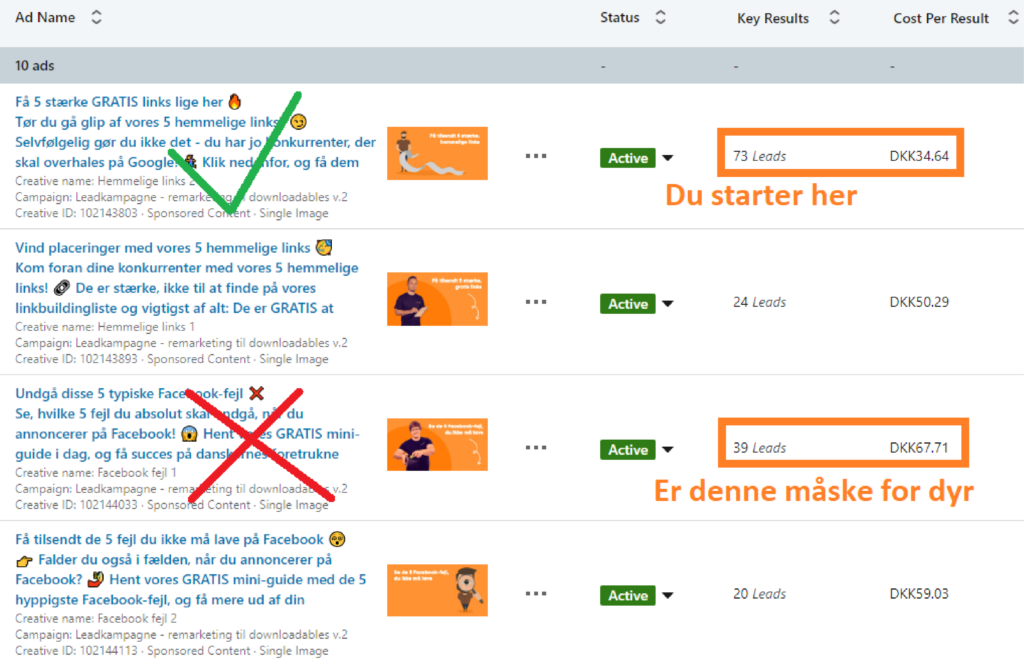
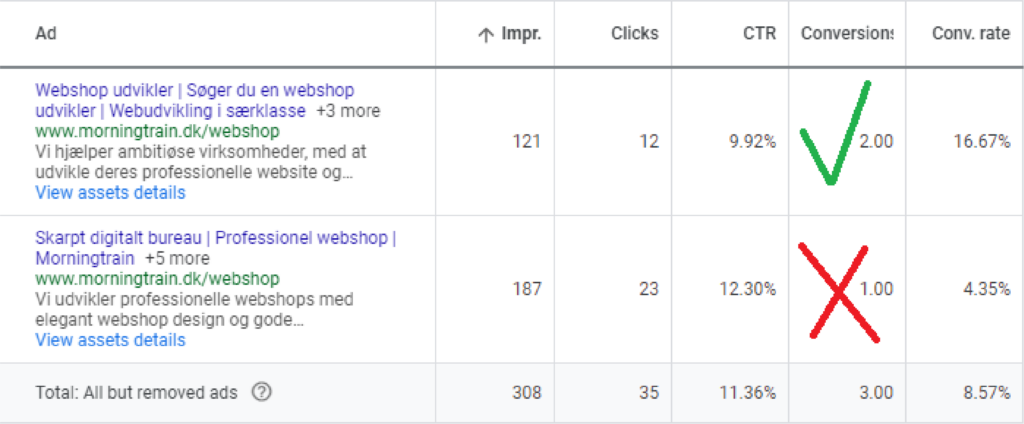
Example 1: There is an ad that performs particularly well
If there is an ad that has performed particularly well, I would consider pausing the other ads you have in the same ad group/set.
This way, the high-performing ad will be shown more frequently, which should increase lead output. Test this hypothesis. If it does not work, create a completely new ad.
Google Ads
Example 2: There is an audience or a keyword that performs
If the case is that an audience or a keyword is performing, you should initially increase bids for that audience or keyword i.e. simply allocate more budget to it.
This is the most obvious action you can take.
Here you test the hypothesis that if you get more traffic from this audience/keyword, you will correspondingly get more leads.
When you allocate more budget to something, it gets more exposure from LinkedIn and Google, respectively.
If that turns out to be the case, continue increasing your bids until the trend levels off.
In addition, we would consider looking at increasing the conversion rate on the landing page associated with the keyword—either by testing other landing pages or by optimising the existing ones based on our recommendations in our article on the website optimisation checklist.
Example for Google Ads and/or LinkedIn: Leads have come in, but the conversion rate from visitor to lead is low
If, on the other hand, the situation is that a campaign has received an enormous amount of traffic but very few leads, we would look at split-testing other landing pages or, alternatively, optimising the landing page according to the website optimisation checklist (see the link in the section above).
Scenario 2: There is traffic but no leads
This is the most common initial outcome when you start lead generation.
The reality is that everything up to the point where the campaigns are running is based on hypotheses and possibly experience from other industries—but not de facto observations from your specific industry.
So you often need to tinker a bit before leads start coming in.
If you are in that situation, consider the following:
1 – Have you tested different landing pages?
Or are you simply sending all traffic to your homepage or contact page? Perhaps you should consider testing other pages.
If you do not have landing pages that match the content of your ads, consider having them created.
2 – Have you chosen the relevant traffic sources?
3 – Are the audience or keywords even relevant?
Indicators of irrelevant traffic include:
- A high bounce rate (+75%) can tell you that your audience finds you irrelevant. This may
be because the audience is wrong, but it may also be due to your landing page lacking relevance
and appeal. - Either a very high or very low ‘time on site’ (under 1 min. or over 4 min.) can indicate that
the audience is either not interested, or cannot find what they are looking for. - Is the audience engaging with your ads? If your ads have a low CTR, it may be a sign that you are irrelevant to the audience. On LinkedIn, you can consider introducing a soft KPI such as “video views” or “engagement”, which can give you indications of whether the audience finds you interesting.
- Are your landing pages optimised according to the principles from our article ‘the website optimisation checklist’?
- Have you written your copy in a way that provides value to readers, and can they understand what they get from you and your products/services?
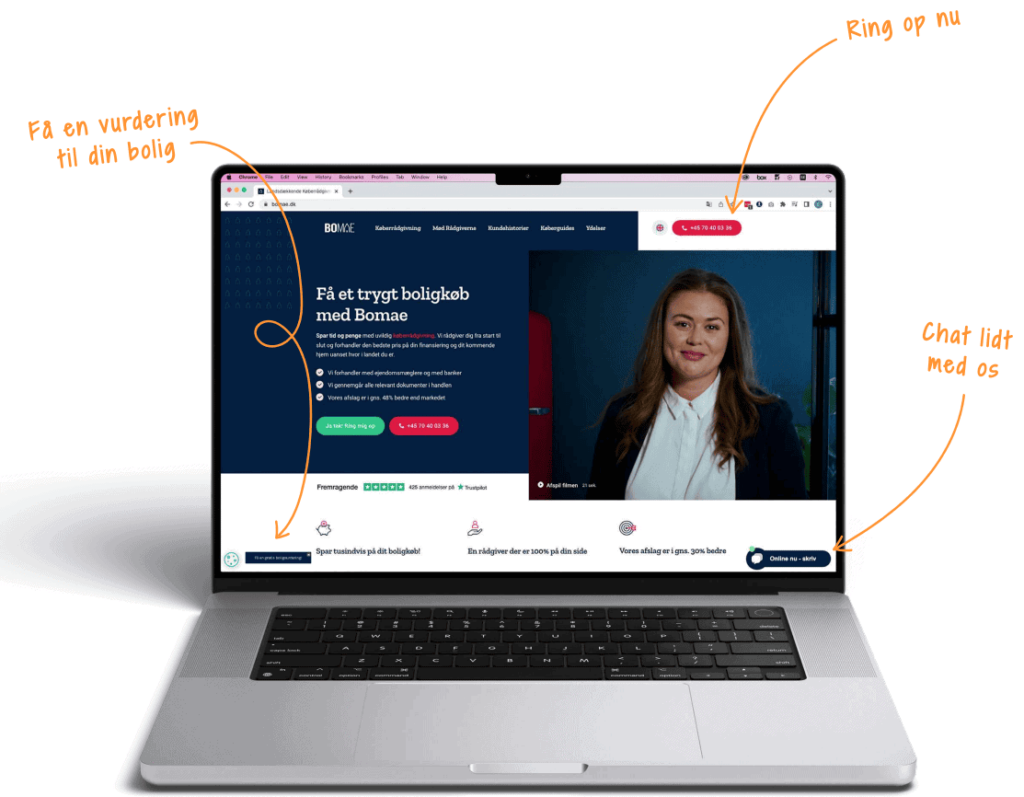
- Do you have visual aids to describe your products/services? Are there clear CTAs?

- And perhaps most importantly: What do you offer your visitors to do on the website? Do you offer them different conversion options that appeal to the different stages of your
customers’ decision-making process (call me, a chat, e-book, brochure, etc.)?
If you generate MQLs by having “gated content“, have you considered whether the content is actually good enough?
If it is just a data sheet, then the answer is already no.
It needs to be material they would almost be willing to pay a symbolic amount for—material you then choose to give away for free or in exchange for contact information.
You should consider different entry points for your visitors. It may also be that they “simply” need to watch a video on the website, so you can then run a retargeting campaign to the people who choose to do so.
This creates synergies between the website and your marketing channels.
Scenario 3: There are many impressions but no traffic or leads
If you are in this situation, it can be a strong indicator that, in one way or another, you are not relevant to your audience or the keywords you have chosen.
Is there enough difference between your ads? To conclusively establish whether you are irrelevant to the audience or the keywords, you need to expose your audience to significantly different ad formats and messages.
On LinkedIn, make sure you have used different formats such as the image carousel, video ads, or something else entirely.
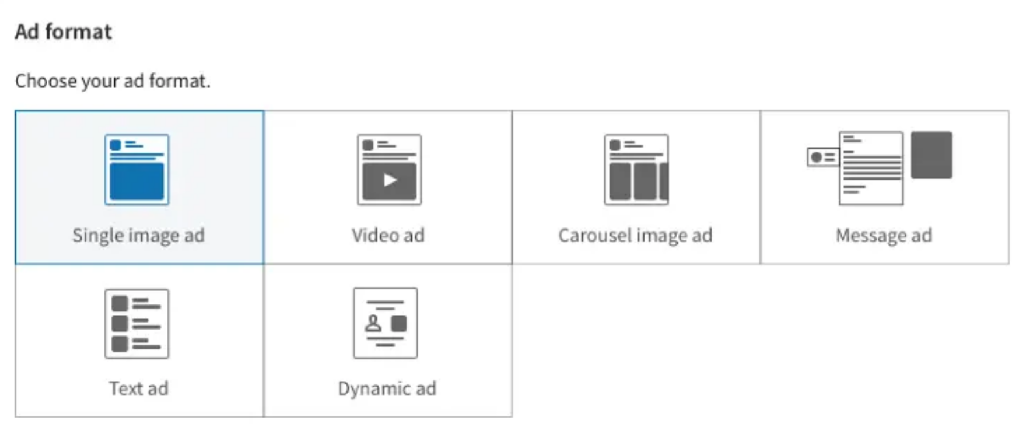
One reason for the lack of clicks could be, for example, that you are only showing your audience video material,
and because they get everything they need from the video, they do not click through to your ads.
In Google Ads, you should likewise make sure you have split-tested different messages. See what else appears in the search results and make sure you stand out sufficiently. At the same time, you should reassure recipients that you can do the same as the competitor.
Both examples below are good ads, but they promise different things for the same keyword.

Scenario 4: There are no impressions or traffic
If you are in this situation, start by checking that you do not have technical issues such as:
- Ads that have been disapproved
- A payment card that has been declined
- Or something similar
Next, we would recommend that you try increasing the budget or bids significantly. That way, you can test whether the issue is that you are not bidding high enough.
If that is not the case, it is most likely because you have been too thorough with your audience segmentation.
In other words, the audience is too narrow and/or there are not enough monthly searches for your keywords.
Scenario 5: There are many leads, but the budget is limited
May we start by saying – CONGRATULATIONS – you have struck gold, and that is absolutely a luxury problem to have in a lead generation context.
As we see it, you have two things to do preferably in priority order:
1. INCREASE YOUR BUDGET!
Surely you can convince a CFO that the money is well spent if it means the company gets more profitable leads out of it?
2. Cost minimisation
Yes, the second step is to clean up the ad account and lower bids on the audiences/keywords that are not performing as well.
You should also pause ads and potentially stop the least effective campaigns so you can allocate the budget to the campaigns that perform best.
It is not the most optimal, but it may be the best option in this situation if you cannot simply increase the budget.

Scenario 6: There are few leads, but they are expensive
Once you have broken through the “lead boil”, this scenario will most likely play out. Because it will typically not be where it performs.
But because you have (rightly) spread your budget across multiple campaigns, you will find that a few things deliver all the results, and the remaining efforts yield nothing.
If you are in this scenario, you need to isolate the things that actually perform.
The way you isolate a performing element is by exploring your campaigns and seeing whether anything stands out something that deviates significantly, for better or worse.
It could be:
- Campaigns that stand out in particular.
- Keywords or audiences that perform significantly differently.
- Ads that deliver more or less return.
- Or landing pages that produce completely different user behaviour than others.
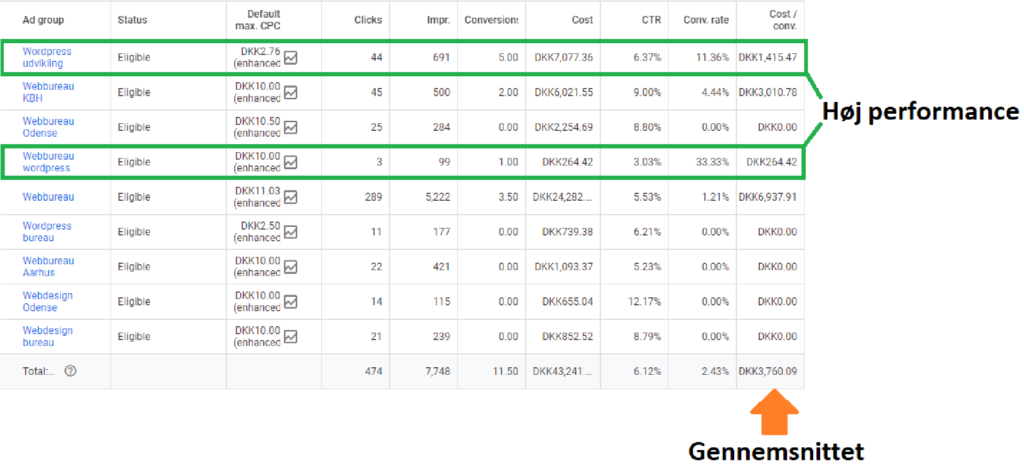
In the example below, you can see that DKK 43,000 has been spent, and 11.5 leads have come in (the half lead is due to an attribution model you can read about those here).
DKK 43,000 in cost divided by 11.5 leads = a CPA of DKK 3,760 per unit for the campaign overall.
But if you dig a little deeper, you can see that there are some keyword groupings (ad sets) that perform far better than others, and that the DKK 3,760 CPA is merely an average.
We have keywords that generate leads at DKK 1,400 each, but there is also a keyword that generates leads at DKK 264 each. In this scenario, 17% of ad spend delivered 50% of the results.
What should you do:
1. In a situation like this, we recommend that you look into reallocating some of the budget
And this is done by moving budget away from the efforts that deliver less and over to the ad sets that deliver the majority of the results here and then monitoring whether it scales the output.
In other words, if those two ad sets had received twice as much budget, would we have gotten twice as many leads?
Often it is not linear; it can increase more or less but it is definitely worth testing, and in 99% of cases we find that results increase as a result. Simply because you have found the corner that performs.
2. Check whether some ads are better than others
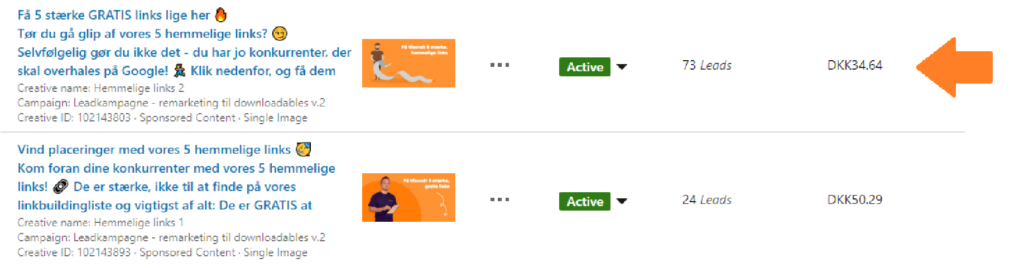
It may well be that the keywords or audience perform better, but what if it could be EVEN better if you channelled the best content in their direction?
Therefore, review the ads for the performing elements, pause poor ads, and potentially create new ones to see whether performance can be improved further.
3. Give some extra attention to the landing pages traffic is being sent to
Do not commit one of the most common deadly sins a marketer can make: optimising only within the ad tools.
Also remember to look at whether some landing pages perform better than others. Test them on your performing keywords or audiences.
You can also try optimising the landing pages based on the principles in the website optimisation checklist.
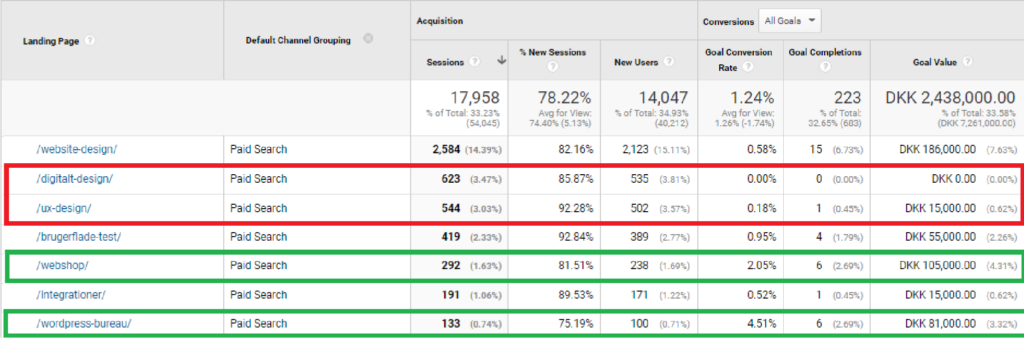
Below is an example showing the landing pages being used for the same audiences.
Marked in green are the ones that perform best, and marked in red are the pages that perform worse.
4. Use your new knowledge from performing campaigns to lift the performance of other efforts
You have now written new ads, optimised, and tested landing pages.
Now run through your other campaigns and see whether they need new ads, or whether they should be switched to sending traffic to your performing landing pages.
Scenario 7: You are getting leads, but they are not qualified
Oh no there is a breakthrough, but it turned out to be just a boil and not a golden egg. However, it is FAR too early to give up.
There are some fundamental exercises that can get you out of this situation.
Review what your leads are saying, and make sure they match your business.
- Are your leads using wording about you and your product that does not align at all?
- Are they comparing you to products or competitors you are not comparable with at all?
- Do they think your pricing is high?
- Or something else entirely?
Try to explore what your leads associate you with, as it will often tell you what it takes to qualify them better in the future.
Take “price”, for example.
If you find that your leads are not realistic in terms of budget, or they think you are expensive, you should consider adding a price point on the landing page.
You do not need to state a fixed price, but you can provide an example where you outline a solution, list what is included, and indicate the starting price.
There are many ways to provide a price point. You can even include it in the ads and completely avoid people who cannot meet you there clicking the ad = money saved.
My experience has always been that you get fewer enquiries, but the ones you do get are better qualified when you provide a price point.
When we added price examples on morningtrain.dk, we actually experienced getting MORE enquiries, and many leads referred to the price examples.
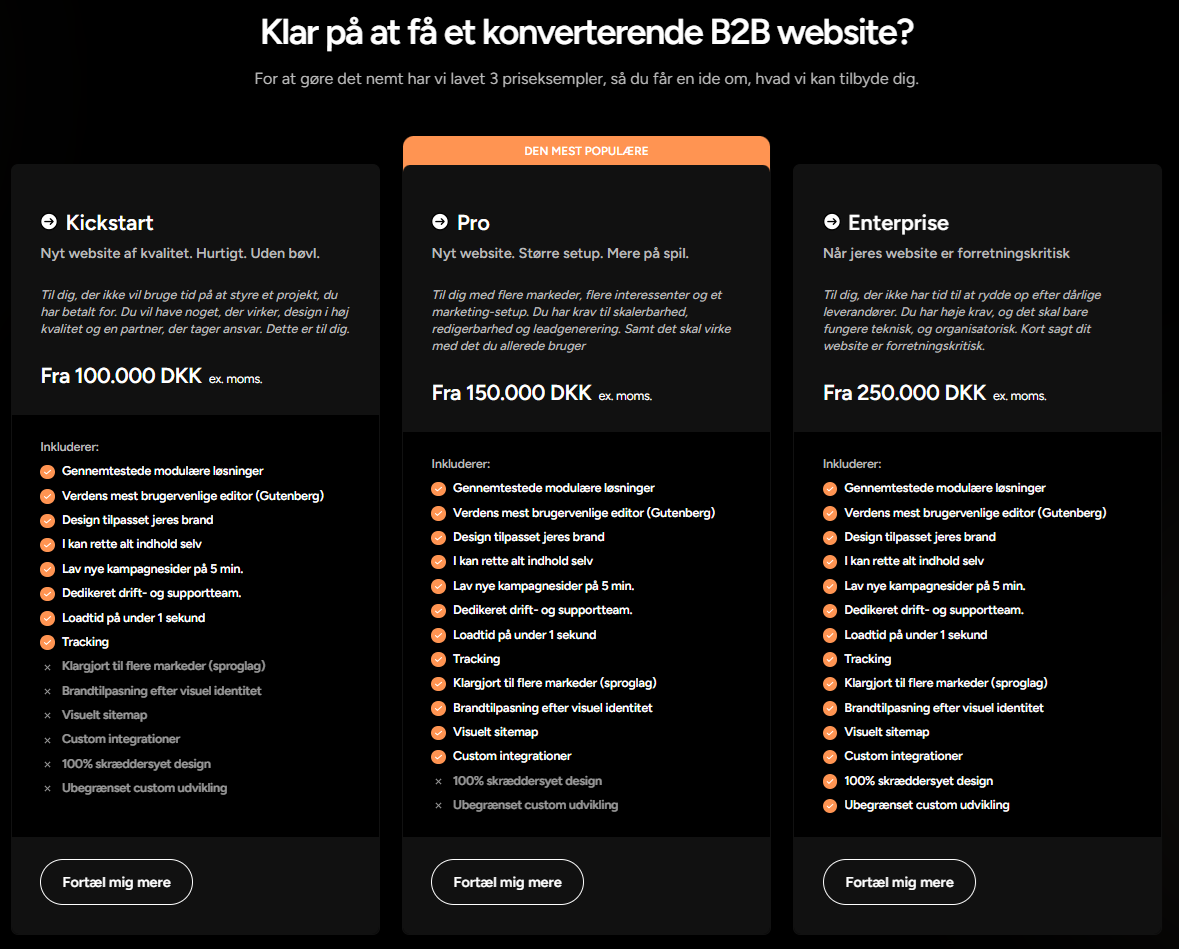
Our hypothesis is that the price examples made our products more tangible for our potential customers, and that many companies previously may not have contacted us because they assumed our product was more expensive than it actually was.
So while the unqualified leads were discouraged from reaching out, the qualified ones were reassured about whether they could “afford” it.
Is there a mismatch between what you promise in the ads vs. your website?
Unfortunately, we often see that the website is not updated, while the ads have received the latest graphics and new copy.
So while you have made an effort to be appealing on the ad platforms, you have not ensured that the website delivers the same “promise” as the ads.
If, for example, the ads strongly emphasise a “no-obligation review”, but you cannot find anywhere that says so on the website, it creates a barrier and an idea that it might not have been entirely true.
So make sure your website and ads “follow on from each other”.
If there are also graphic elements in the advertising, make sure the same visual identity is clearly reflected in the ads and on the website.
Could you do more to nurture your leads before they get in touch?
You could consider making more information available to your potential leads so they are better informed before they reach out.
For example, you may need to set up an FAQ on the landing page, or allow them to download an e-book about your solution.

You may have missed the mark with your keywords or your audience. The final consideration is whether the audience or keywords are the right ones.
It may be that you were too quick in your audience selection or keyword analysis.
Alternatively, it may be that you and your company need to use different words when describing what you do and who can benefit from you.
Perhaps you need to speak much more directly to customers’ pains and their potential gains.
We experienced an example of the wrong keywords and audience first-hand at Morningtrain
A few years ago, Morningtrain’s lead generation was heavily based on the keyword “web agency” in the years 2015–2020.
But in 2021, we found that the keyword generated many irrelevant leads. We explored it a bit and discovered that “web agency” no longer produced relevant leads, while the term “digital agency” had surged ahead.
We looked into the two keywords, and there we could see that the search intent for a web agency was that people were looking for an agency with a maximum of 20–30 employees that could build websites in a price range of around DKK 20,000–50,000.
Whereas “digital agency” was a search for a large agency (30+ employees) that could help more broadly than just a new website, but also with visual identity, strategy, and branding.
Expectations of the service and competence were now different, and it also gave customers a different willingness to invest and a price expectation in the range of DKK 200,000–500,000.
As a company, we had simply outgrown the relevance of a keyword. We no longer matched what people were looking for in a web agency, but were now instead a digital agency.
We rolled the change out across ALL our platforms and also began referring to ourselves as a digital agency on the website and on LinkedIn instead.
I hope this post gave you insight into how you can approach your campaign optimisation.