


Digitalization
15. April 2021
What you need to know about Robotic Process Automation
Robotic Process Automation is receiving a lot of attention across various industries due to the potential to improve business efficiency. With this strategy, companies can streamline processes and free up valuable time for employees. This allows employees to focus on the tasks that create the most value.
Robotic Process Automation is receiving a lot of attention across various industries due to the potential to improve business efficiency.
With this strategy, companies can streamline processes and free up valuable time for employees.
This allows employees to focus on the tasks that create the most value. Using RPA can therefore give your company a significant advantage in your digital transformation.
Below are just a few examples of business needs that RPA can address:
- Need to automate the creation of draft invoices in your financial system
- Need to automate lead tracking so you gain better insight into where your leads come from
- Need for automatic forecasting of capacity utilisation in your production
- Need for automatic collection of data from other systems into one system
- Need for automatic sending of emails when specific rules are met
As you can see, it is “only” your imagination that sets the limits for which processes and tasks can be automated. The possibilities are many, and therefore it is important to start by implementing the RPA that creates the most value.
How does a typical RPA implementation work?
Some preparatory work is required when developing a software robot that meets your business needs. More specifically, you must have a clear understanding of your workflows, the human requirements, and last but not least your business needs. Once we know these, it is possible to deliver the best possible RPA solution for you.
Below is an example of what a typical process would look like.
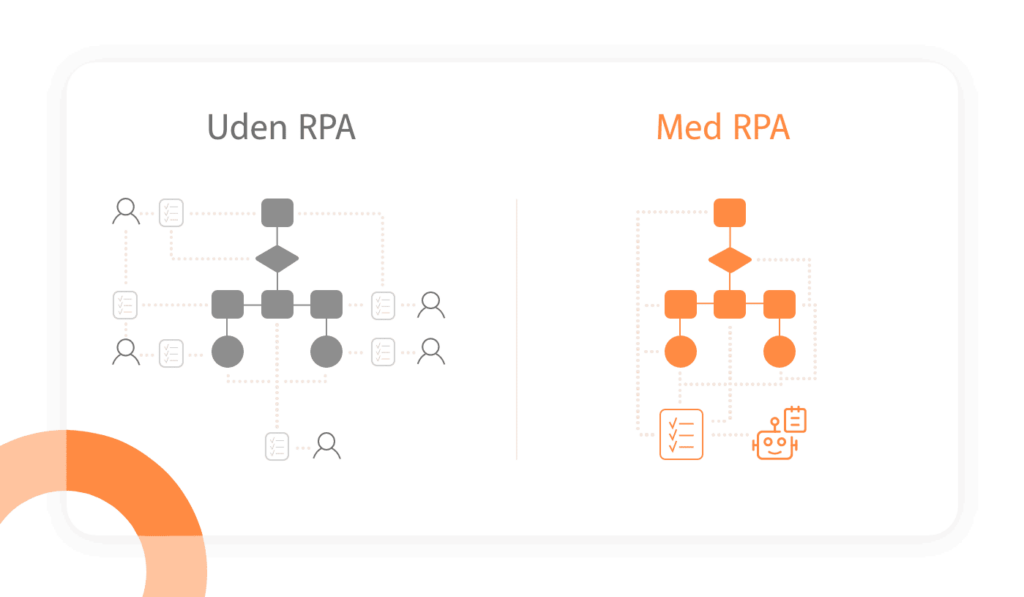
The process for implementing RPA:
1. Analysis, understanding, and clarification of business needs
2. Identification of use cases and definition of success criteria
3. Forecast of potential savings from implementing RPA
4. Development of a pilot project that addresses the highest-priority use case
5. Measurement of results and dialogue about the findings
6. Expansion of the implementation with a new use case. Then repeat from step 2.
Step 1 – What is RPA, and what is it not?
However, implementing RPA can be challenging, and there are no guarantees of success. In the worst case, it can create more challenges than benefits. Therefore, it is important to do thorough preparatory work before you begin. We recommend that, before you start, you have the following in place:
Analysis: Have you analysed which process you need to automate? Are there multiple possible solutions, and what is the specific challenge?
Understanding: An understanding must be established of your specific challenge. An understanding must also be formed of what RPA can help you with, but also what it cannot help you with.
The business need: What is the need in your business that an RPA solution must address for you?
Another thing to remember is that most RPA solutions are not self-learning. If they are, it is because some form of Machine Learning has been implemented, which also makes the RPA investment significantly larger. So it is still the people behind the RPA who are the “brain”. This means that it is the person behind it who can build an effective RPA solution.
Step 2 – Identifying use cases and opportunities
In step 2, you will typically look at identifying which use cases (also called usage patterns) exist. This is done to uncover requirements and create the different scenarios where RPA can improve your business efficiency.
However, you should be aware that once you start seeing the benefits of RPA, the desire to automate everything may arise. BUT this is also where you need to limit yourself, as it is better to start small.
This way, you will achieve the effect faster and can then move on to the next use case. It may also be that you simply want to expand an existing use case because its impact is significant.
Step 3 – Choose the first use case and define success criteria for this RPA
This is the step where you need to limit yourself and select the first use case from your wish list. This is the use case you should focus on initially.
You may benefit from ranking your wish list of use cases according to the following criteria:
1. How much time do you expect to save after implementing the given use case?
2. What is the frequency of performing the task/process?
3. How critical is it to get this solution?
4. What is the investment required to implement this RPA?
This is also the step where you will look at impact targets and define the success criteria that determine whether the RPA implementation is a success.
The success criteria are a useful management tool that can be used throughout the implementation to ensure that your overall goals are achieved as effectively as possible. Here, you will typically be able to review how the above criteria were met.
Step 4 – Developing the pilot project
In this step, the actual development of the pilot project takes place. This is where your supplier begins developing and testing the RPA solution.
In this step, it is important to focus on ensuring that the RPA solution addresses the use case and criteria set out in step 3. By keeping this in mind at all times, you also ensure that your business case remains valid.
When choosing a supplier, it is important that you select one who can also help with the commercial angle of the pilot project. This will help you avoid scope creep, so unnecessary functionality is not developed.
Step 5 – Measuring results and documenting findings
In this step, the pilot project will have been rolled out into operations, and results can now be measured. Based on the well-defined criteria and use case in step 3, these results must be documented so they can be compared against the success criteria. This way, we know whether our impact targets have been achieved, and last but not least to what extent.
Also make sure to document what went well and what could be improved. This is valuable knowledge to bring into the implementation of the next use case.
Compare implementation and maintenance costs against time saved, the current error margin, and the need for human interaction in the process. This will give you insight into the investment itself and your potential ROI.
Step 6 – Implementing a new use case
It is now time to look at implementing a new use case if you are satisfied with the results of your first pilot project. You may benefit from bringing experience from the first implementation so that the implementation of a new RPA solution is optimised.
Here, you will typically revisit the wish list that was previously created. From there, the process will be to repeat the entire process from step 2.