


Digitalization
20. November 2022
What is Google?
Google is a so-called “search engine”, which in practice means it is a website with several million robots trying to find the content you are searching for. Imagine a gigantic archive consisting of everything on the internet, with small robots rushing around trying to match it with the relevant results.
Google is a so-called “search engine”, which in practice means it is a website with several million robots trying to find the content you are searching for.
Imagine a gigantic archive consisting of everything on the internet.
Instead of an angry librarian, the archive is populated by millions of small robots rushing around with words and fragments of sentences and trying to match them with the relevant results.
There are many search engines in the world.
The search function on elgiganten.dk is also a search engine, for example it just searches only within results on Elgiganten’s own website (and anything else would, of course, be pointless).
Google’s search engine works in exactly the same way; it just searches across everything with a broadband connection.
One might be tempted to say that Google has become the nerve centre of our online activity.
What does the word ‘Google’ mean?
There are roughly 400,000,000 websites, each with a vast number of subpages, images, videos, and much more.
Just imagine a website like Fyens.dk, which alone has more than 1 million subpages and Fyens.dk is only one of the 400 million websites on the internet.
If you multiply these numbers together, you suddenly understand why Google was, at the time, an absolute necessity.
Because how on earth would you otherwise be able to find anything among trillions of web pages?
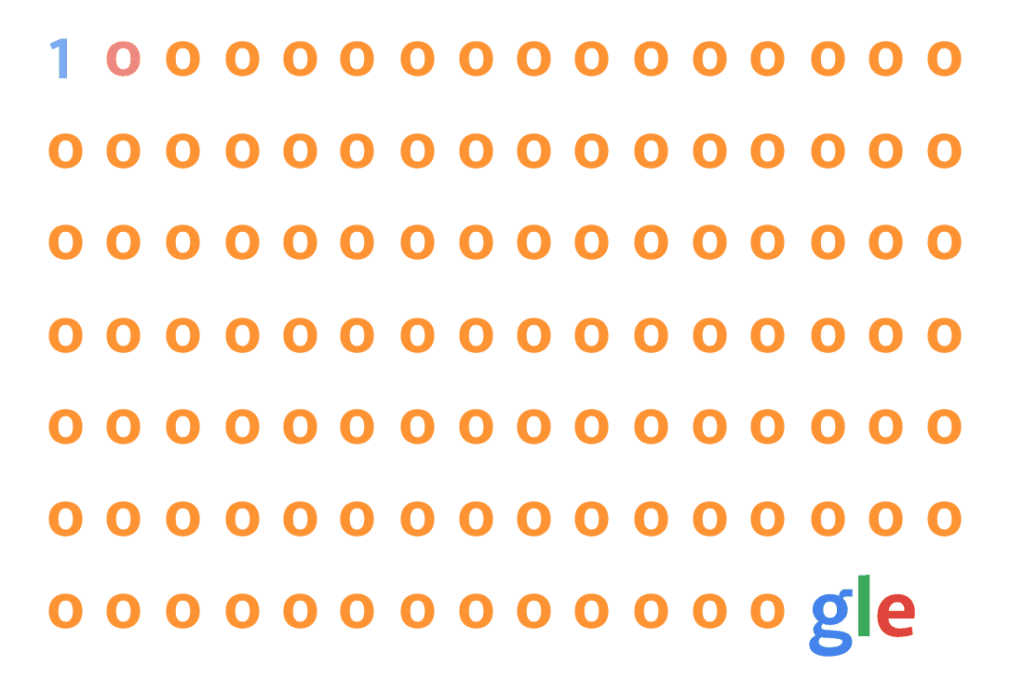
This observation also explains the name “Google”.
Google comes from the word ‘googol’, which is a mathematical term for an astronomically large number with 100 zeros.
The idea behind the name was to illustrate the enormous amount of content Google handles for users.
Bonus info: A googol is actually a number used in practice: It is primarily used in contexts where distances in the universe are calculated.
So how does Google work?
Many have tried to answer this question!
All SEO agencies and experts have an idea, but the truth is that, in reality, we can only make qualified, empirically grounded guesses.
Because Google has never opened up and said: “This is exactly how it works.”
Instead, Google is happy to tell us what its focus is, and from that you can infer and calculate forward or backward how things actually work.
One example is that Google has always said that speed is important. “But how fast should my site be?”, you ask yourself.
If you use Google’s own speed tool, you find that Google calculates a website’s speed based on visiting the site on an old device via a slow 3G connection.
Okay so from that we can infer that your website is fast enough if the experience on a slow 3G connection is reasonable.
In this way, you can work out a wide range of the metrics Google cares about.
In short, you could also say that Google works like this:
Google matches the search term with the web pages that, from a linguistic perspective, resemble it the most. It then ranks the results found in an order based on a number of factors: ✅ How easy is the website to understand?
✅ Is there a lot of traffic on the site in general?
✅ Is this a popular result for others?
✅ Does the page resemble something you would personally click on?
✅ Does the website seem trustworthy, and do others recommend the website in question?
and many other metrics.
So Google simply does not spend most of its time finding the results.
That part is easy enough.
It is simply a matter of whether the search term appears on the website.
The difficult part and what takes Google the most time is understanding how the results should be prioritised and ranked relative to one another.
Are there other major search engines besides Google?
Yes, there are countless search engines.
But the fact that people talk about “to Google” tells us everything we need to know about that.
Google holds roughly 95 percent of the market, and all other search engines are merely trying to copy Google, because it is and remains the search engine that has come the furthest with its project.
Microsoft’s search engine, Bing, comes in a respectable second place globally. But even they have shown their hand as the smaller challenger. In Bing’s advertising tool, they have literally chosen to include an “import from Google Ads” feature.

Why is Google’s search engine so much better?
Another good question.
And the answer is actually extremely simple: DATA!
Google simply has access to more data than its competitors, and it has incorporated it brilliantly into its search engine.
Over the years, Google has developed a huge number of new products, many of which are completely free to use.
Most people know tools such as:
- Google Analytics
- Gmail
- Google Ads
- Google Maps
- Google Chrome
- Google Tag Manager
- Android
- *add more here yourself*
All these tools are free, but as a wise man once said: “If something is free, it is because you are the product.”
That applies here as well.
Because when we use these tools, we give Google access to understand what we do across the internet. As long as you are logged in to your Gmail, you have actually allowed Google to jump on your back and follow you everywhere.
The same applies to Google Chrome.
When you use Chrome as your web browser, Google can see exactly how you use the internet.
And with Google Analytics, Google gains access to see whether your company’s website is relevant to users. This happens by collecting information about whether visitors stay on the page, what they look at and for how long. Do visitors put something in the basket in the webshop, do they buy something, etc.
It may all sound frightening, but something good comes out of it too.
Because Google knows you so well, you also get help finding the very best content on the internet and the search results are served in a way that is specially tailored to YOU!
So Google has access to all information about you and what you would like to see.
Competitors largely do not and how could they possibly compete with all that information?
This turned into a longer piece, but that is just how I am. 😊
If you take one thing away from this, let it be a stronger understanding of why Google is such a central part of our digital user journey.
Without Google, you would have to spend hours on the internet to find the perfect recipe for raspberry slices.
P.S. Here it is right here.