

Lead generation
2. September 2022
5 common mistakes to avoid in your Facebook advertising
In this post, we outline the 5 most common mistakes we find our customers have previously made in their Facebook advertising.
You should avoid the following 5 mistakes when working with your Facebook advertising:
- You are wasting your money with the Boost button
- Overly broad targeting delivers poor audiences
- Do not use “Interests” Facebook does not know what people are interested in
- Generic re-engagement campaigns are ignored by users
- Never advertise on Facebook without a clear objective
We elaborate on each point below.
1. The Boost button is money down the drain
It can be tempting to hit the Boost button when Facebook says you can reach many more people with just a few clicks. The truth, however, is that while your post will be shown to more people, the Boost button only offers a fraction of the features available in Facebook’s real advertising tool, Ads Manager.
In other words: When you use the Boost button, you have little to no control over who sees your ads and how your ad spend is used.
In Ads Manager, you can instead:
- Choose ad placements
- Choose start and end dates
- Choose ad formats
- Choose an optimization objective (i.e., what Facebook should focus on getting you the most of within your budget)
- Create detailed audiences, e.g., previous visitors to your Instagram profile, etc.
Most importantly, you get data on your campaign’s performance, so you know how to reallocate your budget to get the most out of your efforts.
In short: Stay well away from the Boost button it is nothing more than a crippled version of Ads Manager.
2. Broad audiences are poor audiences
It is perfectly natural to want your campaign to reach as many people as possible (who wouldn’t). But when you create audiences that are too broad, you spread your budget so thin that you get nothing for your money.
For example, targeting men and women aged 18–65+ across all of Denmark. That is far, far too broad, and you have no chance of knowing which parts of the audience perform better than others.
Instead, you should split your audience into smaller segments and prioritise the most relevant ones to begin with. Facebook has a lot of interesting demographic data, such as:
- Marital status
- Job title
- Education
- Number of children
- Life events such as engagement and wedding, etc.
Why not leverage the data and take a focused approach? For example, if you sell children’s clothing in sizes 0–10 years, one audience could be women aged 28–48 with children aged 1–12. If you are a local business selling to local customers, it would also make sense to target your immediate geographic area.
Then, when you see that the current segments start to become exhausted or perform poorly, or you are allocated more ad spend for your efforts, you can move on to the next ones on the list and continue with them.
3. Facebook cannot use “Interests” properly
Imagine you are a company that sells video games, and you want to advertise to all Facebook users who are interested in gaming. In that case, Facebook does not know who is most relevant for your ad:
The young man who is active in every gaming-related group and follows all the major game developers
or
the middle-aged woman who has Candy Crush installed on her phone.
Therefore, avoid using “Interests” to define your audience Facebook cannot determine what is a genuine interest based on users’ activities.
Instead, use data-based attributes to define your audience, e.g., age, education, job title, etc., as these are based on facts, not guesses.
4. Generic re-engagement campaigns are ignored
An evergreen, obvious audience is people who have already visited your website. They have already shown interest in you by visiting your website so why not try to reach them and get them to do more?
However, when you run a re-engagement campaign, it must not be a carbon copy of what people see on your website. The audience has already seen that content. Instead, you need to give them something new or different information in your ads to get them off their chairs.
Discounts, whitepapers, USPs, FOMO (fear of missing out) are strong incentives to get previous visitors to engage with you again.
5. Never advertise on Facebook without an objective
Only run ads on Facebook if you know what you want to achieve otherwise it is a waste of both time and money.
Ask yourself: “Why am I advertising on Facebook?“
If the answer is that it is because your competitors do it, or because it is just something you do, then pause and get your objectives in order before you throw far too much money into a black hole.
In addition, it is an advantage if, in your considerations, you do not only think in terms of visibility, traffic, conversions, etc. in the short term and as isolated activities.
Because you can use Facebook to create a longer automated flow where you expose your audience to different ads, offers, content, etc., depending on how and how much they have interacted with your channels and your content so far.
Below is a sketch of what such a flow could look like. Click the image to view it in full size.
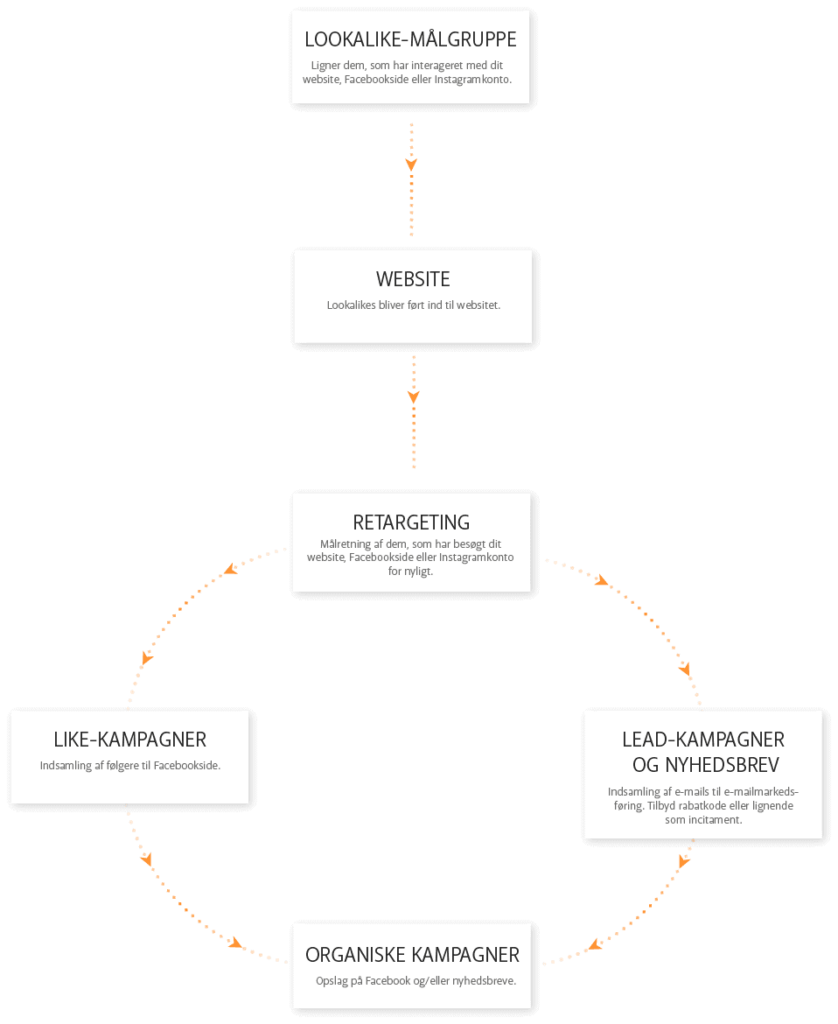
Facebook is actually a fairly sophisticated tool when it comes to marketing automation, so feel free to incorporate your Facebook campaigns into a broader, holistic effort that involves both paid and organic marketing.
I hope you can use the advice to create even sharper Facebook campaigns.