


Digitalization
13. November 2025
Backend vs. Frontend
Backend vs. frontend may sound technical, but the difference is crucial to whether your digital solution both feels great to use and works behind the scenes. The frontend is the user experience in the browser, while the backend is the logic and systems that handle data and processes behind it and both are necessary for…
Content
The difference in brief Frontend development HTML CSS JavaScript Backend development Example of backend Programming language Full-stack developmentBoth terms are English loanwords that refer to the “code world” (everything online). The difference between the two is that:
- a frontend developer works on the part of a digital solution that runs on users’ devices and that they interact with
- while a backend developer works with everything that happens on a server or in a database i.e., the infrastructure and functions that sit behind it.
Frontend and backend in brief
“Frontend” = The layer your users meet: design, buttons, forms, and the entire experience in the browser. Everything you see.
“Backend” = The engine behind it: data, logic, integrations, and automation of manual processes. Everything you do not see.
What is frontend development?
A frontend developer is most often focused on the user interface (UI) and the user experience (UX) in other words, what the solution looks like overall and what it is like to interact with.
Frontend development takes place in users’ web browser, which is also called ‘client-side’.
Frontend development happens using a combination of these primary technologies:
- HTML (Hypertext Markup Language)
- CSS (Cascading Style Sheets)
- JavaScript
HTML
This technology gives the frontend developer the ability to build visual elements and overall functionality. In HTML, you define web pages and other information that can be displayed in a web browser (e.g., images, text, links, and more).
HTML is the foundation your web solutions are built on the better you understand this top-level layer, the easier it is to assess the quality of the work you receive.
HTML is almost always used in combination with CSS and JavaScript so the solution does not feel flat and boring to interact with. HTML only defines “what is” and “what exists,” but not how things feel to interact with, how elements behave in relation to each other, or how things should look on different devices (responsive).
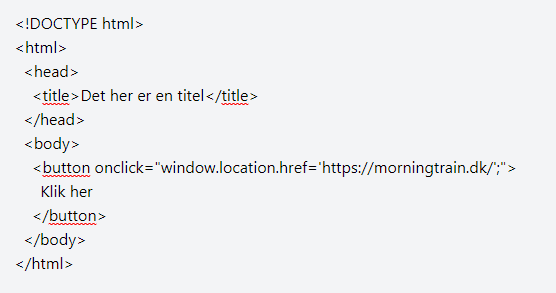
Example of HTML code for a button:
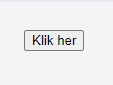
Result:
CSS
With this technology, frontend developers can define what a solution looks like and what it feels like to interact with it.
CSS is a web solution’s “stylesheet,” meaning this is where a developer defines and describes how the elements written in HTML should present themselves. HTML looks the same across all solutions on its own; CSS is what makes your website look different from others.
Without CSS, all solutions would look the same and boring
In other words, CSS allows a frontend developer to control the visual appearance of the web solution.
CSS is also where developers define how responsive a solution should be.
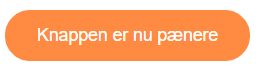
Continuation of the button example, now with CSS attached:
JavaScript
This is a complex programming language used to build interactive and dynamic elements in web solutions, such as animations, pop-ups, and digital “feedback” to the user.
A frontend developer primarily uses JavaScript toadd interactive elements to a solution in other words, everything you can interact with as you move around a website.
JavaScript is the only one of the three technologies that can be used both to define the frontend (things defined in the user’s web browser) and to build backend functions (things defined on a server).
The button now (also) with JavaScript:
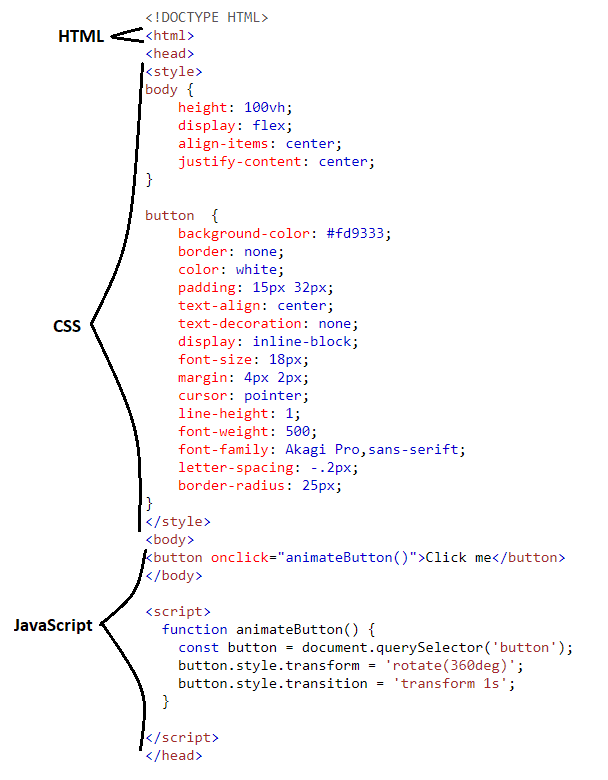
Final result:

DISCLAIMER
If a developer is reading along, I am well aware that it is not best practice to write all the code ‘inline’, but that you would normally just reference the CSS and JavaScript files in the HTML. The example above is only to make the example visually easier to understand.
What is backend development?
A backend developer primarily focuses on everything that happens ‘server-side’, where they work on building the connection that delivers data to a web solution when it is requested.
Let me give an example of everything a backend developer builds
Imagine you are shopping in an online shop. Most of what you interact with is built by the frontend developers. But the content and products shown on your screen are actually sent from the database or a server to the frontend, where all content is managed from.
That means that without the backend developer, you would not be able to see any content or products at all, because they would not be loaded into the interface you are using.
But the backend developer is not done…
Because when you add an item to the cart and complete your purchase, information is sent to external finance and inventory management systems that also run on a server. This is where your information and your order are processed.
None of this would happen if a backend developer had not been involved.
It is also in the backend that a wide range of manual processes are automated by building a system or an integration between systems that handles a given process automatically. This is also called RPA (Robotic Process Automation).
There are many programming languages for coding backend applications, including:
- Ruby on Rails
- Java
- C++
- C#
- Python
- PHP
What determines the choice of programming language for a backend task?
In reality, you can set up a server in whatever programming language you want. In other words, programming languages are not something you “choose” as such but when a backend developer chooses a language, it is most often about what needs to be developed.
3 programming languages we would like to highlight:
C#
PHP
JavaScript
… But what about full-stack development?
When talking about frontend and backend, the concept of full-stack often appears as a third variant. While frontend and backend developers typically have their primary focus in one place in the solution, a full-stack developer works across both layers in the same project. This means they can help shape both the user experience and the technical logic and data handling behind it.
Our view on full-stack
At Morningtrain, we deliver full-stack web solutions, but we do not believe in the idea of the classic “full-stack developer” who is equally strong at everything.
We see that the best developers either lean towards frontend or backend and that the best solutions emerge when specialists bring out the best in each other, rather than one person having to do it all.
In practice, a full-stack profile often makes sense in smaller solutions or early phases, where there is a need to move relatively quickly from idea to working product. In larger and more complex projects, you more often choose a team where frontend and backend specialists work together on the solution.
The short explanation
Ultimately, everything you look at online ends up as HTML in your browser. On the server, the backend assembles the HTML page you need to see based on data and logic, and thus determines what should be displayed. The page is then sent to your device. In the browser, the page is “rendered”, and this is where the frontend code controls how the content is presented i.e., structure, appearance, and how you can interact with it.
So the better you understand the difference between frontend and backend, the easier it becomes both to have your website built correctly and to manage it day to day.