


Lead generation
3. March 2021
Customer Lifetime Value (CLV): How to use it in your sales work
Customer Lifetime Value (CLV) is the cumulative value of a customer to your business over the entire period that customers, on average, remain with your company. Looking at this value—rather than order by order or year by year—changes how you view your efforts to acquire new customers.
Content
Why should you care Customer value Old calculation method New calculation method How you do it CLV and investment Get startedWhy is CLV worth knowing?
In short, your competitors will win the battle for new customers if you do not truly know how much you should invest to bring in new customers.
Whether you are B2B or B2C, your customers are, with 98% certainty, worth far more in total than the revenue from the first order they place (which many unfortunately use as a benchmark for what a new customer is worth).
After reading this blog post, you will have a clear understanding and a guideline for how to calculate an accurate lead cost for a new customer. Let us take a closer look.

Yes, yes, that is all very well – but what is a new customer actually worth?
All good merchants know that you “buy the customer” at the beginning of a new customer relationship. That can be a costly affair. There are specific acquisition costs in the form of advertising budget, staff costs in sales and marketing, possibly a free trial period, and so on. Only the very best merchants know that acquiring a customer should cost no more than around 30% of the revenue you receive from them.
And that is where CLV comes into the picture. Because if you play your cards right in a customer relationship, the customer will come back. Or put another way:
If the customer does not come back, you have probably not played your cards very well.
But if the customer is happy, she may place another order with you—and it continues until it becomes clear that the customer is worth far more than the first order of DKK 3,000. Suddenly, the customer may be closer to DKK 15,000 in value.
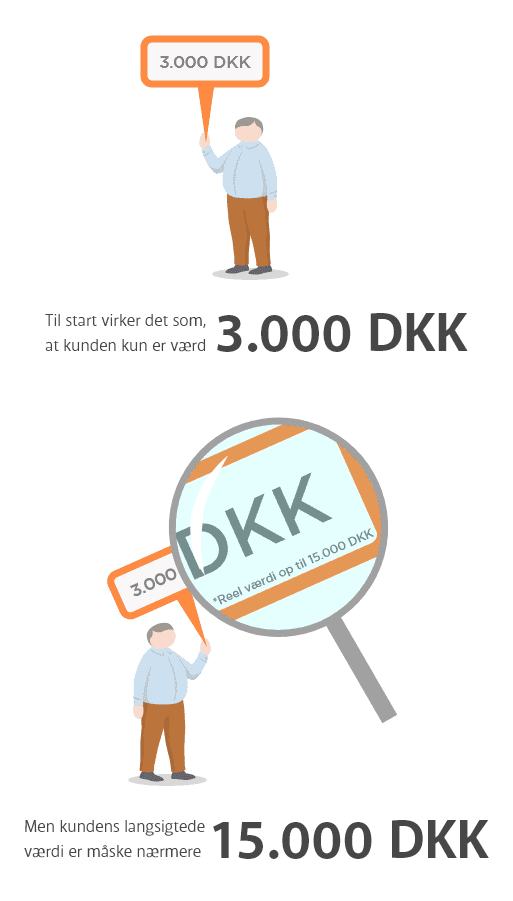
Therefore, you should be willing to invest more to acquire the customer in the first place. Remember that you should be willing to pay an acquisition cost equal to 30% of the customer’s CLV to get them on board.
Okay, you have my interest – but I still do not understand it?
Yes, we need to put some numbers on the table, otherwise it becomes too vague. Below, I have created a running example for the rest of the walkthrough.
For the sake of simplicity, I have chosen an industry we all know and one that would be very wise to know its customers’ CLV: the hairdressing industry
The fictional hair salon Morninghair is a women’s salon centrally located in Odense. The calculations below illustrate the business.
Old calculation of a customer’s value
- Morninghair has an average order value of DKK 650.
- Since you should be willing to invest 30% of the potential customer revenue to acquire the customer, Morninghair is willing to invest DKK 195 per customer acquisition in marketing, sales, and other order-handling costs.
- Morninghair has a lead conversion rate of 40%, which means that 4 out of 10 enquiries lead to an actual customer relationship.
- This means that a lead may cost a maximum of DKK 78 (DKK 195 * 0.4 conversion rate).
So there are not many advertising kroner you can throw out the window before it is no longer profitable. But, but, but … this equation does not provide an accurate picture of reality at all.
Because the reality is that the majority if not 100% of all businesses live off “recurring” sales, i.e., customers who return and buy again.
Morninghair has only priced a lead based on the average order value. They have not looked at the statistics for what recurring sales bring them. Subconsciously, they know it is about keeping the customer for longer, but they have never calculated their customers’ CLV.
New calculation of the customer’s value (thinking in CLV)
One day, Morninghair’s owner decides to look at the total value of existing and returning customers.
It turns out that customers’ first order has, on average, only accounted for 9% of their CLV i.e., the value of the total number of orders the customer has placed over their “lifetime”.
This means that the full CLV value of an average new customer is not only worth DKK 650 but DKK 7,200 (see the full calculation a little further down).
Therefore, Morninghair should be willing to pay as much as DKK 864 for an average new customer lead, and not just DKK 78. (see that calculation a little further down as well).
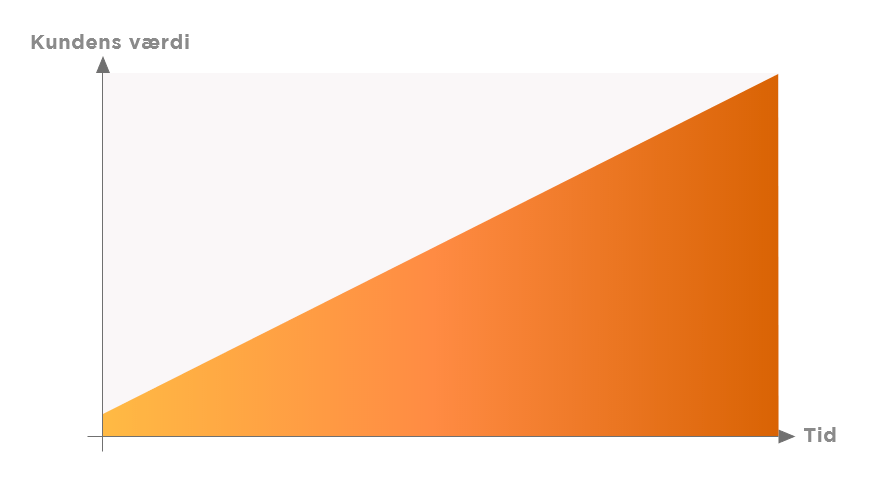
Suddenly, there is a significantly greater incentive and room to increase marketing and other investments to bring more customers into the shop.
How to calculate CLV for your customers
- First and foremost, you need to calculate your churn rate. Churn rate sounds fancy, but it is simply the term for the percentage loss of customers over a given period.
Your churn rate is calculated as follows:
First, find out how large your customer base is at the beginning of the year. In Morninghair’s case, there were 1,000 customers at the start of the period. By the end of the year, 600 new customers had joined. However, there were 400 customers who had not been there during the year and are therefore lost. Example: 400/(1000+600)X100= Morninghair’s churn rate is 25%
This means that the average customer lifetime is 4 years (1/0.25) = 4 years.
- Next, you need to know the annual revenue per customer.
Example
Morninghair generates annual revenue of DKK 2,160,000 and has 1,200 customers at year-end. Thus, DKK 2,160,000/1,200 customers = DKK 1,800 in revenue per customer per year.
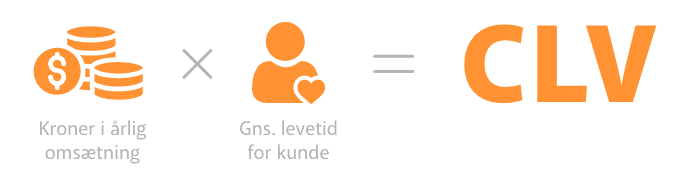
Now you know what a customer’s CLV actually is. You take the average annual revenue per customer and multiply it by the average lifetime, which was 4 years = DKK 1,800 * 4 years = DKK 7,200 CLV.
And this is how you calculate exactly what you should invest to bring in new customers
- Now that you know your average customer is worth DKK 7,200, you can calculate the maximum you should invest to bring in new customers based on existing customers’ lifetime value if you want to stick to the rule of thumb that you should only invest 30% of the customer’s revenue value.
Example: Morninghair’s CLV for a customer is DKK 7,200 so Morninghair should only spend DKK 2,160 to bring in a new customer (7,200 * 0.30) = DKK 2,160.
- The final addition is that you must also factor in that not all efforts to bring in new customers bear fruit. You need to know your “conversion rate” in your sales work (i.e., how many do you end up closing as customers for every 10 leads?)
You must multiply this factor by the value above, which you may spend per customer.
Example: Morninghair could, in principle, spend DKK 2,160 to bring in a new lead, but Morninghair does not make an agreement with all new leads they only make agreements with 40% of their leads.
This must be included in what they can actually pay for each new lead.
DKK 2,160 * 0.4 conversion rate = DKK 864 per new lead

Get started chasing customers at the right price
Now you have the formula and well done for making it through!
It is not easy, and not all data is equally easy to access. Certainly not all businesses can readily find the information above, as it requires an up-to-date customer database, etc.
However, with the following tips you can still get started sensibly and pay a competitive price for your new customers:
- I = Make a qualified estimate of the average annual revenue per customer (e.g., DKK 5,000)
- P = Make a qualified, conservative estimate of the average customer lifetime (e.g., 3 years)
- G = Make a qualified, conservative estimate of your close rate on new leads (e.g., 25%)
- L = Multiply the three numbers together, and finally multiply by the 30% rule of thumb
DKK 5,000 revenue * 3-year lifetime * 0.25 conversion rate * 0.3 rule of thumb = DKK 1,125 per lead
I * P * G * L = investment per average lead
I hope this walkthrough made sense and has given you tools to acquire leads for your business in a profitable way.