


Digitalization
6. November 2025
What is Design Thinking?
Design Thinking is a user-centred process. You talk to users, clarify needs, try out ideas, and learn from the results. The goal is to arrive at a solution that makes sense for both users and the business—without guessing.
Content
What is Design Thinking? Intro to phases Phase 1: Empathy Phase 2: Definition Phase 3: Idea generation Phase 4: Prototyping Phase 5: Testing How do you do it? Why do it? Who should use it?Design Thinking is a structured approach to innovation that combines the context of a problem with creativity in generating solutions, in order to find the most suitable solution.
The purpose of the method is to create user-friendly solutions by focusing on the real underlying problem from multiple angles.
Design Thinking is an iterative process that can be used by anyone (regardless of professional background) to solve challenges creatively.
This also means that when we say “design”, we mean “create”, “develop”, “define” ish.
The phases of Design Thinking
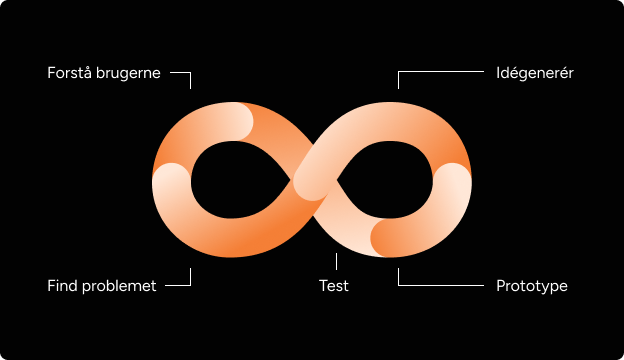
Design Thinking typically consists of five phases:
- Empathy
- Definition
- Ideation
- Prototyping
- and Testing
This is not necessarily a linear process you can jump back to earlier phases based on what you learn along the way.
Phase 1: Empathy
The first phase of the Design Thinking process is about understanding the people you are designing a solution for. This involves empathetic listening and observation to find out what truly matters to them.
In this phase, it is important to distinguish between those who have the challenge and those who may only be involved in it.
For example, some people in the company may want customers to change their behaviour, but it is the customers’ needs that must be examined directly.
In this phase, you should aim to understand:
- “What is it, really, that these people want solved? They say they want a specific behaviour—but why? What does it give them?”
The desired action is often a symptom of a deeper need. - “Why does the target group/customers do what they do?”
Useful methods in the empathy phase
Phase 2: Definition
In this phase, you gather all the insights you gained in the empathy phase and use them to define the real problem you want to solve. This is where you begin to ask the right questions to address the underlying issue.
Useful methods in the definition phase
Phase 3: Ideation
Now that you have a clear understanding of the problem, it is time to start generating ideas. The goal is to get as many ideas as possible, so be careful not to limit this phase.
Be aware of your biases about what a solution is, and challenge them continuously.
It is tempting to be biased about what the solution is, but ultimately you should test multiple things so you can compare the results.
Useful methods in the ideation phase
Phase 4: Prototyping
In this phase, you create/build/generate the simplest version of your idea (a so-called MVP) so you can put it in the hands of the target group.
Useful methods for prototyping
Read how to identify and prioritise features for your MVP here.
Phase 5: Testing
Finally, it is time to test your prototypes. This involves getting feedback from users and learning from their reactions. Based on this feedback, you can adjust your solutions and test them again.
Useful methods for testing
So how do you use Design Thinking?
Design Thinking is a method that can be applied across a wide range of contexts and industries. It is an approach that requires the courage to challenge what exists and to be open to new insights.
Here are some steps (based on the phases above) you can follow when applying Design Thinking:
- Understand the context: Explore the context and the users to gain a deeper understanding of the problem.
- Define the challenge: Use your observations to define the real problem.
- Generate ideas: Brainstorm and come up with as many solutions as possible.
- Build prototypes: Create a physical representation of your ideas.
- Test and refine: Test your ideas and use feedback to improve your solutions.
What do you gain from this approach?
Design Thinking gives you a structured process for thinking creatively and solving problems in a user-friendly way, while also quickly testing hypotheses and solution proposals.
In other words, you move quickly from problem to hypothesis and then on to testing the solution.
The approach helps you focus on the user’s needs and create solutions that truly make a real difference.
In addition, it is an approach that promotes innovation capability and can improve your company’s results already in the short to medium term.
Who should consider using the principles of Design Thinking?
The simple answer is everyone who wants to solve a problem. 😉
Design Thinking is relevant for anyone who wants to solve complex problems in an effective and user-friendly way.
However, if we are to highlight areas where Design Thinking is particularly applicable, it would be: professionals in fields such as product development, service design, and business development.
In short, Design Thinking can be a useful method to apply if you are facing a complex problem where the solution is not obvious, or if you want to create a user-friendly solution.

Written by






Do not hesitate – we are always ready for a chat
Let’s talk about your design project
Let’s go into the details together so we can find the solutions that fit your needs.