


Lead generation
8. November 2024
When should you work with lead scoring and lead tracking?
Lead scoring and lead tracking are primarily relevant for B2B companies and B2C service businesses with a significant average order value or a high lifetime value.

Content
Who should read this Leadscoring Benefits Implementation Leadtracking Feedback Conversion values ToolsIf your products or services are priced above DKK 10,000+, implementing lead scoring and lead tracking can be valuable. It helps ensure you prioritise your resources and focus on the most promising leads with the potential to generate the highest revenue.
Lead scoring and lead tracking are two tools that can help you optimise the return from your lead generation and sales process.
Who should read this post?
This post is definitely not relevant for everyone. In my view, a few things need to be in place before it provides value.
- You work in a B2B or B2C company where you deal with sales opportunities and lead generation.
- You experience a volume of enquiries, but 50–80% of them are irrelevant—existing customers needing support, grandmothers calling the wrong number, bots, or salespeople trying to sell you their…
- Your customers are worth at least DKK 10,000 or have a high customer lifetime value.
- At least 1,000 visitors to your website per month.
- You have a sales department/owner/responsible resource that handles enquiries.
If you can tick off these 5 parameters, you should read on.

A bit about lead scoring
Lead scoring is a method for ranking and qualifying leads based on their likelihood of converting into a paying customer. This is done using a points system, where each lead is assigned points based on various criteria. The higher the score, the better the chance that the lead will become a customer.
“Lead scoring is a systematic way to identify the most promising leads, so sales and marketing teams can focus their time and resources on the most profitable leads.”
The idea behind lead scoring is to increase the number of potential opportunities a sales team can handle by nurturing the target audience through a flow of events, where they move from being an MQL (Marketing Qualified Lead) a lead handled by the marketing department to being an SQL (Sales Qualified Lead), a lead that should be handled by the sales department.
In the SaaS world, there are many factors that can be used to create a 0–100 score and filter out leads that are not worth spending time on.
These factors can include the number of trials, user behaviour, engagement with your product, and much more. By implementing an effective lead scoring and lead tracking strategy, you can ensure your sales teams focus their time and resources on the most promising leads.
The benefits of lead scoring
- Improves efficiency:
By focusing on the most promising leads, sales and marketing teams can save time and resources. - Increases the conversion rate:
Leads with a high score are more likely to become customers, increasing the conversion rate. - Improves customer satisfaction:
By targeting the right leads, companies can ensure they offer the right products and services to the right customers.
Example of a lead scoring model:
# Example of a lead scoring model
def score_lead(lead):
score = 0
if lead[‘har_interageret_med_websted’] == ‘Ja’:
score += 10
if lead[‘har_downloadet_content’] == ‘Ja’:
score += 20
return score
How do you implement lead scoring?
Implementing lead scoring requires an in-depth understanding of your company’s target audience and sales process. Here are some steps you can follow:
Step 1: Define your criteria
Define the criteria that will count towards a lead’s score. These can include demographic data, behavioural patterns, interactions with your company, and more. For example, if someone has visited your website multiple times, it may be a sign of interest and therefore contribute to a higher score.
Step 2: Assign points
Assign points to each criterion based on its importance. For example, if you believe that someone who has downloaded an e-book from your website is more likely to become a customer than someone who has only visited your website, you can assign more points to the first criterion.
Step 3: Test and adjust
After you have implemented your lead scoring model, it is important to test it and adjust it as needed. It may be necessary to adjust the point allocation or add new criteria based on the results.
And a bit about lead tracking
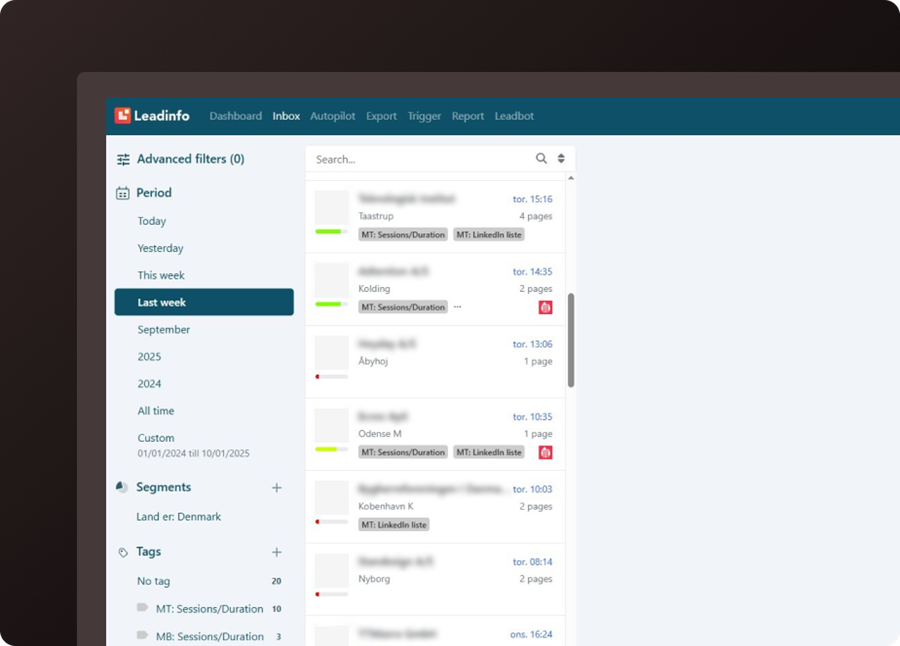
Lead tracking is the process of following and monitoring leads throughout the entire customer journey. It involves tracking their behaviour, engagement, and interaction with your brand to identify potential sales opportunities.
One of the primary reasons to work with lead tracking is to qualify your leads and separate the wheat from the chaff.
It is important to filter out irrelevant enquiries and ensure that your strategy and bidding are not based on leads that have zero value.
Important feedback for the marketing department
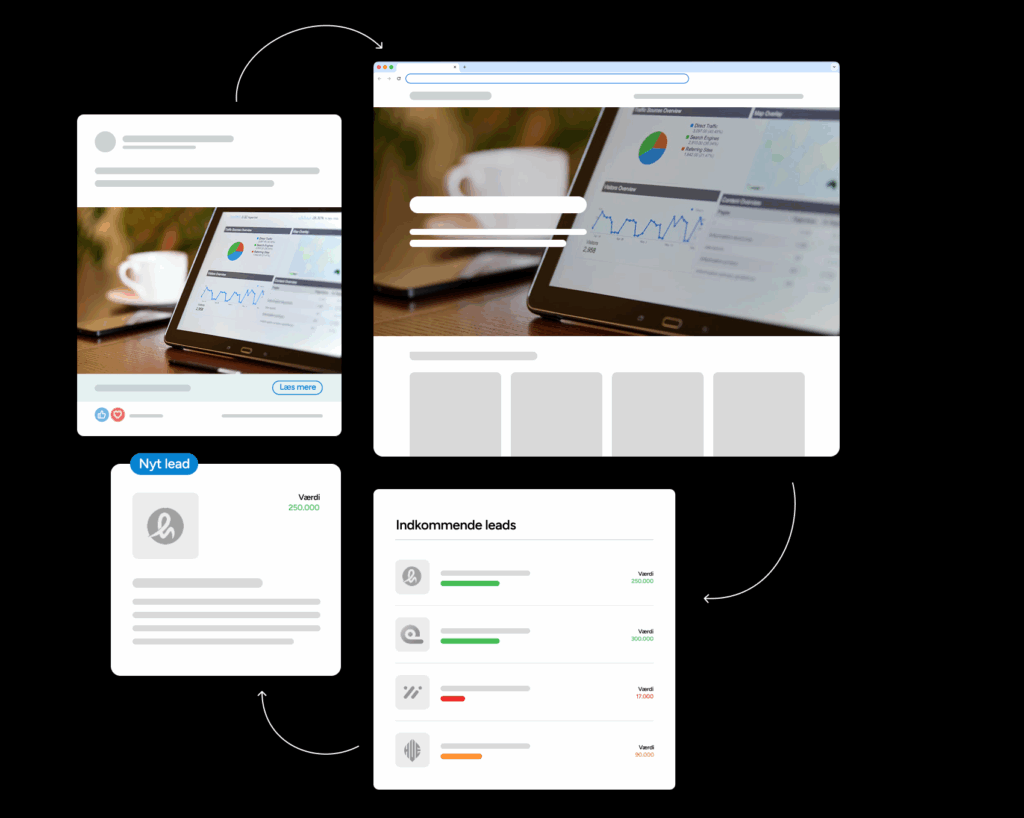
Once you start tracking the customer journey behind the relevant leads, you will quickly discover that it was not a single channel or a single effort that generated all the results, but rather a combination of several factors.
When you can inform the marketing department about which leads are particularly interesting, they can trace back to identify where those leads came from and what their journey looked like what channels, ads, blog posts, cases, etc. the person visited first.
The marketing department can use this information to optimise their efforts and increase the likelihood of generating more relevant leads. For example, if many qualified opportunities end their journey on the “cases” page, it may indicate that marketing should prioritise this page more highly and perhaps increase its visibility on social media.
Good tip: Assign value to your leads
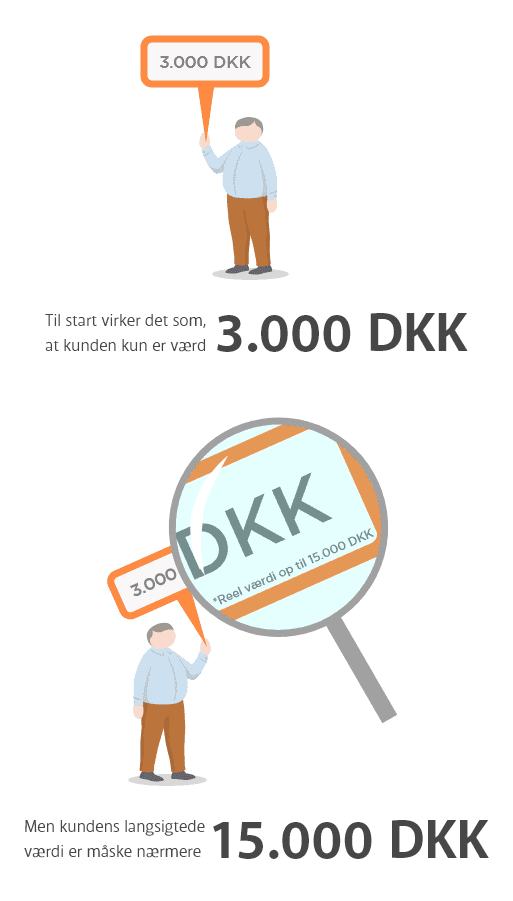
If you run a smaller business or do not receive that many enquiries, it may be more relevant to focus on quantifying the value of the different enquiries.
This can be done by estimating what a customer is worth to you in terms of lifetime value and sales odds. This may be more relevant for companies that want to identify which leads are worth spending time and resources on contacting.
Formula:
Avg. new customer value = DKK 150,000
Conversion rate from SQL to customer = 35%
Conversion rate from MQL to SQL = 20%
DKK 150,000 in customer value x 0.2 x 0.35 = DKK 10,500.
In the above case, an average enquiry is worth DKK 10,500.
This is an acceptable indication, but it is very generalised and does not account for the fact that a phone call often has a higher value than simply downloading a product sheet or brochure.
Distribute your valuation per touchpoint
For those of you who want to take lead tracking extra seriously, I recommend assigning an individual value to your touchpoints, depending on how qualified the leads are and what the conversion rate is at each touchpoint.
Below is an example based on the example above:
- Phone call [SQL] = DKK 52,500 (DKK 150,000 x 0.35)
- Contact form submission [SQL] = DKK 22,500 (DKK 150,000 x 0.15
- Demo booking [MQL] = DKK 15,750 (DKK 150,000 x 0.35 x 0.3)
- Direct contact to main email [SQL] = DKK 7,500 (DKK 150,000 x 0.05)
- Material download [MQL] = DKK 1,575 (DKK 150,000 x 0.35 x 0.03)
The above is pulled out of thin air, but it provides a good visualisation of the outcome you want to achieve. Some touchpoints will be significantly more valuable than others.
For example, making a phone call is a major commitment, and therefore the people who do so are often more reserved and have a higher likelihood of being selected, compared to those who have downloaded material, where they first need to convert to an MQL and then perhaps convert into an enquiry.
It is important to emphasise that the above should not be interpreted as meaning you should not value lower-value touchpoints. These touchpoints can still be an important part of the customer journey and help generate the high-value leads.
My view on lead scoring and lead tracking
Lead scoring and lead tracking are not a miracle solution, but when used correctly, they can be a brilliant way to optimise your sales process.
It is important to understand that it is not a cure-all, and it can be foolish to use it as a quick fix if you are already experiencing a lack of good leads or volume.
Instead, lead scoring and lead tracking should be used as tools to identify strengths and weaknesses in your marketing channels, events, and other sales-promoting activities.
Not for everyone
Lead tracking makes sense if you receive at least a few qualified enquiries that are very valuable to you. That way, you know what you are chasing. If you start with 0 enquiries, you have no data to work with, and you therefore cannot actually practise lead tracking.
Lead scoring is only a good tool if you have the above under control and want to increase the number of leads by leveraging the potential of existing website traffic. You do this by further qualifying some of the potential companies that have not previously contacted you.
If you have no traffic and no leads, using lead scoring is like firing cannons blindfolded. Start somewhere else.
How can you achieve a good setup?
A good lead scoring and lead tracking setup depends on your company’s specific needs and goals. It may include the following:
- Using other relevant methods or approaches that fit your specific goals and needs.
- Prioritising the right customers to avoid overfilled calendars and wasted time.
- Cleaning your database to ensure you only work with qualified leads.
- Identifying the 2–3 customers with the potential to carry the whole load and generate significant revenue.
Which tools can you use?
There are many tools that can help you implement and optimise your lead scoring and lead tracking processes. Some of the most popular tools include:
- Dreamdata: A tool for companies with large budgets that want deep insights into their sales and marketing effectiveness.
- Morningtrack (damn this is popular 😉): A tool that can help you quantify the value of your leads and estimate their lifetime value.
- Hubspot: A versatile tool that offers automation and email flows to automate and optimise your sales process.
- Salesforce: A powerful tool that is ideal for larger companies and sales organisations with complex needs.