


Lead generation
21. August 2021
Do not let ROAS hold your business back
If you push your marketing agency too hard on ROAS alone, you will miss out on a great deal of business. The easiest way to achieve a high ROAS is to turn off everything with a lower ROAS, but that limits volume—and therefore also your potential in the aftermarket.
Content
Brief Use KPIs correctly Profit vs. volume Price per. new customer Let your ROAS fall ConclusionenThe headline only mentions ROAS, but this blog post is about how all “qualitative” KPIs can put you at risk of holding your business back.
These could be KPIs such as:
- POAS (Profit on ad spend) – How much profit you get per krone invested.
- ROAS (Return on ad spend) – How much revenue you get per advertising krone spent.
- ROI (Return on investment) – How much revenue you get back from an investment.
- CPA (Cost per acquisition) – The acquisition cost per lead.
- CAC (Customer acquisition cost) – The acquisition cost per customer.
In this blog post, I will take you through some of the maths and the logic behind why these metrics can be toxic to your business.
Use your KPIs correctly
I have previously written on the blog about how you should select and use KPIs. Here, I explain how qualitative metrics provide no value without quantitative metrics and vice versa.
The point is that it is meaningless to say you have made your money back x times if you are not also looking at the volume of the case.
This is the first challenge I see with a ROAS focus. Read more about this here.
Profitability vs. volume
The challenge is that by focusing ONLY on the qualitative, you remove the scaling potential from a business case entirely. If you are fixated on getting your money back 16 times over, you eliminate enormous market potential.
Quite a few marketers have completely misunderstood revenue vs. sales volume. So let me make one thing crystal clear:
There is no world in which you can scale a business case indefinitely and maintain your ROI, CPA, ROAS, etc. Not at all.
So if, as of today, you have a case where you get 30 leads per month at a CPA of DKK 1,200 each, you cannot simply increase it to 50 leads per month at the same CPA.
You will most likely have to accept that your CPA increases slightly (i.e., leads become a bit more expensive).
Why is that?
I am glad you asked because that is exactly what we will cover now.
Pricing the purchase of a customer
To understand why your profitability declines as your volume increases, you need to understand how pricing for a new customer or a lead works.
For this, I will use an e-commerce case as the starting point, but it can easily be translated to B2B and B2C.
The case:
- Online shop selling home interior products
- The average order value in the shop is DKK 200 (regardless of what it cost to acquire the customer)
- The gross margin on products is 60%
- The online shop markets itself on Facebook and Google
The scene is set let us go…
No matter which marketing platform you use, it is a kind of auction. On Facebook, you bid on impressions (views) for a selected target audience, and on Google, you bid to be shown for a keyword.
The price of a lead or a sale therefore depends on how many impressions or clicks are needed before you get a conversion. Simple!
Now, hold on…
Depending on how a person makes decisions, or how far they are in their decision-making process, there is a difference in how many times they need to be exposed to a message whether it is newspaper ads or clicks on a Google Ads ad.
In short, that means some customers are more expensive to acquire than others.
They are, because they either need to click your Google ad several times, or they need to see your Facebook ad many times before they are ready to make a decision and that costs you more money.
Simplified explanation
So imagine a line of 100 people (potential customers). Each of these people costs x kroner to convert into a customer. The price depends on how many times they need to be exposed to your message before they buy.
Some may cost DKK 10 to acquire because they are far along in their decision-making process. Others need to be nudged, reminded, influenced, etc. These may cost DKK 500 to acquire as a customer.
So those people cost DKK 10 to acquire as a customer, and the last person costs DKK 65 to acquire as a customer.
If you then have DKK 800 to spend on marketing, you can buy the part of the market (convert those people) that your budget allows.
To get the most out of your marketing spend, you should always “buy” the cheapest customers first. That is what we consultants call the “low-hanging fruit”.
But at some point, there are no people left in the target audience who are ready to be picked. So if the case is to be scaled further, we need to start buying the customers who cost a bit more.
Before we move on to the next section, let us remember that all customers we buy do, of course, put some money into our business (that is essentially the criterion for being a customer). So naturally, revenue comes with the cost. But more on that in the next section.
It is healthier for the business when ROAS declines
I often see very high ROAS expectations. And they come from young marketers like myself who need to sell their product. Because who can argue against “getting your money back 16 times over”?
What is missing from that equation is simply: Exactly how much money does that amount to?
I would much rather get my money back 3 times over if it is DKK 1 million turning into DKK 3 million, rather than DKK 10,000 turning into DKK 160,000.
And this is the mathematical logic we miss when we fixate on a very high ROAS target. Remember: there is no case where you fulfil your market potential while ALSO having the maximum ROAS, ROI, etc.
If we use the webshop example above, we can illustrate sales volume vs. revenue.
CASE 1: ROAS 20
- In this case, we spend DKK 400 per month on ads. That means we can buy the first 40 out of 100 potential customers.
- Each customer is worth DKK 200 = DKK 8,000 in revenue
- Cost per customer = DKK 10
- After deducting spend, we have DKK 7,600 to pay salaries, cost of goods, shipping, administration, etc.
CASE 2: ROAS 8
- In this case, we spend DKK 2,000 per month on ads. That means we can buy the first 80 out of 100 potential customers.
- Each customer is worth DKK 200 = DKK 16,000 in revenue
- Cost per customer = DKK 25
- After deducting spend, we now have DKK 14,000 to cover expenses (a 46% increase).
Yes, you have higher shipping costs and cost of goods in case no. 2, but you also have 46% more liquidity to cover them. That is only a 4 percentage-point difference from the increase in revenue.
The more your customer is worth, the more dramatic the picture becomes
NOTE: The example above becomes ONLY more significant the more an average customer is worth. So the higher the average customer value, the lower the ROAS you should aim for, because you gain exponentially more of the market.
In the example below, customers are now worth DKK 2,000 each.
Competition is often higher in markets with higher customer value. Therefore, I am also adjusting the acquisition costs accordingly.
*New CASE 1: ROAS 20
- In this case, we spend DKK 4,000 per month on ads. That means we can buy the first 40 out of 100 potential customers.
- Each customer is worth DKK 2,000 = DKK 80,000 in revenue
- Cost per customer = DKK 100
- After deducting spend, we have DKK 78,000 to pay salaries, cost of goods, shipping, administration, etc.
*New CASE 2: ROAS 8
- In this case, we spend DKK 20,000 per month on ads. That means we can buy the first 80 out of 100 potential customers.
- Each customer is worth DKK 2,000 = DKK 160,000 in revenue
- Cost per customer = DKK 250
- After deducting spend, we now have DKK 158,000 to cover expenses (a 51% increase).
The sharp reader will have noticed that what you have left after ad spend is paid increased by 5 percentage points. It would increase further if your customers are worth more than DKK 2,000 each.
In addition, there are knock-on effects: after-sales, repeat purchases, etc.
The maths alone tells us that there is a better and larger business to be gained by easing up on qualitative metrics and increasing volume.
In addition, there are the things that are more difficult to measure: What is a customer’s “customer lifetime value”? It is higher than DKK 200 or DKK 2,000 per customer if an average customer buys 2–3 times in the shop or if they refer other customers. Etc.
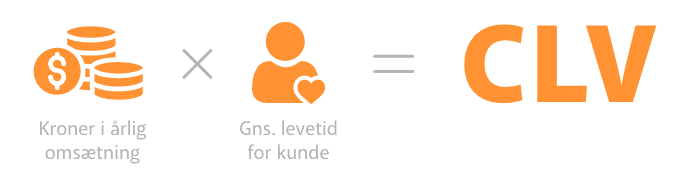
The higher your CLV, the more it becomes about buying as much of the market as possible at lower profitability. Then your upsell and after-sales will turn it into a strongly profitable case over time.
Read more about customer lifetime value.
Conclusion
Are qualitative KPIs simply the devil’s work?
Absolutely not!
They are simply being used today as the consultant’s loaded pistol. That was not their intended purpose.
The conclusion is that there is a balance between sales volume and revenue I learned that in the first semester of upper secondary school, so it is nothing new. It has always been the case that volume and profitability are opposites.
You need to find the balance between them. Because if profitability is too low, you make no money. And if profitability is too high, your business will not be viable because you earn too little albeit with a many-fold return.
And do consider your business in that context. If CLV is high, consider whether you should simply buy as much of the market as possible. Otherwise, find the threshold for what a customer may cost, and see whether that allows you to unlock your scaling potential.
I have said it before, and now I will say it again:
- Have a quantitative target
- Use one or more qualitative metrics to regulate the quality of the volume
- Consider the customer journey and CLV in relation to the two targets above

That is it. Nothing more to it.