


AI
29. August 2024
From 0 to 10,000 visitors via AI-generated content
We wanted to test whether AI content would be flagged as SPAM and therefore penalized by Google. That is why I created a brand-new website and produced a lot of content exclusively with the help of an AI setup.The results speak for themselves. AI content is not penalized, as long as the content is good.

Project background
At a time when AI tools such as ChatGPT and Claude.AI are revolutionizing the way we create content, I decided to run a test that went directly against the established consensus.
In recent years, Google has rolled out numerous updates focused on quality and combating spam. It quickly became a widespread belief that these updates specifically targeted AI-generated content, but Google itself actually changed its guidelines to not be against AI content as such, but against generally poor or thin content. That gave me an idea. You can read more about this in the post here.
Why did I do it?
Quite simply because I love to provoke and challenge the status quo. I am not a fan of people who simply go along with a shared consensus without having tested the theory in practice.
As Eminem once said:
They tend to flock like shepherds, the black sheep. But i be the worst thing that these motherfuckers ever heard.
I wanted to challenge the established belief that AI content is, by definition, bad for SEO. So I decided to build a website consisting exclusively of AI-generated content, without any manual editing whatsoever.
What did I want to achieve?
My goal was to test how raw AI content would perform in Google’s search results. Not AI content polished by an editor, but 100% raw output from AI.
The focus was on answering users’ search intent better than the existing material, even though the content was 100% generated by AI.
I chose keywords where the search intent was calculators, mathematical formulas, and tables, as I knew that the written words on the page would match far fewer search intents.
Setting up the website with AI content
I started by using ChatGPT to create a simple calculator that could convert “inches to centimeters”. After 3–4 attempts and about 10 minutes, I had a functional calculator that could be inserted directly on the page.
However, it did not look very good, so I asked ChatGPT to add CSS styling to make it more visually appealing. The result was still not satisfactory, so I switched to Claude.AI to see whether it could produce better output. It could, so I used Claude.AI’s version of the calculator, which was placed at the top of the page, as I assessed this to be the most important search intent.
Next, I asked Claude.AI to create a simple HTML table showing various conversions, e.g., what 1, 10, 100, and 200 inches corresponded to in centimeters. I followed up by asking ChatGPT why people generally searched for this type of calculator and what they would typically be looking into (e.g., TV sizes, pipe dimensions, etc.).
Based on this, I asked ChatGPT to write a paragraph that started with a manual calculation, but also covered the common needs behind the search.
All in all, it resulted in more than 60 different calculators on the website, all 100% AI-generated without any manual intervention or editing.
Boosting traffic with PBN links
Because this was a LinkedIn project, I wanted to accelerate the results. I decided to combine the 60 pages with links from PBNs (Private Blog Networks).
PBNs are generally considered “crappy links” in the SEO world, so it was a perfect way to test two things at once: could AI content perform well even with a poor link profile?

The result: the success of AI content
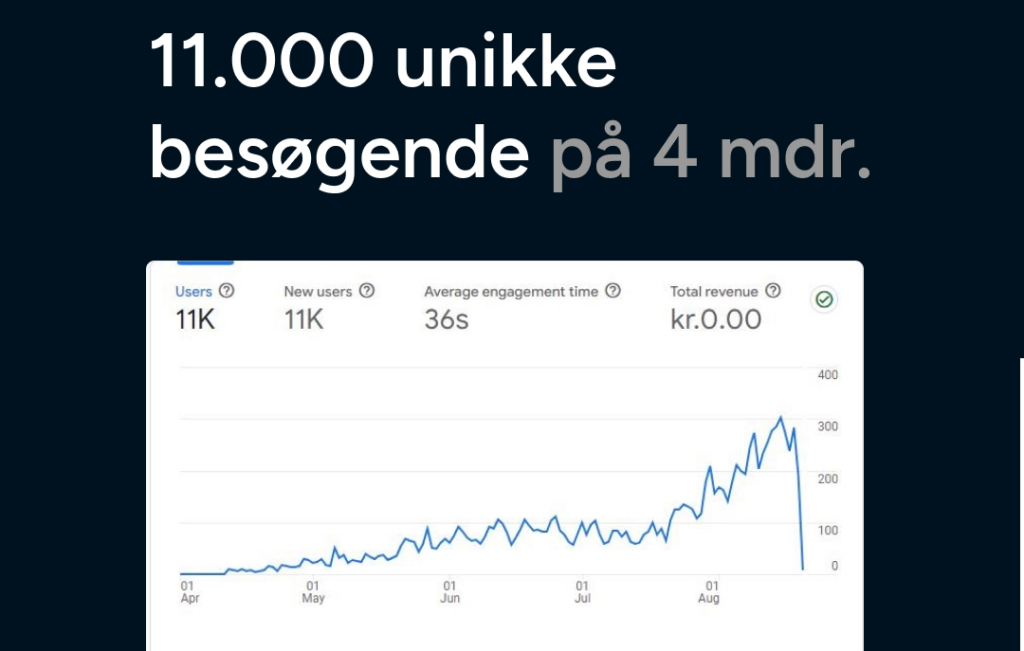
The results speak for themselves. After just four months, the site had achieved more than 10,000 visitors. Currently, it averages 350–400 visitors per day, and I expect it to get 10,000 visitors in September alone.
In August, it already reached 8,000 visitors. It is now clear that even with 100% AI-generated content and a link profile from PBNs, you can still achieve solid traffic.
The conclusion is that AI is the most important factor for SEO today
This test shows that the most important thing for SEO today is to match users’ search intent. If you sell cycling gloves, you should not target the broader keyword “gloves”, even if it has higher volume.
People searching for “cycling gloves” are probably looking to buy, and therefore Google only shows webshops for this keyword. That is why you cannot expect to get much traffic from the keyword “cycling gloves” if you publish a blog post called “The best cycling gloves in 2024”.
Answering users’ search intent is absolutely essential in 2024 and the only correct way to do SEO.
This test has proven that it is not necessarily about how the content is created, but about how well it answers users’ questions and needs.
By delivering value in the form of accurate calculators and relevant tables, a website driven exclusively by AI content was able to achieve remarkable traffic and success in the search results.
It is about being smart, innovative, and not afraid to challenge accepted truths.