


Digitalization
26. June 2026
Therefore, you cannot scale the effect of your sales and marketing efforts
If marketing does not impact pipeline and revenue, and if sales does not use the insights marketing gathers, then in practice the two departments are working towards separate goals. That is the reality in many B2B companies. That is why they end up with the same results year after year, even as budgets grow.

Content
Status quo Test your scalability Mismatch on sales process Marketing focus CRM data no user Connect data sources Website behavior Marketing must provide support Process existing customers Three things you can do differentlyIf you do what you usually do, you get what you usually get
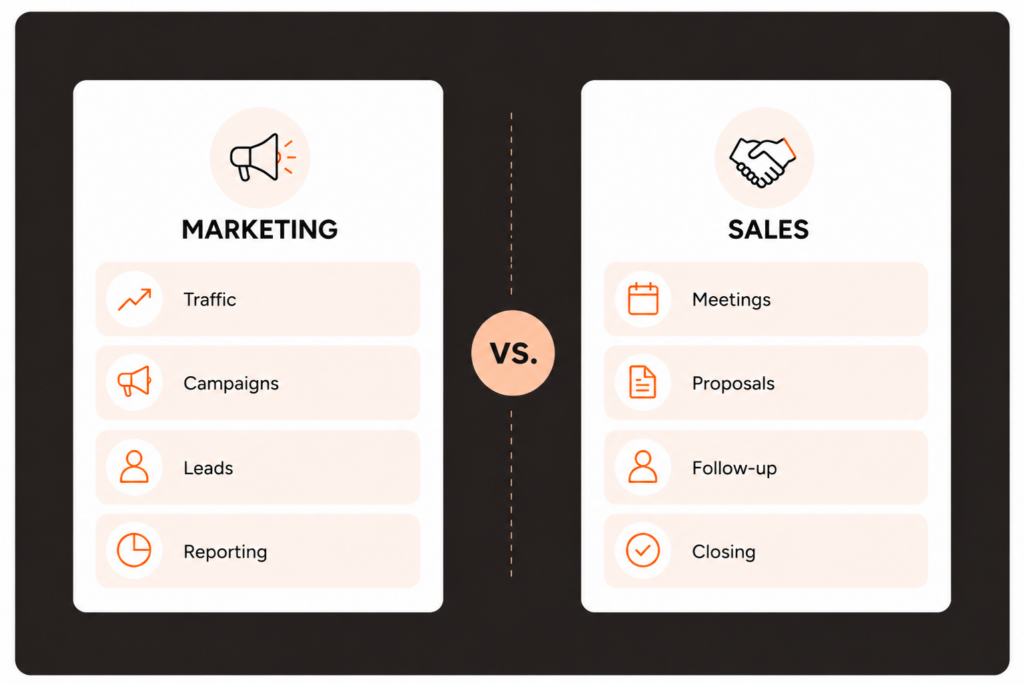
Marketing chases traffic and leads. Sales chases customers and new bizz. The CRM acts as an archive rather than a growth engine, and existing customers get far less attention than potential new ones.
The result is that companies get more activity, but not necessarily more growth.
More campaigns. More meetings. More dashboards.
But if you do what you usually do, you will usually get the results you usually get.
Still, many experience the same challenges:
- Sales believes that marketing delivers too few or too poor leads.
- Marketing believes that sales does not follow up well enough.
- The CRM contains lots of data that no one actively uses.
- Existing customers are forgotten in the pursuit of new ones.
- Marketing is measured on traffic and leads, while sales is measured on revenue.
The problem is rarely a lack of activity.
The problem is that marketing and sales still operate like two separate companies.
- Marketing produces content, campaigns, and leads.
- Sales tries to turn them into customers.
But no one truly owns the entire journey from first interest to signed order. It is a model that worked fine when the buying journey was simple.
It is not anymore.
Test how scalable your sales and marketing efforts are
Find out how scalable your sales and marketing efforts are – and where you are likely losing revenue.
The test contains 11 questions and takes 3 minutes
Do marketing and sales have common KPIs?
Your customers buy differently than you sell
Many companies are still organised around a linear sales model:
Marketing creates a lead → Sales takes over → The customer buys.
Reality rarely looks like that.
Today, potential customers research the market themselves long before they fill out a form or speak with a salesperson.
They:
- Search on Google.
- See posts on LinkedIn.
- Visit the website multiple times.
- Read case studies.
- Compare suppliers.
- Discuss options internally.
- Involve multiple decision-makers.
- Come back again and again.
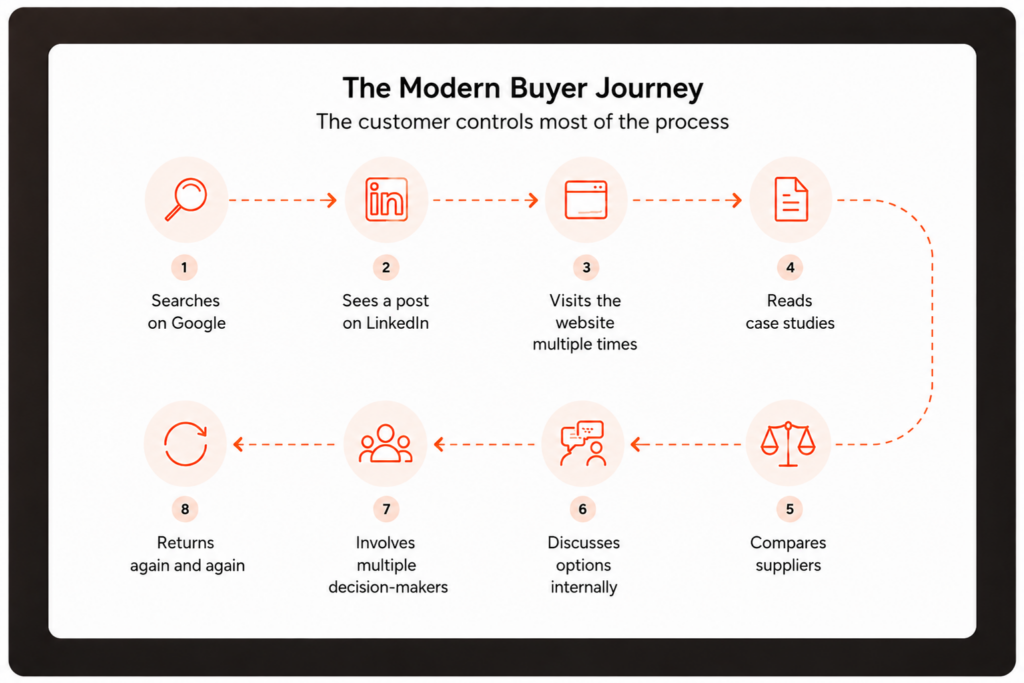
Many of these activities happen without the company noticing. The result is that companies often react far too late.
Only when a form is filled out or a meeting booking comes in does anyone act, but by then large parts of the decision have already been made.
That is why it is no longer enough to think of marketing on one side and sales on the other.
The companies that will win market share in the coming years (especially in the global economy we are heading into) will be those that manage to create one unified commercial engine.
If marketing does not impact pipeline, it is a cost
That sounds harsh.
But it is hard to argue against.
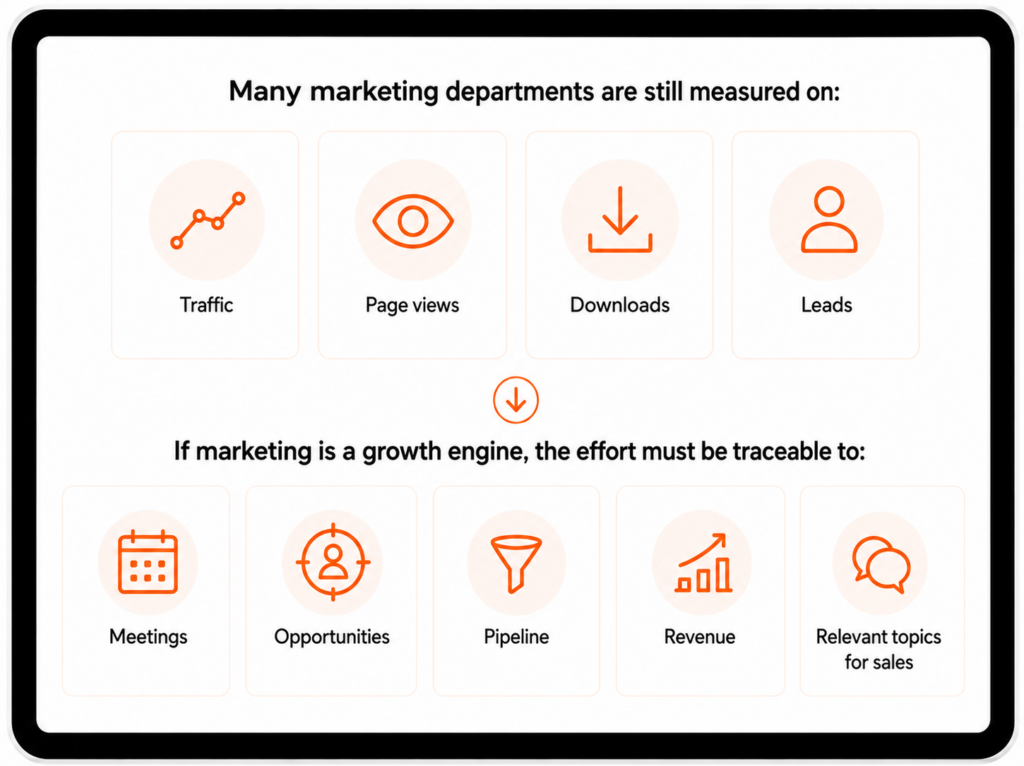
Many marketing departments are still measured on:
- Traffic
- Views
- Downloads
- Leads
The problem is that none of these KPIs necessarily create revenue, or at the very least; something sales can work with.
REMEMBER: You can easily double your traffic without creating a single additional customer. I will go so far as to say it is dead simple. And I meet many companies that do it.
Likewise, you can generate a hundred new “leads” without creating a single additional sales opportunity.
I have seen marketing departments that are measured on the number of leads, but not on the quality or type. So suddenly the marketing department’s interest is to call everything “a lead”, even if it just meant you downloaded a whitepaper or visited an “about us” page for 10 seconds. Because then marketing hits its KPIs.
If marketing is to be a growth engine, the effort must be traceable to:
- Meetings
- Opportunities
- Pipeline
- Revenue
- Relevant topics for the sales team
Everything else is activity and effort – not necessarily business.
That is why every CMO and Head of Sales should be able to answer:
- Which campaigns create customers?
- Which pages influence the likelihood of purchase?
- Which activities increase the win rate?
- Which companies are showing buying signals right now?
If the answer is unclear, there is likely significant untapped potential.
The CRM is full of data that no one uses
Most companies already have the necessary systems – at least I sure hope you do:
- HubSpot
- Pipedrive
- Salesforce
- Business Central
- Or a custom-built solution
The problem is rarely a lack of data; the problem is a lack of cohesion between the data.
The CRM is often used as an archive. A place where activities are logged, not a place where actions are triggered. As a result, valuable signals end up never being used.
Example
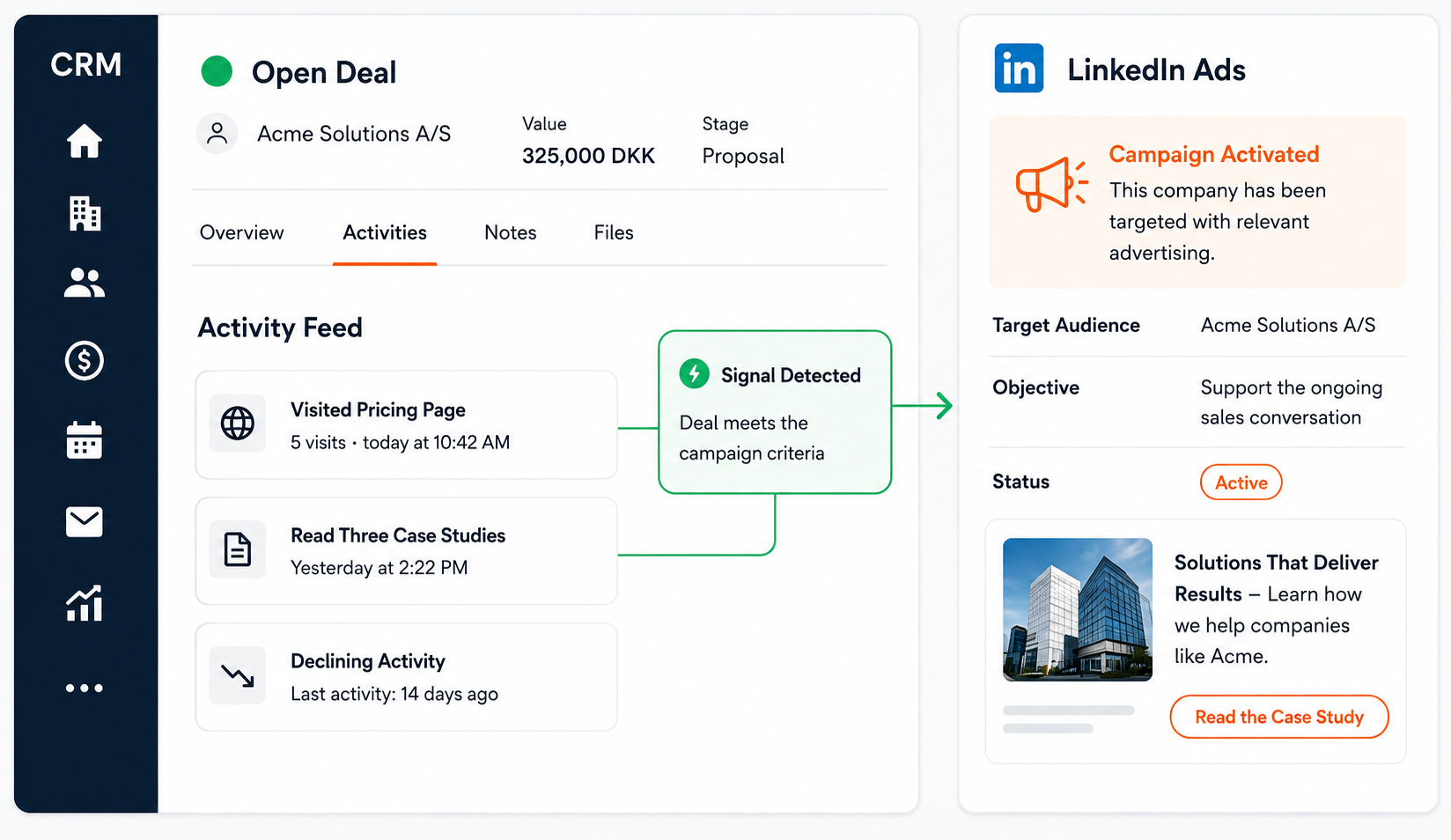
A company visits the pricing page five times
No one reacts.
A potential customer reads three case studies
No one reacts.
An existing customer shows signs of declining activity
No one reacts.
The opportunities are already there, but they are simply not turned into action.
Things you probably did not know were possible
It is quite easy to set up a flow where marketing campaigns and email flows are activated fully automatically, based on which deal stage a potential customer is in.
For example, if there is low activity from an existing customer, a LinkedIn campaign is activated, targeting stakeholders in that company
Or if a deal is created, campaigns are targeted at stakeholders and decision-makers in the organisation the deal belongs to. So marketing tries to influence the lead’s stakeholders – while sales works the lead. NOW that is cool.
Start by connecting CRM and marketing data
The first step is often surprisingly simple. Start by connecting the systems you already have, and make the CRM system the centre. The CRM system should not live a life of its own.
It should be connected to:
- LeadInfo
- Google Analytics 4
- Meta
- Email platforms
- Website events
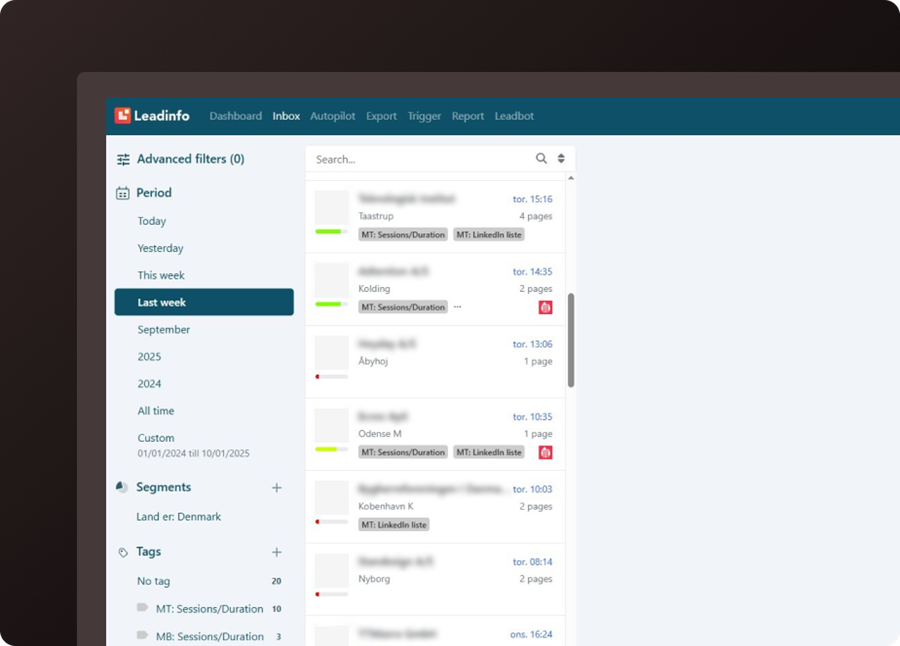
When data is brought together, entirely new insights emerge.
Suddenly, it becomes possible to see:
- Which companies visit the website.
- Which content they engage with.
- Which campaigns impact pipeline.
- Which activities lead to sales opportunities.
Only then do marketing and sales begin working from the same reality.
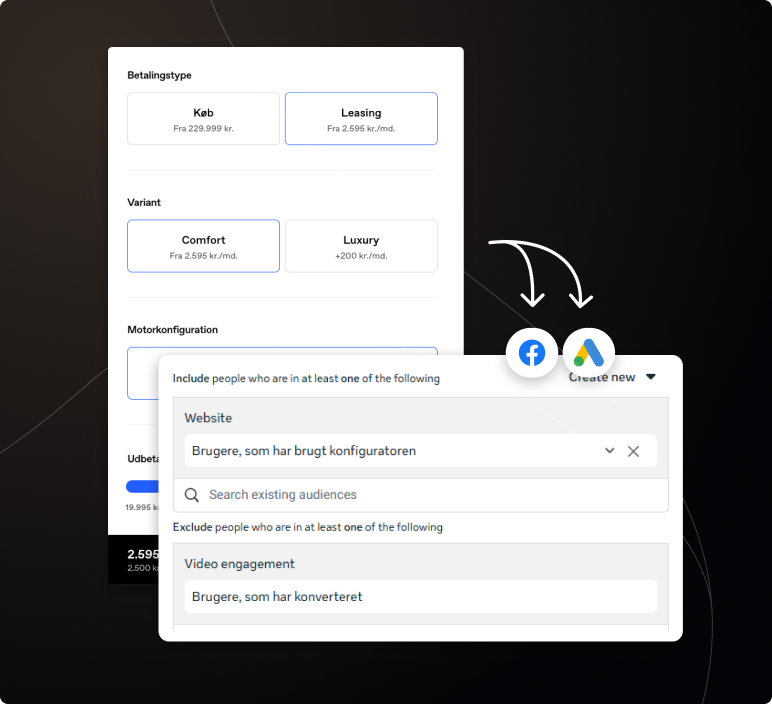
Use website behaviour to prioritise the right leads
Most companies still treat all leads more or less the same.
That does not make sense.
There is a big difference between a company that has visited the website once, and a company that:
- Has visited pricing pages.
- Has read case studies.
- Has used a calculator.
- Has completed a test.
- Has viewed multiple product pages.
- Has returned multiple times.
That behaviour tells you something, and often far more than a form does.
When this data is passed on to the CRM system, salespeople can prioritise their time far better. They talk to the companies that show genuine interest. Not those who have merely left an email address.
Marketing should support open sales opportunities
This is probably one of the most overlooked areas within B2B marketing. Most marketing departments focus on creating new leads, but what about the companies that are already in dialogue with sales?
Imagine the following;
- One of your salespeople has been in dialogue and meetings with a potential customer
- The need has been identified
- A proposal has been prepared for a potential customer.
- The proposal has been sent.
and now everyone is waiting.
Meanwhile, marketing continues running generic campaigns to the market.
Why?
Instead, marketing should support the companies that are already in the pipeline.
If the CRM is connected to marketing platforms and ad channels, it becomes possible to:
- Target relevant decision-makers in the company via LinkedIn.
- Showcase case studies from the same industry.
- Work with common objections.
- Support the value creation in the solution.
- Keep the company warm throughout the entire decision-making process.
Many B2B purchases involve more people than the contact person the salesperson is speaking with.
That is why it makes sense for marketing to help influence the rest of the organisation while sales works the deal.
Marketing should not only create opportunities.
Marketing should help close them.
Your biggest growth opportunity is probably existing customers
When companies talk about growth, the conversation almost always revolves around new customers.
- More leads
- More meetings
- More proposals
But many overlook the most obvious place to create growth.
The customers they already have.
Most companies have customers who:
- Do not know the full product portfolio.
- Do not buy as often as they could.
- Do not leverage all the opportunities in the collaboration.
- Are on their way out without the company noticing.
Yet most of the marketing budget is spent on acquiring new relationships.
We have seen companies find the revenue and the leads they were missing through a more systematic effort towards existing customers.
Not because they got more visitors, but because they got better at activating the relationships they already had.
When CRM data, marketing automation, and customer behaviour are connected, it becomes possible to:
- Identify customers with upsell potential.
- Reactivate inactive customers.
- Spot churn risks earlier.
- Target relevant messages to existing customers.
It is rarely as visible as a new lead campaign.
But it is often far more profitable.
The website should not just generate leads
Many companies still assess their website based on one question:
How many leads does it generate?
That is too narrow a perspective.
A modern B2B website needs to help with far more than that.
It must:
- Qualify visitors.
- Answer objections.
- Document the value.
- Identify buying intent.
- Help salespeople prioritise.
Far too many websites still function as digital brochures.
They talk about products.
They describe features.
They list specifications.
But they do not help the visitor understand why the solution is relevant to them.
That is often why companies see major improvements from relatively small changes.
We regularly see companies get significantly more relevant enquiries by shifting the focus from features and characteristics to:
- Business value.
- Benefits.
- Objection handling.
- Risk mitigation.
- Documentation.
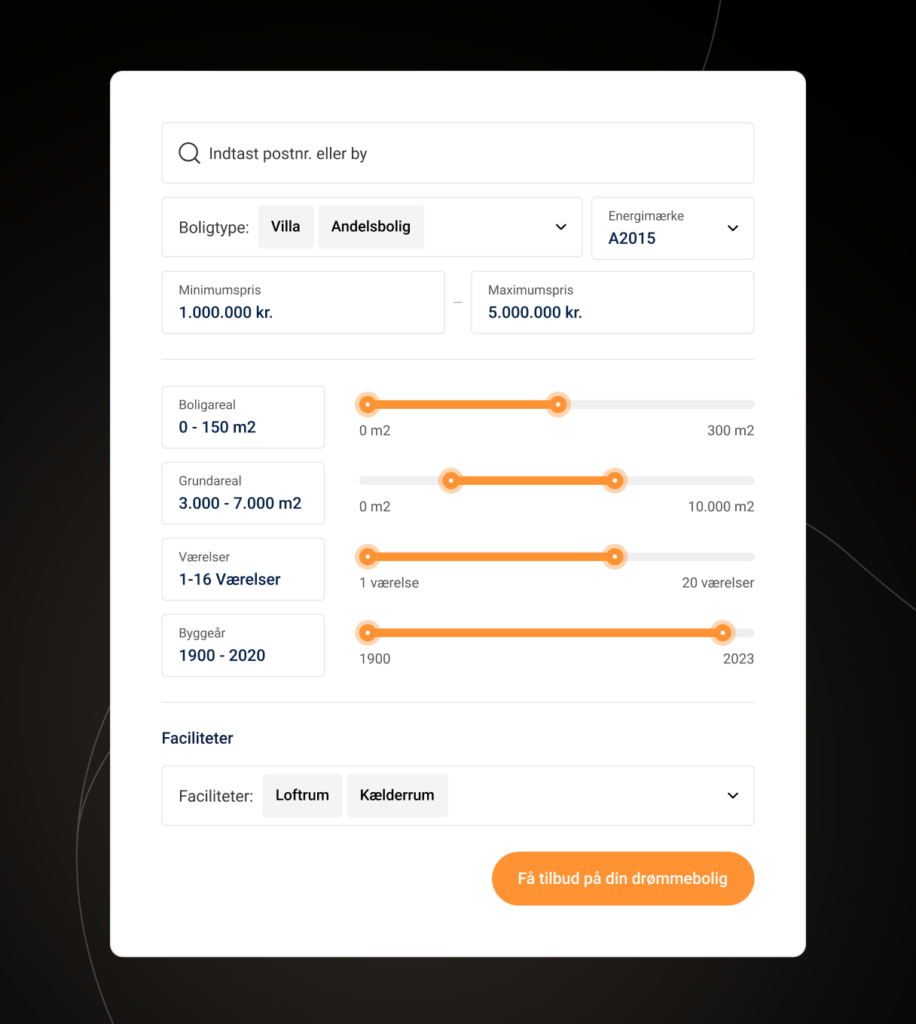
At the same time, the website can be used actively to collect signals.
This can be through:
- Calculators.
- Tests.
- Configurators.
- Case studies.
- FAQ hubs.
- Interactive tools.
Activities that both help the visitor and give the company valuable insight into buying intent.
Three things you can do as early as tomorrow
If you want to create better alignment between marketing and sales, there are three initiatives that deliver value almost regardless of the company’s size.
1. Connect CRM with marketing data
Collect data from CRM, website, LeadInfo, GA4, LinkedIn, Meta, and email platforms.
The goal is not more dashboards.
The goal is to understand which activities create pipeline and revenue.
2. Use behaviour to prioritise leads
Stop treating all leads the same.
Let behaviour determine who should be prioritised.
A company that has visited the website seven times, read case studies, and used a calculator should be treated differently than a company that clicked on a single ad.
3. Let marketing support open opportunities
Marketing should not stop when a lead becomes an opportunity.
On the contrary.
This is often where marketing can create the most value.
Use marketing to influence decision-makers, handle objections, and support the sales dialogue while the deal is being worked.
If you do what you usually do, you get what you usually get
Many companies will spend the next few years doing more of the same.
- More campaigns
- More blog posts
- More ads
- More meetings
- More activity
But activity is not the same as progress.
If marketing continues to chase traffic and leads without insight into pipeline and revenue, and if sales continues to operate without access to the signals and data marketing collects, the result will likely be the same as last year.
- Maybe with a few more leads.
- Maybe with a few more meetings.
But not necessarily with more growth.
The companies that will win in the coming years will be those that manage to get marketing, website, CRM, data, and sales to work as one unified system.
Because if marketing does not impact pipeline and revenue, marketing is not a growth engine.
Then it is simply another cost in the budget.