


Lead generation
22. March 2022
What is a keyword analysis?
A keyword analysis is an analysis of what your ideal visitors are searching for on search engines. You need this analysis to optimise your website for the right keywords, ensuring that your site contains relevant content.

Why conduct a keyword analysis?
A keyword analysis is a tool you can use to find and analyse keywords or search terms that you can – and should – be visible for in search engines. The analysis forms the foundation of your entire search engine marketing (SEM). The keywords you select are, and will remain, the cornerstone of both SEO and PPC.
A keyword analysis should be used by all companies that want increased visibility in search engines. The analysis should not only be based on internal company knowledge, but also on the industry. Because the keywords you choose define your entire SEM strategy, you must take them seriously.
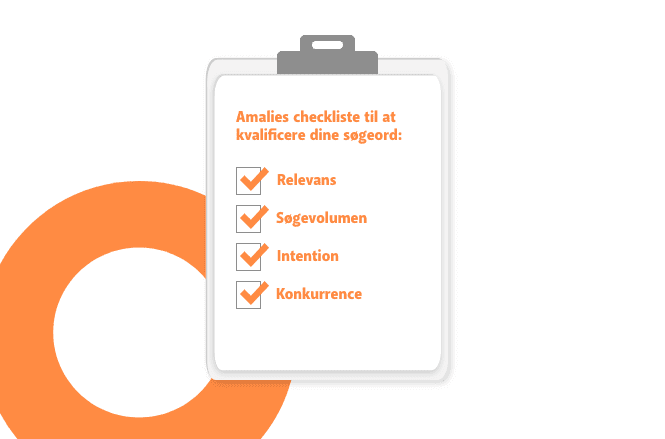
You should not only brainstorm keywords you must qualify them based on:
Why do you conduct a keyword analysis?
You conduct a keyword analysis for the simple reason that you need to understand users’ search habits/intent on search engines in order to optimise your website accordingly. If you do not do the groundwork first, you risk optimising your website for the wrong search intent, which can harm the relevance and credibility of your site two factors that Google, for example, uses to evaluate a site.
That is why search intent is important for your SEO
As part of your keyword analysis, it is important if not the most important thing that you get a clear understanding of the intent behind consumers’ searches. The need consumers have is the need you must meet through the content you produce.
Strong search engine optimisation is about delivering highly relevant content that is based on the service, offering, or product you provide, and that matches what people are searching for on Google.
What different search intents do users have?
When we talk about users’ search intent, it can be divided into different categories. It is important that you know what intent the user has in order to optimise for it as effectively as possible. Once you understand the search intent, you can begin to develop your content strategy.
Informational searches
This user is looking for a specific answer. It can be very specific, such as “banana cake recipe”, or based on question words such as why, how, what is, and why. Here, it is important that you optimise your content for the long-tail searches customers use, and that you answer the question otherwise your content is not relevant.

Navigational searches
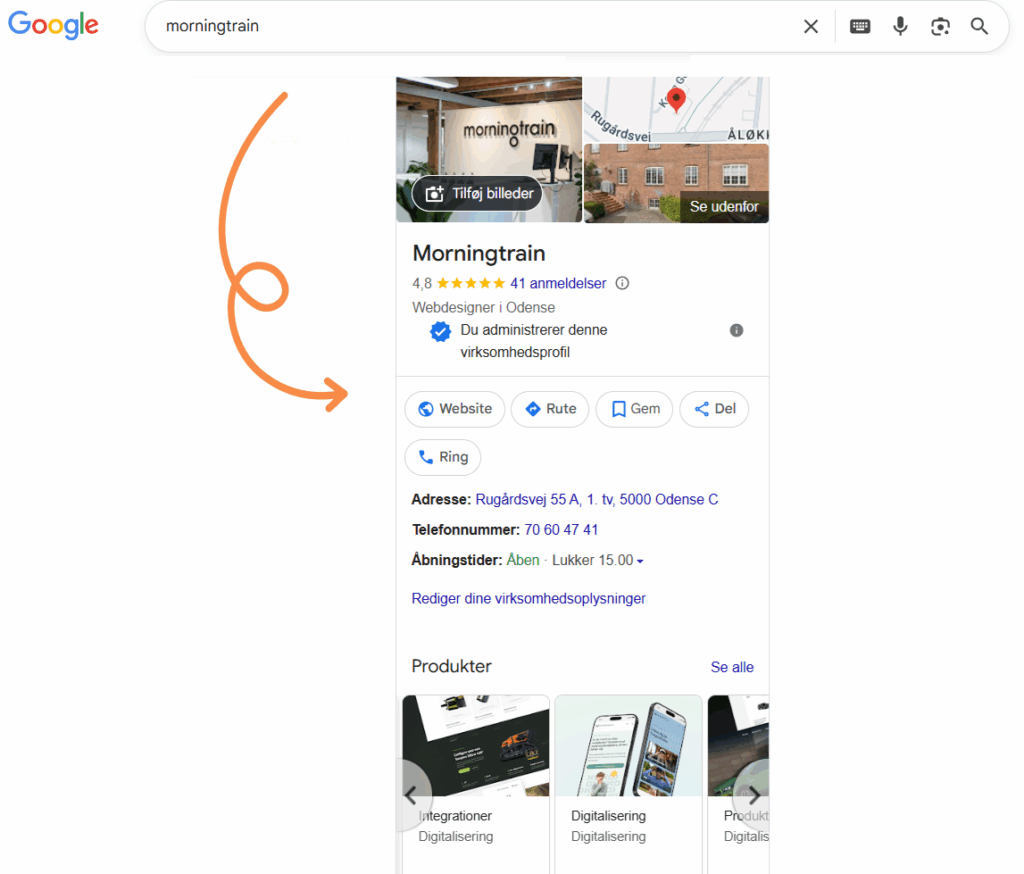
This type of search is more specific; the user is often looking for a particular website. Most commonly, navigational searches are for a company name, business, or brand, but it can also happen that a navigational search circles around the company name or brand because the searcher may not remember it, but knows they can find the company by searching for something specific.
Research searches
If you want to reach a research user, you should know that this user does not intend to buy or convert right now, but only after they have, for example, gathered information from several sites. The user may want to buy a specific pair of shoes, but wants to find them at the lowest price.
Transactional searches
This user is solely looking to take some kind of action for example, making a purchase.
You should be aware that optimising for this user involves very tough competition, as all competitors also want a share of the traffic for that specific keyword.
If you want to reach a transactional searcher, it is important that when they land on your website you have clear CTAs, so the customer knows exactly what action to take and ideally this should be placed high up on the page, and on mobile above the fold, meaning the first thing the user sees on mobile before they need to scroll down to read more.

What does a keyword analysis give you?
The analysis gives you a strong understanding of your target audience and your industry, in terms of how they use different keywords on, among other platforms, Google.
The analysis can therefore provide you with the following:
- A list of qualified keywords
- A foundation for website content and copy (which is a major part of on-page SEO)
- Deep insight into your competitors’ use of competing keywords
But what do you need all those keywords for? Well, let me tell you.
Based on the knowledge you gather from the keyword analysis, you can base and optimise your SEM efforts in relation to, for example, SEO and Google Ads. If the results of the keyword analysis are applied correctly, in the right places, and with the right quality, you can look forward to:
- Higher rankings in search engines
- More traffic
- Better expectation alignment with potential customers
- More potential customers who are ready to buy
- A higher conversion rate
How do you conduct a keyword analysis?
A keyword analysis is time-consuming and a significant part of optimising your online marketing. That is why it is typically SEO and Google Ads specialists who prepare them, as they are the foundation of their marketing optimisation and strategic planning.
That is why working with an SEO agency or a Google Ads agency will often result in a high-quality keyword analysis. With that in mind, you can certainly create a good analysis yourself and achieve strong results.
However, you should be aware that a keyword analysis for SEO differs from Google Ads. This is because SEO is organic search (focused on competition and search volume), whereas Google Ads CPC is more focused on “can we afford it?”.
You have a wealth of options for finding the keywords that are relevant to your business. Not only that, but with the help of tools you can satisfy your curiosity about what your closest competitors are doing and how they rank compared to your company.
Keyword analysis tool
There are several different keyword analysis tools you can use. Some of these tools cost money, so assess the scope you want to take on yourself before getting started.
Your best tool is actually to Google your desired keyword and see which keywords your competitors are ranking for. You can then “steal” those keywords and enter them into one of the tools below to find the search volume, discover related keywords, and gather informational search insights around that keyword.
Popular tools:
- Ahrefs
- Semrush
- Morningscore
- Google Ads Keyword Planner
How do you use the keyword analysis?
It depends largely on which type of marketing you want to optimise. Therefore, I have outlined some options you can use in connection with SEO or Google Ads, if you want to optimise yourself.
However, you should remember that SEO is a long-term plan, so you cannot see results immediately. Google Ads, on the other hand, delivers results more quickly, and it is easier to stop the “bleeding” compared to SEO.
SEO:
- Target the website’s content towards the keyword/search term.
- Include the most important keywords in the meta description.
- Create new landing pages targeted at new relevant keywords/search terms.
Google Ads:
- Adjust campaigns to the keywords/search terms.
- Create ads that match the consumer’s search intent.
- Ensure a consistent thread between ad relevance, landing page, and the search term.
Why monitor your efforts?
When you start your keyword analysis, it is important to understand that it is not a one-off task. It is an ongoing process, and to ensure you do it correctly, it is important that you continuously work with the selected, correct keywords and keep an eye on whether your efforts are working. If what you are doing is not working, you need to change strategy.
There are several reasons why you should continuously monitor whether you are optimising for the correct keywords/search intent.
- Your potential customers’ needs may change, and therefore also how they search on search engines.
- New competitors may enter the market, meaning you need to approach your efforts in a different or new way.
- New queries may appear in search engines that users have not previously searched for.
- There may be changes to Google’s algorithms that require you to adjust your efforts.