

Content
6. November 2025
What is a value proposition?
A value proposition is an ultra-short, precise statement that explains who you are, who you are for, and what people gain from choosing you.In plain Danish terms, it is also what you would call an “elevator pitch”. It is a condensed message that captures the essence of your value to your target audience.
Content
Why it is important What it can be used for Example Try our generator The equation behind What does it cost DIYWhy is a value proposition important?
In short, the fewer words you need to describe something clearly, the sharper your message is.
If you cannot express, briefly and clearly, what your company is and what customers gain from it (value added), how can it be easy for your target audience to understand?
I would go so far as to say that a value proposition is a “belief system” in the sense that it is the cornerstone of all the company’s communication, both to employees and colleagues. In other words, it is the core message from which we develop all other messages.
A strong value proposition answers the following in seconds:
- Who are you?
- Who are you for?
- And what do they gain from using your product/service?
It does not get more central than that.
With a sharp value proposition, you cut away everything unnecessary. A value proposition acts as a compass for marketing, sales, and management.
Once you have defined what you truly promise your target audience and why it matters to them it becomes easier to:
- Hit the mark in your communication
- Create consistency across channels
- and ensure that everyone in the organisation tells the same story
In short: you save time, money, and confusion.
What do you use a value proposition for?
Beyond the obvious being clearer to your target audience and being able to deliver an effective elevator pitch in sales a strong value proposition is used to create all kinds of company communication, such as:
- Taglines – that short 3–4-word sentence that sums up what the company can and wants to do, e.g. Spar365’s “the right place to save”, Virgin Airlines’ “See the world differently” or Fernet Branca’s “Life is bitter”.
- USPs – The 3–5 things you highlight that customers especially get from you should stem from your value proposition.
- Visual identity – Ideally, your visual identity should be aligned with your value proposition, so your identity matches the message and the target audience.
- Internal communication – using your value proposition to communicate internally: “What is it that we stand together for?”
- Decision-making – A healthy organisation will make decisions based on the company’s values, vision, and value proposition. In other words: is this within these boundaries, or does it move us closer to our goal?
- Better marketing materials – When you know your “elevator pitch”, the task in marketing suddenly becomes thinking in creative ways to “show it, don’t tell it”. It also creates coherence in your communication to centralise it around the company’s value proposition.
Example of a value proposition used well – Mercedes
Value proposition: “A combination of luxury, prestige, and performance built on a foundation of German engineering and innovation.”
Tagline: “The best or nothing”
Visual identity: Yes, look at the image below and do not tell me it does not fit together well.
Decision-making: For many years, Mercedes has been the one driving technological development in the automotive industry—developments other car manufacturers copied a few years later. Mercedes set the agenda.
Better marketing materials: Whether an ad is good or not is subjective, but you cannot deny that Mercedes’ marketing supports the core message by ALWAYS highlighting the quality and luxury of the cars. The people driving them radiate prestige.
Important question: Do I drive a Mercedes? No—and I will not, but I am not the target audience either.

The formula behind a value proposition
There is actually a proven formula for what a value proposition should include, and it looks like this:
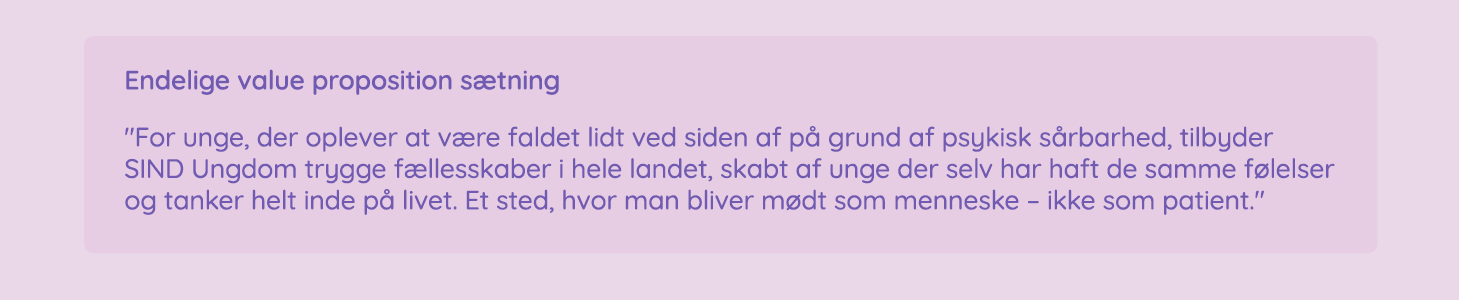
For [the target audience] who [insert the target audience’s need], our [product/service name] provides [product description] that [insert benefit].
Lav din value proposition
Udfyld felterne nedenfor, og få et godt udgangspunkt at arbejde videre ud fra. Sætningen et ca. 70-80% i mål, så du kan selv berrige den bagefter, så den bliver helt perfekt.
This formula makes it easy to clarify who you are speaking to and why they should listen.
Note: The final formula can certainly be shortened a bit, and some filler words may need to be replaced, but you get 75–85% of the essence with this formula.
Who should have a value proposition?
All companies that want to communicate more effectively.
Whether you are a startup, NGO, B2B company or e-commerce brand, a sharp value proposition is the foundation of all strategic marketing.
What does it cost to get a value proposition?
It can cost anything from your own hourly rate to DKK 1,000,000, depending on the process you choose.
The price depends heavily on how clear you are on, for example:
- Your story
- Your reason for being
- How your product portfolio stems from the above
- Your “value added”
- Your target audiences cut down to the essentials
- and much more
If you have none of this, you have to work on everything, and that increases complexity and price.
At Morningtrain, developing a value proposition is part of our brand and communication strategy programme.
The price depends on your size and level of ambition but typically the process ranges from DKK 25,000–100,000. We can also help companies that are already fairly clear on the information above and “just” need help structuring it and making some sharp choices and trade-offs.
Can you do it yourself—and what is the process?
Ye – like any other marketing task, you can create your own value proposition, but it requires a clear picture of your target audience and your real strengths.
The process typically looks like this:
- Identify your target audience – who are you speaking to, and what matters most to them?
- Map their needs – what are they trying to solve, and why?
- Put your solution into words – how do you help them in concrete terms?
- Highlight your advantage – what makes you different or better?
- Test and adjust – let both customers and colleagues respond to your message.
When we run the process together with clients, we find that two things are the hardest:
- The hardest part is daring to “choose something away” things like: “what if we scare some of the target audience away”, or “we can do those things too”. A sharp value proposition appeals strongly to fewer people. So you have to believe that you will get more business by being a lot to fewer people. The alternative is being very little to more people.
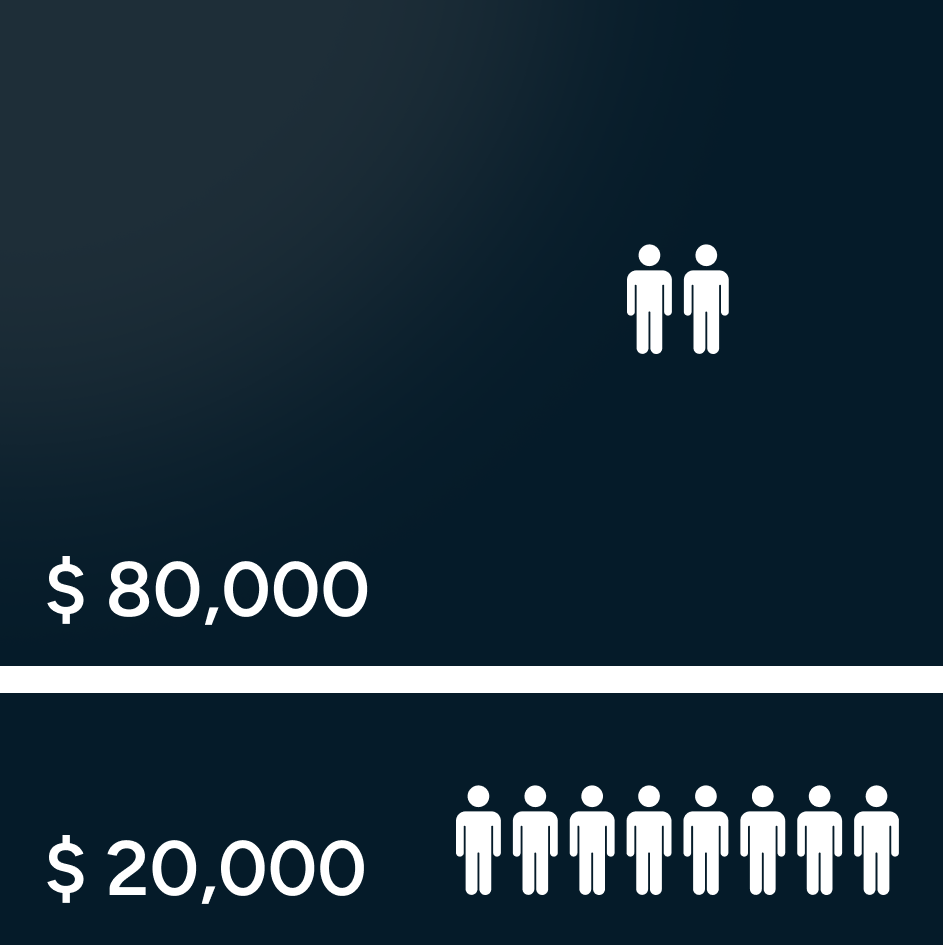
- The second hardest part is not getting caught up in all the exceptions. You should create a value proposition based on the Pareto principle the 20% that gives you 80% of your business. Focus on the target audience that gives you the most, and the products that account for the majority of your business—not everything that generates revenue.