

Data insights
3. December 2021
What is CTR, and what can you use it for?
CTR is an abbreviation of ‘Click Through Rate’ (in Danish “click rate”). It is a KPI that shows what percentage of the people who have seen a hyperlink also chose to click it. A hyperlink refers to all online links that take you somewhere on the internet.

What is CTR?
It could be:
- A search result in search engines
- A link on a website
- An ad (whether it is a banner, SoMe, or something else entirely)
CTR is most often used to evaluate marketing efforts. Here, CTR tells you the percentage of people who have seen your marketing material and also choose to click it. The result is most often used to assess whether the ad is well constructed.
How is CTR calculated?
CTR is shown as a percentage, and you calculate your CTR by dividing the number of clicks by the number of impressions/exposures and multiplying by 100.
Example
If an ad has been shown 14,500 times and 371 chose to click the ad, then the CTR is 2.5%.
When is CTR high?
Whether a CTR is high or low depends entirely on the target audience, the purpose of the effort and the medium/channel used.
Some target audiences will have a higher click-through rate than others because they are further along in their decision-making process.
If your target audience is very broad, your CTR will most often drop. This is because you are communicating to many different people at once, who do not all respond to the same things and/or are at different stages in their decision-making.
The medium or channel used has the greatest impact on your click-through rate, because different media reach different target audiences at different points in your potential customers’ decision-making process.
Media such as online newspapers, streaming services, and display banners reach extremely broadly, and you reach many people both within and outside your target audience.
A channel such as PPC or search engine optimization, on the other hand, will have a higher click-through rate because you are only shown to people who are actively searching for you, your service, or your product. In other words: they are further along in the decision, and you have not pushed your message out to the target audience at a time when they were not looking for it.
If I am to provide some indications of roughly where your CTR should fall on the spectrum, it looks like this:
- Google advertising: 8–20%
- SEO: 8–15%
- Organic SoMe: 3–8%
- SoMe advertising: 1–5%
- Display banners: 0.5–2%
- Digital newspapers: 0.1–1%
High exposure = low CTR
With CTR, as with all other KPIs, it is not binary whether the number is good or bad. Your campaign may have had a low CTR, but perhaps you gained something else instead?
It is almost a rule as certain as gravity: channels that generate many impressions deliver a low click-through rate.
TV commercials probably have the highest view rate of all marketing channels, and here you have a CTR of 0% (since you cannot click on your TV 😉). That does not mean TV commercials cannot be effective.
The point of the channels above, where you most often get a lower CTR, is that you want to reach as many people as possible to spread the message about your brand.
Conversely, channels with very few impressions deliver the highest CTR because you target a narrow group of people who are actively searching for you and your services in search engines, or are exposed to your organic SoMe content because they already follow your company profile.
You have to choose: do you want to build a brand, or drive traffic?
A low CTR can therefore also be a symptom that the purpose of the campaign was to create brand awareness, not to acquire traffic.
And then some people will surely say: “well, I would like both things”…
*I take a deep breath before I answer this*
Building a brand and driving traffic (sales activation) are two very different disciplines that require different content, media planning, and execution. So you cannot get both from the same campaign.
How do you use CTR?
CTR is only an important metric in a context where the effort you are measuring is intended to drive traffic to the website.
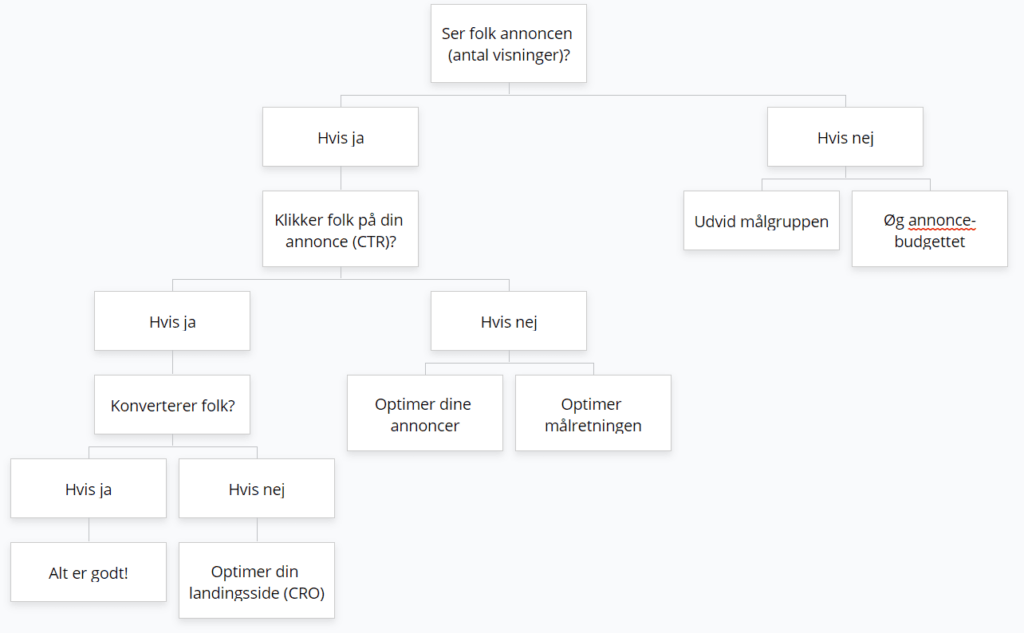
Here, CTR plays a significant role when analysing the “funnel” from the target audience seeing an ad to converting into a customer.
Imagine that you think you are getting too few leads or sales for your marketing budget. Then you need to sit down and review your funnel.
- Step 1: Do people see our ad (impressions)?
- Step 2: If yes, do they click your ads (CTR)?
- Step 3: Do they convert (CRO)?
Depending on the answer to the 3 steps, you know where to optimise. In this case, your CTR can tell you where the chain breaks.
- Is your CTR high, but you have received few clicks, then there is demand and interest in you, your product, or your service. Conclusion: You need to get more impressions.
- Is your CTR low, but you have many impressions, then perhaps you are not relevant to what the user is searching for? Conclusion: Optimise targeting and ad messaging.
- If your CTR is high and traffic to your website is also high, then you need to work on your landing pages. Perhaps they need to be optimised. Consider whether you promised something in the ad that your landing page does not deliver. Conclusion: Optimise the landing pages from a user experience perspective (CRO)
Below you can see my version of an optimisation flowchart: