


Lead generation
8. September 2023
Boost your marketing efforts with conversion values
Conversion values can play a crucial role in transforming your business from being driven by gut feeling into an effective lead and sales machine. They help you make sound decisions about how to invest in acquiring more customers—because what should a customer cost?

Content
Introduction What is it The value of a new customer How we do it How you get started Setting up in GA4The topic is not rocket science (in fact, it is not science at all); it is simply about providing yourself and your marketing platforms with qualitative inputs so better decisions can be made by assigning a value to your enquiries.
So, in this article I will elaborate on the importance of conversion values and how they can improve your company’s results.
I will also cover how you can implement them across different advertising platforms and optimise your bidding to achieve better results.
Disclaimer: The article is primarily written with B2B companies in mind, but it may also be relevant in a B2C context where customers have a high value, e.g. in real estate agencies.
First and foremost: What are conversion values?
Conversion values are a method for defining and measuring the value of different actions that users take on your website.
This may include actions such as:
- Filling out a contact form
- Signing up for the newsletter
- Phone calls
- Booking a demo
- Downloading a PDF, etc.
By assigning a value to these actions, you gain a better understanding of how valuable they are to your business.

Understand the value of your potential customers
With conversion values, you can understand the value of each action, which can help you identify which efforts have the greatest potential to generate leads and sales.
This enables you to focus your resources and marketing budget on the most effective areas.
How we work with conversion values
When it comes to working with conversion values, there are three models (in the future, 4) you can use:
The automated – This world does not quite exist yet
Basic – for those who may never have worked with conversion values before and simply need an indication.
The extended – For those who have done the above but now want to nuance the picture a bit more.
The dedicated – When you have mastered the two above and find that it is not accurate enough.
The basic method:
For example, if you receive 100 contact form submissions, how many of these are actually potential customers (leads)? In other words, how many are interested in buying your product or service and could therefore potentially become customers?
And how many of these then become customers?
The calculation:
Let us assume that we estimate that, out of the 100 contact form submissions, 50 of them result in 5 actual customers, and an average customer generates revenue of DKK 100,000 with a bottom line of DKK 25,000.
The formula:
Now, revenue per contact form can be calculated as: 5 / 100 * 100.000 = 5.000,-
And the bottom line per contact form: 5 / 100 * 25.000 = 1.250,-
Whether you use revenue or bottom line as your conversion value in Google Analytics 4, Google Ads, LinkedIn Ads, Meta Ads, etc. should depend on your business goals: What matters right now?
- Is it cost minimisation – then it is bottom line
- Is it scaling – then use revenue
The extended method:
Once you have played around with the basic method but want to be a bit more precise in your attribution of conversion values, you should calculate them per enquiry type:
- Phone
- Lead forms
- Book a demo
- Brochure download
- Whitepaper download
- Newsletter sign-ups
Etc.
Example: If you run a plumbing business, you will probably find that forms are more valuable to you than phone calls.
People call more often when a pipe has burst then there is no time to wait for a form.
But when a house is being fully renovated, you may turn to a contact form so, as a customer, you can provide more information to you as a potential supplier.
The dedicated method:
Now we turn up the heat and the data nerdiness!
With the help of Google Tag Manager, conversion values can be adjusted depending on factors such as device type, geography, time of day, etc.
Example:
You still run a plumbing business.
For you, phone calls are hardly created equal. Some are gold, and others are Hanne-Dorit who has gotten lost on the internet.
You will probably get the potentially large renovation orders from:
- Desktops
- During normal working hours or perhaps Sunday afternoon?
- From specific areas with detached-house neighbourhoods
Whereas a burst water pipe comes from:
- All areas, but also many rental properties
- Mobile phones
- More often outside than within normal working hours also at night!
Via Google Tag Manager, you can factor this into your conversion values so your ad accounts have the best possible conditions for bidding.
How to get started with conversion values
Step 1: Identify your conversion actions
Start by identifying the actions that matter most to your business. This may vary depending on your industry and business model.
For example, if you are a plumbing company, some of your most important conversion actions may be filling out a contact form, phone calls, and signing up for the newsletter.
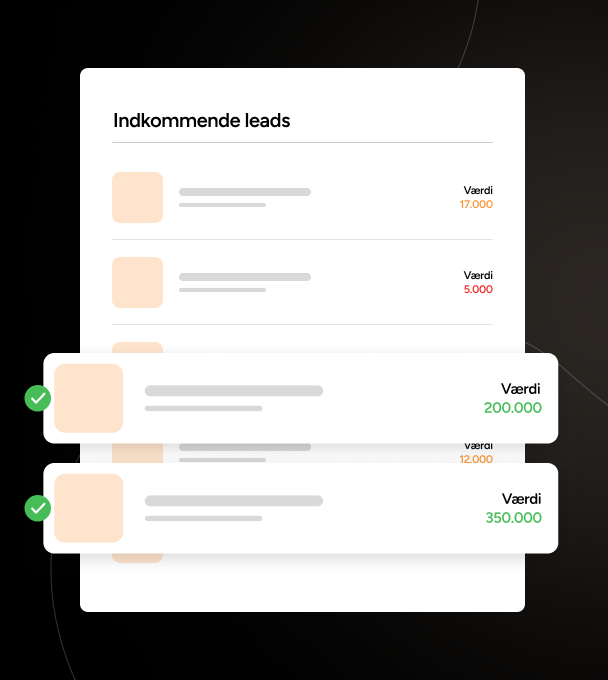
Step 2: Assess the value of each action
The next step is to assess the value of each action. This can be done by analysing data from previous sales and customers.
- How many of the submitted contact forms became actual leads?
- And how many of these leads became paying customers?
By calculating the average revenue and bottom line per customer, you can assign a value to each conversion action.

Step 3: Assess your business goals
By aligning your conversion values so they reflect your business goals, you can achieve even better results.
This may include choosing between revenue or bottom line. Here I am referring to the earlier point about the difference between focusing on growth vs. cost minimisation.
Step 4: Differentiate the value of each conversion action
The extended approach to working with conversion values would tell you that you should differentiate the value of each conversion action based on factors such as enquiry type, geography, and time of day.
Step 5: Implement the conversion values in your advertising platforms
Once you have calculated the value of each conversion action, you can implement them in your advertising platforms such as Google Ads, LinkedIn Ads, or Meta Ads.
This enables you to bid more effectively and focus your resources on the actions that have the greatest value for your business.
You do this simply by creating or editing a conversion you have set up; here you will find a field on all platforms labelled “value”. Enter your value in this field.
This applies to:
- GA4
- Google Ads
- Meta Ads
How to implement Conversion Values in Google Analytics 4
To implement conversion values in Google Analytics 4, you can use Google Tag Manager.
By passing the parameters “value” and “currency” to Google Analytics 4, you can record the value of each conversion action and gain detailed insight into your company’s performance.
“And why should I care?”
Implementing and using conversion values in your business has many benefits:
- Improved business insight: By analysing conversion value data, you can gain a better understanding of what drives your company’s success and identify areas that can be improved.
- Better bidding: By knowing the value of each conversion action, you can bid more effectively and focus your resources on the most valuable actions.
- Optimised marketing: By focusing on the most effective actions, you can achieve better results from your marketing and increase your ROI.