

Lead generation
31. July 2023
Guide to the B2B sales funnel from lead to customer
In the complex landscape of B2B sales, understanding a lead’s journey through the sales funnel is crucial for business growth.But with all the jargon associated with these stages—such as lead, MQL, SQL, conversion, lead generation, etc.—it is easy to feel overwhelmed and lose focus on the critical stages.
Conversions – simple, but misleading
Most B2B marketers are aware of the difference between a lead and a client/customer. They also understand what conversion and conversion rate are, and know that these should be tracked and optimised. However, complexity arises when we overlook the fact that conversions happen at different stages in the sales funnel and are not solely related to the final purchase of services or products.
A conversion occurs when a website visitor or potential lead takes a desired action in response to your marketing message or efforts. This conversion can happen on your website, in ads, on social media, or at any other touchpoint you have with your target audience.
There are many actions our leads take throughout their customer journey that can be considered conversions. They can be as small as downloading your brochure or clicking a PDF, or more significant and closer to the buying stage, such as making a call or submitting an enquiry via your contact form. And then there is the final purchase, where the lead is converted into a customer/client.
It is not uncommon for a marketer to look into conversion rate optimisation with a focus on only one conversion usually either the touchpoint or the final purchase. However, problems arise when we overlook that there are many conversions and touchpoints throughout the customer journey. Focusing only on the end of the buying process can easily result in missed growth opportunities for the business.
The stages of the sales funnel
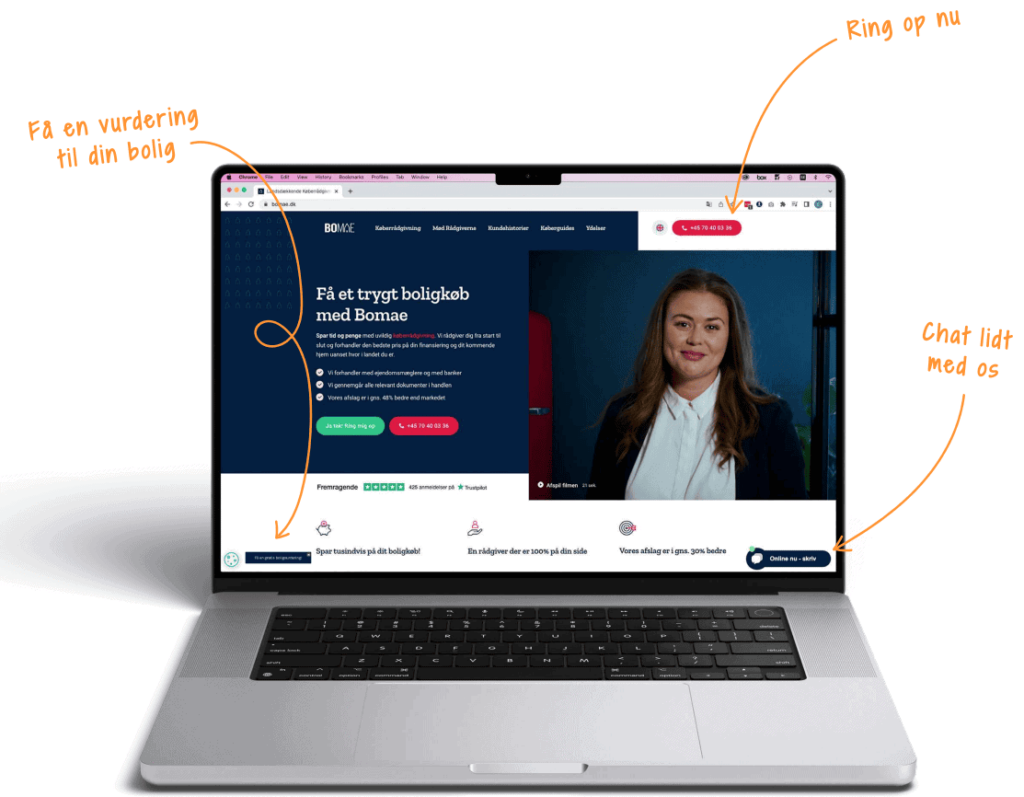
By placing each term in the correct sales-funnel stage and explaining the conversions required to move from MQL to SQL to client, we gain an overview of the buyer’s journey and identify specific points to optimise.
When you know who is responsible for handling leads at each stage, and which actions are required to move them further down the funnel, it becomes easier to increase the conversion rate or scale the number of relevant leads.
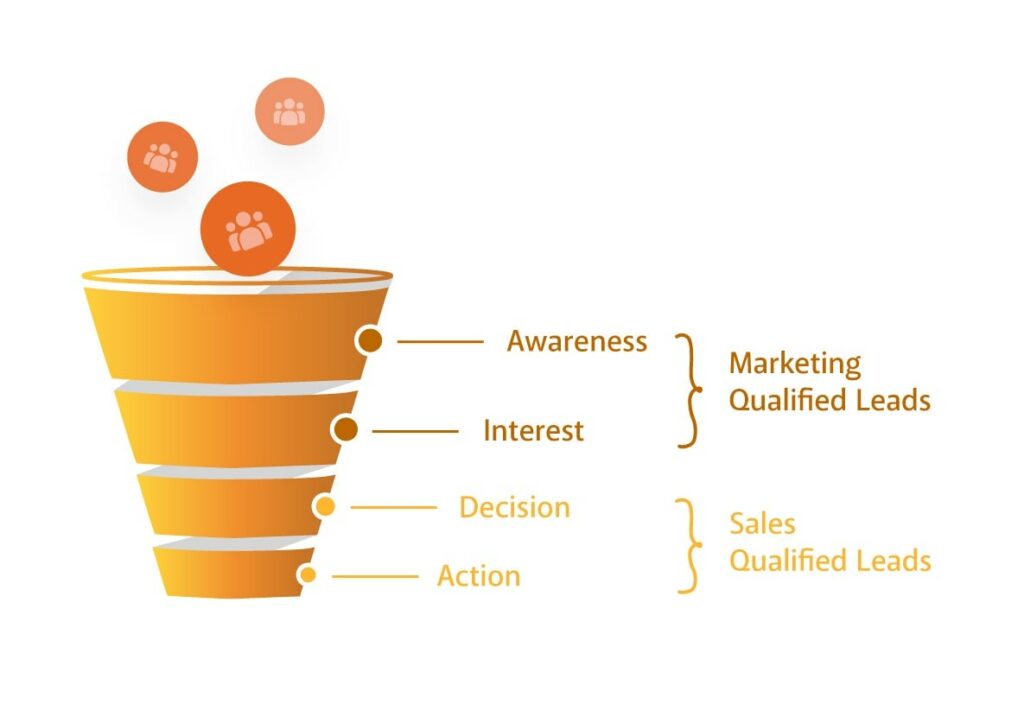
1. Lead
These are new visitors in the awareness stage of the sales funnel who have just heard about the company through marketing efforts such as content marketing, ads, or sharing posts on social media platforms.
They may have googled for information, found your blog post in the search results, and then downloaded an e-book, a brochure, or signed up for a newsletter. These are soft conversions, primarily used for brand awareness, based on the chance that the brand is top of mind when the lead realises they have a problem and starts looking for a solution (the service or product your company offers).
Leads can also be new website visitors who are already aware of a problem and are actively looking for a solution. They may find your product or service on Google by searching for very specific keywords (the ones your landing pages are optimised for). They may click your email address or phone number, but never actually make a call or send an email.
At this stage, the marketer is responsible for all the processes and efforts that go into lead generation.
2. Marketing-qualified leads (MQLs)
The marketing-qualified lead is actively looking for a solution to their problem in the form of a product or service. They evaluate your company based on the marketing messages in your ads and the content on your website. Based on this evaluation, they complete a hard conversion on your website or ad. They call you, send an email, or fill out your contact form to ask about your product or service.
They have shown interest in what you sell and have sent you their contact details (phone number, email) or requested a meeting.
This is where the sales team performs the first qualification of leads based on their interaction with them.
Some MQLs reach out via email or a contact form and ask to be called back, but for some reason they do not answer when the salesperson calls. Some may answer but say they have already purchased a service from another company.
Some may have misunderstood your ads and the content on your website (or did not bother to read it properly) and thought you were selling something else. Others are fully aware of what they want and what you have to offer, but their budget does not match your prices, or their expectations do not match what you offer. These MQLs are marked as irrelevant leads.
The rest (the relevant leads) are moved further down the sales funnel and become SQLs.
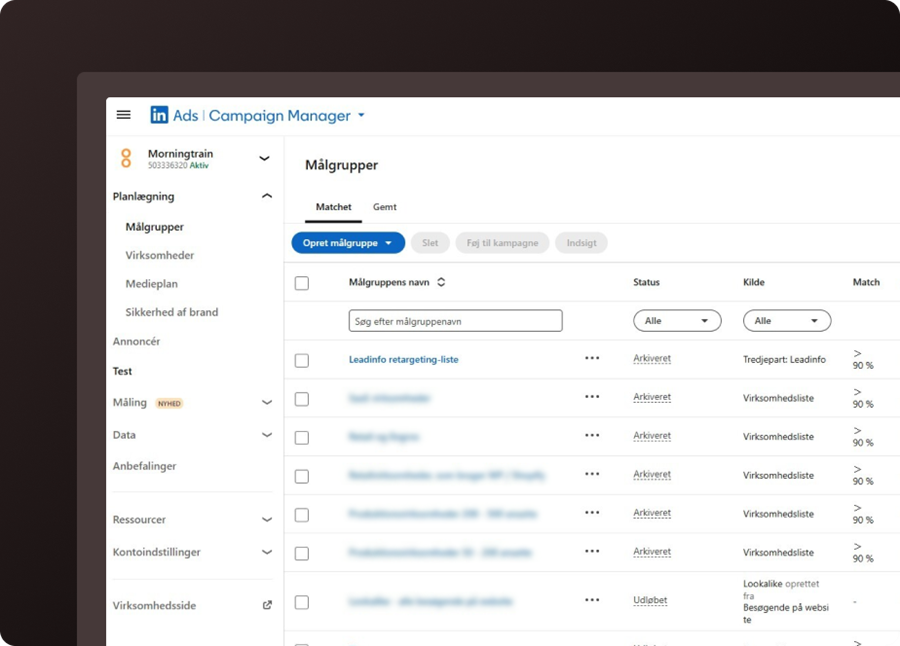
3. Sales-qualified leads (SQLs)
Sales-qualified leads (also referred to as relevant leads) are in the evaluation stage of the sales funnel. During the first call or initial meeting, it was clarified that they understand what you sell and that your product or service solves their problem. The sales representative and the lead agree on a product, a service, or a combination of the two that can solve the lead’s problem.
The sales team is responsible for this entire phase. It is up to them to further convert the SQL into a client and inform the marketing team if they see the same issues recurring with their SQLs.
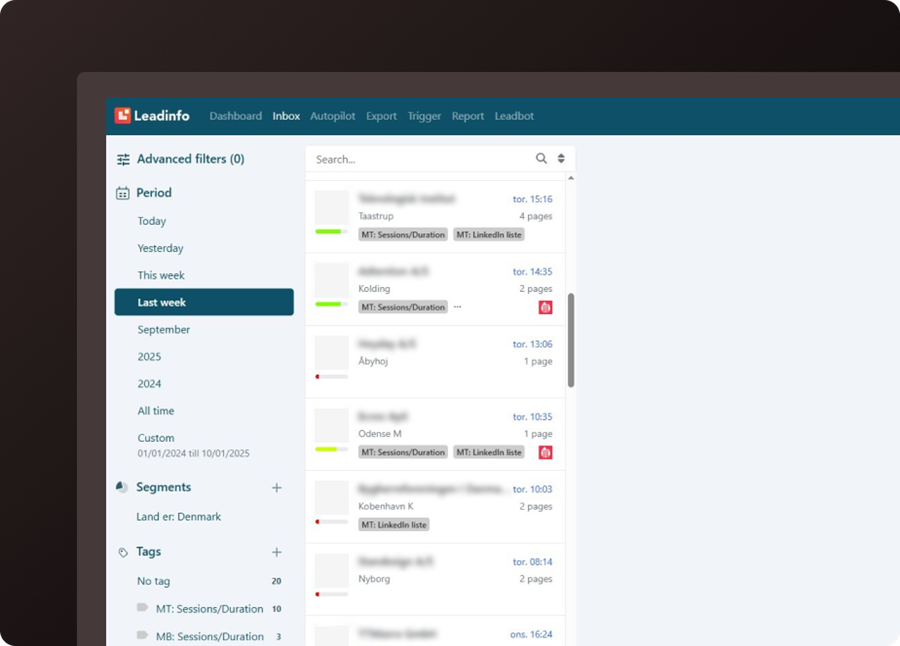
4. Opportunity
An Opportunity is an SQL that is highly interested in your service or product, has been very engaged during your calls and meetings, and has received a proposal from you. All that is left for them to do is say yes or no.
Some companies have a very clear distinction between SQL and Opportunity, and others do not. It all depends on the product and service they offer and the decision-making process within the SQL’s company.
For example, your contact person may be responsible for researching options and finding the best service provider or the best product on the market. But that does not mean they have the authority to say yes to the deal you are offering. They may need approval from the company’s CEO or board.
5. Customer
We probably do not need to explain this one too much. They have received a proposal, and they have said yes. The contract is signed, and now the ball is in your court. Make sure you deliver what you both agreed on, and nurture the customer even after the service or product has been delivered.
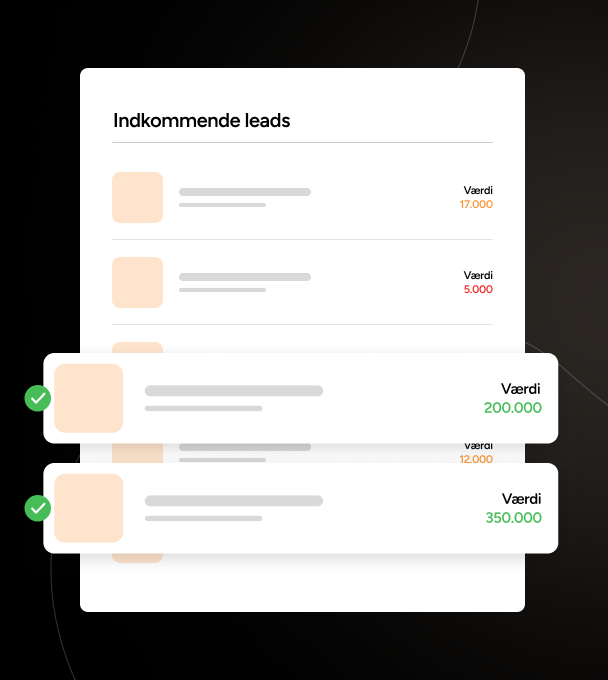
Conversion rates: your tool for finding issues in the sales funnel
A high conversion rate indicates that your marketing and sales efforts are working well, leading to more customers and increased revenue. Conversely, a low conversion rate may be a sign of potential obstacles in your sales process that need to be addressed.
By analysing the conversion rate at each stage, you can identify bottlenecks where potential customers may drop off before becoming customers. By focusing on these bottlenecks, you can improve overall business growth by increasing the number of qualified leads that ultimately become paying customers.
So here are the conversion rates for each stage and the issues they may indicate.
Conversion rate from website visitors to MQL
This conversion rate gives you the percentage of visitors to your website who have completed a conversion. A low conversion rate here may indicate issues with your content and your ads (unfortunately in a very general sense).
It is possible that the keywords you use in your SEO and Google Ads have a different search intent than you expected. For example, you might use a keyword such as “web development” that describes a service, but when used on Google it returns highly informational content mostly associated with educational programmes. As expected, the conversion rate for traffic from that source would not be very high.
There may also be an issue with your CTAs. Are they clear? Do they stand out? Do they all work? User testing is your best friend here.
Content is a common issue for many websites. Are you answering frequently asked questions? How often are leads confused about or misunderstanding your product or service?
The formula for the conversion rate from website visitors to MQL:
Number of MQLs / Number of website visitors = Conversion rate from visitors to MQLs
Conversion rate from MQL to SQL
This metric gives you insight into the percentage of irrelevant leads. It is one of the best ways to determine lead quality and an excellent indicator of how well your marketing team is at creating content and ads that target your relevant leads.
By comparing which sources and channels the irrelevant leads came from, you can best identify marketing campaigns that are not worth the effort. I often use this group to decide which keywords we should remove from our Google campaigns, or which landing pages need work.
Finding patterns in this group can be a great tool that can help you save money on your ads, but also help you identify campaigns that consistently produce high-quality relevant leads that can be scaled if you increase the budget.
At this stage, communication between the marketing and sales teams is extremely important. Both teams need to be aligned on the definition of an irrelevant lead. Are irrelevant leads those who wrote to you but never responded when you contacted them even when their email clearly described that what they were looking for matched your product and service? What about leads who are very interested in your product and service but do not have a sufficient budget?
Ask questions, and do not forget that it is okay to update the lead list if it turns out that the irrelevant lead ended up purchasing your services in the end.
The formula for the MQL to SQL conversion rate is:
Number of sales-qualified leads / Number of marketing-qualified leads = MQL to SQL conversion rate
Conversion rate from SQL to Win
The sales metric SQL-to-win conversion rate is the percentage of sales-qualified leads that are converted into customers (won deals). By monitoring the conversion rate at this stage, your team will be able to identify potential issues and opportunities to improve the overall sales cycle.
This conversion rate helps you understand the effectiveness of your deal closers and identify issues in your final sales stage.
If the conversion rate is low here, you should look at solutions immediately. There is little point in pouring large amounts of money into the marketing machine if leads do not ultimately become customers.
Do you ask for the reason for the drop-off? There is not much to lose when you have already experienced a decline, and it can help you find and fix issues. If, for example, the answer is consistently “You are too expensive,” you may need to review your pricing or get better at communicating the value of your products or services.
Do they take a long time to get back to you, or do they simply disappear without sending a response? Make sure you have a follow-up framework. Book a meeting immediately when you send an offer, or schedule a call with the potential customer so you can go through it together.
The formula for the SQL-to-win conversion rate is:
Number of won deals / Number of sales-qualified leads = Win conversion rate
In conclusion, understanding the journey from lead to customer in B2B sales is crucial. A clear understanding of the terms and stages involved can help marketers focus on the right stages and optimise their strategies for better conversion rates and business growth.