


Content
20. November 2023
How do you write SEO copy?
The most important thing to remember about SEO copy is that if your content does not match what the user searched for, Google will notice and not assign value to your content. Google updates have made it so that technical tricks cannot make up for whether your content actually helps the reader.

You write good SEO copy by doing the following:
- Give your content a meaningful, well-considered headline
- Get to the point immediately and answer any questions right away
- Use a clear information structure (what, why and how)
- Write so the text is understandable to everyone (limit readability score and jargon)
- Add links to other relevant content on or outside your own website
- Make your content readable with paragraphs and without convoluted language
- Use visual aids such as images, video, illustrations and infographics
When you write SEO copy, first and foremost you must ensure that your content aligns with the user’s intent behind using a given keyword.
Therefore, make sure to get the structure right in your SEO copy. Divide the page into three or more sections.
- The first section should describe “what”.
- The next section should describe “why”.
- The last section should describe “how”.
There is no fixed template, but be aware of …
Essentially, there is no fixed template for writing SEO copy. However, there are certain things that Google’s algorithm likes.
1: Give your content a page title and a meta description
The page title indicates what the page is about. It is shown in the browser tab and in search results (blue/purple text) in search engines.
In many ways, the meta description is similar to a ‘standfirst’, as you know it from newspapers. In both cases, it is a short text that introduces the rest of the content. It should be inviting and make the reader want more.
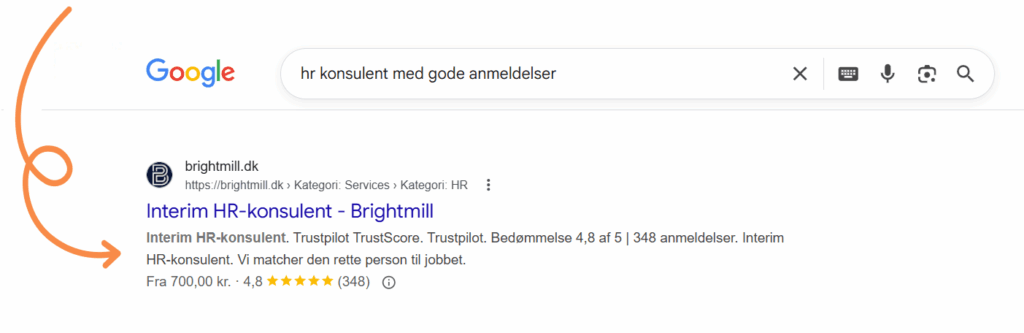
2: A good, well-considered headline
A good headline matches the content of the text, but it should also aim to match the user’s search intent.

3: Content – that users understand
Write content that provides the user with some kind of value. If they are looking for information, they should ideally find the answer with you.
In other words, you need to write SEO copy that helps the user along.
They should benefit from reading your text, regardless of what their intent is.
4: Use links
Links are also an indicator that Google uses for ranking. You may have heard of link building before. There are two ways to link.
– Internal: Here you link between your own landing pages to help the user along.
– External: Here you link to other sites. These can be other credible sources that support what you are writing about.

5: Update your content continuously
You may have written the world’s best landing page 1 year ago. Therefore, it may happen that new knowledge has emerged about the content in question.
In that case, you can advantageously update your content so it is up to date. This will improve the user experience.
6: Optimise for user signals
Once you have the above structure in place, you can do a number of other things to ensure that Google users love your content:
Write an introduction
Instead of opening with “This topic is important because of XYZ,” you can open with something like “Today I will show you how to XYZ”.
Use images and graphics
Images are far more visually engaging than an article consisting solely of text. And they are especially important for long-form content.

Add internal and external links to your page
That way, people can learn more about topics you cover on your website or blog—without having to jump back to the search results page.
Make your content readable
Use large fonts. Use H1, H2 and H3 subheadings to break your content into neat sections.
Keep your content current and up to date
I have found that a significant update of old content results in a “freshness boost”. In addition, most users generally prefer to read new things that are 100% relevant right now.
Read more about “newsjacking SEO”.
Avoid copying from other texts
Duplicate content is content that resembles or is an exact copy of content on other websites or on other subpages on your own website. Having large amounts of duplicate content on a website can negatively impact Google rankings.