


Data insights
2. March 2020
The 8 things your bounce rate tells you
Your bounce rate (in Danish: afvisningsrate) indicates what percentage of your visitors land on your website without visiting any pages beyond the one they arrived on, before returning to Google, Facebook, or the channel they came from.

Content
The 8 indications 1. Tracking doesn’t work 2. Wrong intention 3. Slow load 4. Non-responsiv 5. Bad traffic 6. Much blog traffic 7. You are irrelevant 8. Website is broken8 things your bounce rate can tell you
- Your website tracking is broken
- Your content does not match the visitor’s intent
- Your website loads slowly
- Your website provides a poor responsive experience
- You are paying for poor-quality traffic
- The blog is driving the traffic
- You are (ir)relevant for a given keyword
- Something is seriously wrong with your website
Most marketers understand what a bounce rate is, yet we find that only very few understand exactly what they can use their bounce rate reading for.
1. Your website tracking is broken
Yes, it is a slightly odd place to start, but an improbably high or low bounce rate tells you that something is wrong with your tracking code. Because even though a bounce rate of 15% sounds fantastic, it is simply unlikely that you have such a low bounce rate.
Below, we have described when you can assume that something is wrong with your tracking. In addition, you can see what constitutes a good, okay, or poor bounce rate.
- 0-30% = Something is wrong with your tracking
No website has no bounce rate—anything below 20% can safely be assumed to be due to your tracking code being set up incorrectly. - 30-45% = It does not get any better
The internet is a disloyal and impatient place, and you have managed to tame it with your awesome content. Hats off to you! - 45-60% = Average
It is neither fantastic nor poor, but if your bounce rate is at this level, I would generally be satisfied and focus on other, more important things. - 60-85% = Poor
You should take action! Your bounce rate tells you that you are getting very little out of your marketing activities. Time to roll up your sleeves. - 85-100% = Something is wrong with your tracking
Yes, the internet is a disloyal place, but no website has such a high bounce rate. So, good news: there is most likely something wrong with the tracking on your website.
2. Your content does not match the visitor’s intent
A very high bounce rate may indicate that traffic coming to the website from a given channel finds that the page they are sent to does not match what they searched for on Google, or what the ad they clicked “promised” them.
So, if you have a very high bounce rate from a given channel, I would look at which landing pages I am sending traffic to from that channel.
- Identify the channel
- Check which landing pages people are being sent to
- See what the message on the page is
- Check what the ads/search result promised the visitor before they visited the site
- Check whether it matches the experience of landing on the page. For example, if you write about advice and tips & tricks, people expect to get useful advice on the landing page—not just the option to contact you.
Bonus info!
When it comes to pull traffic (traffic from search engines), you can actually screen what people’s intent was with the search in advance. In other words, you can check what people expected to click through to.
Was it:
- Information
- A video
- Guides
- Product sales
- Other?

You do this by Googling the keyword in incognito mode. When you Google in incognito mode, Google does not take your search history into account, so you get a more accurate picture of what appears in the search results.
You can Google how to access incognito mode.
This is interesting, because the top 3 ORGANIC results on Google indicate what people actually engage with when searching for a given term. By engage, we mean that people stay on the page for a while, click around, fill out forms, and the like.
So, if you Google a term and the top 3 organic results are Wikipedia, a blog page, and suggested videos about the topic, that tells you that people’s intent with that search is to find information—preferably in a video format. That is the type of content you should present on this topic—not a page that talks about how great you are as a company. 😉
Matching your content to the searcher’s intent will become a bigger part of Google’s algorithm over the next few years. So, if you want to win at SEO, you need to have search intent under control.
3. Your website loads slowly
Yes, this is a no-brainer. If your site loads slowly, or does not load at all, we leave the site—period.
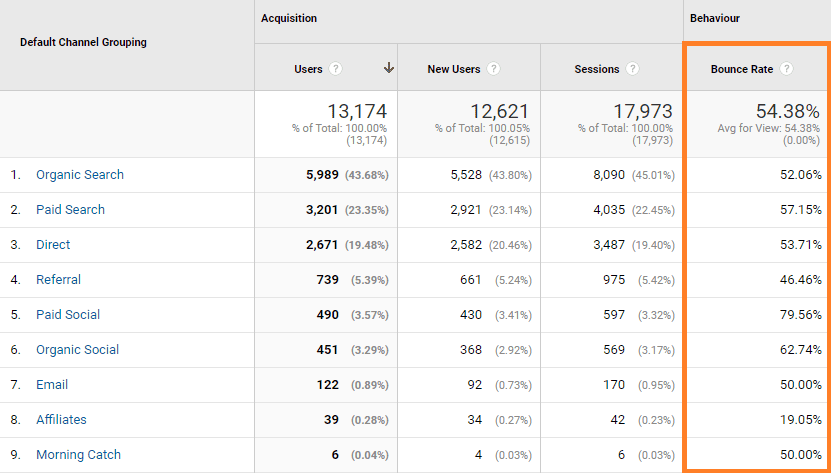
An indicator that page speed is affecting the bounce rate is that the bounce rate is high across channels.
If the bounce rate varies between channels like in the example below, it is most likely not speed that is causing a high bounce rate from paid social.
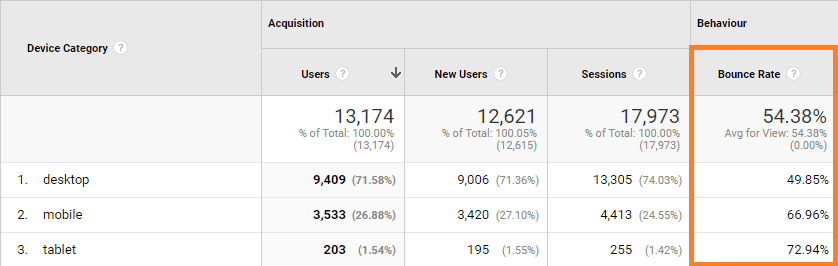
If all your channels are affected by a high bounce rate, I would also check whether this applies across devices. If mobile and tablet are much slower, it may be because the site is heavy to load, and devices on 3G signals are therefore affected more than people on a fibre connection on desktop.
4. Your website provides a poor responsive experience
If your bounce rate is particularly high on mobile (see point 3), I would definitely go through the site on a phone to see what the mobile experience is like.
Often, if your website is not designed responsively, the experience becomes a wall of text, or elements overlap on mobile, which makes your visitors leave immediately.
5. You are paying for poor-quality traffic
Another possible explanation is that you have targeted too broadly in your marketing, and are now simply bringing irrelevant traffic to your website.
This would show up as one channel having a significantly higher bounce rate than the average across channels.
Feel free to review your target audience and consider narrowing it down a bit to see what it does to the bounce rate.
6. The blog is driving the traffic
This point is most relevant for SEO traffic. Historically, SEO traffic has a low bounce rate. So if the opposite is true, check whether it is because most of your organic traffic lands on a blog page by checking which landing pages people arrive on from organic searches.

Blog traffic generally has a higher bounce rate, because people are often at the very beginning of their information search and therefore do not quite know what they are looking for, or their search is vague, which caused them to land on your blog post by mistake.
If you have a lot of SEO traffic on the blog, a good tip is to work on moving traffic around the site more with a “read also” section at the bottom, or with links to other pages/posts throughout the blog post itself.
Your bounce rate is an SEO metric, so if you lower it, you will most likely see your rankings improve.
7. You are (ir)relevant for a given keyword
Your organic traffic will usually have a low bounce rate. That is because Google is getting better and better at matching the user’s search with content on various websites. This also means that if your organic traffic has a high bounce rate (above 60%), it needs to be addressed now.
Having a high bounce rate on organic traffic negatively impacts your rankings, because it indicates that you are not relevant to the topic/not the best experience to land on for a given search.
Over time, Google will take away your rankings if it is not fixed, because Google absolutely has to show the best results first—otherwise they lose their reason for existing.
You can use the same trick as in point 2—Google the keyword in incognito mode. See what appears organically. Your content should match the top 3! Not in the sense that you should shamelessly copy it, but in the sense that if blog pages are ranking, you should not try to rank a product page. If the top 3 pages have tables or videos, it shows that people either want to compare something within the topic or want to watch a video, and then it simply does not help to write 3,000 words about the topic.
Read more about how to find the right keywords
8. Something is seriously wrong with your website
The very last rabbit you can pull out of the hat is: something must be seriously wrong with the website. I would not jump to this conclusion before you have investigated one of the other 7 points, as it can be difficult to pinpoint what is wrong with the website beyond responsiveness, speed, or the traffic you are driving in.
Here are some ideas of what could be wrong:
- Check with your host whether your site has sometimes been down, so that when people visited you, they were met with an Error 503.
- Check how many 404 calls there have been on the site—i.e., people who have visited broken links.
- If people spend a long time on the page (3+ min. on average) but the bounce rate is still high, this may indicate that your content is not guiding people properly to other parts of your site.
Thank you for reading—now you know everything worth knowing about bounce rates. Go make that change.