

AI
19. August 2026
ChatGPT is getting ads in Europe: What does it mean?
From 24 August 2026, OpenAI will start showing ads in ChatGPT to users in 31 European countries, including Denmark. It is still very new and we do not have all the answers yet, but here is what we know.
Content
The quick overview What opportunities does it offer B2B companies? Google Ads vs. ChatGPT Ads A little about ChatGPT Ads How to get started as an advertiser What does it mean for your marketing efforts? There are still unanswered questions We’ll keep you updatedThe quick overview
Ads in ChatGPT will roll out across 31 European markets – including Denmark – in late August 2026. This is the first time an AI model becomes an advertising channel here in Denmark.
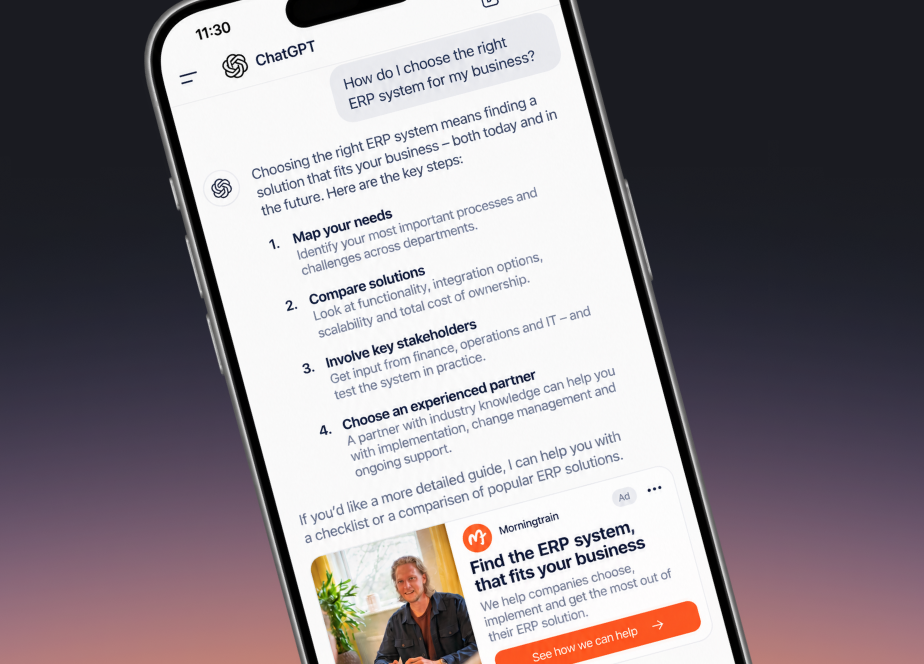
Ads will only be shown to adult users (18+) on the free tiers, Free and Go. If you pay for Plus, Pro or Enterprise, you will not see ads. They appear as a highlighted, clickable box at the bottom of the chat and do not change ChatGPT’s actual responses.
What is interesting is not just that ads are coming. What is interesting is how the ads are selected. Unlike Google Ads, you do not target keywords; instead, ads are shown based on what a person is actually chatting about, in real time. So-called “Context Hints” (context hints).
And that hits right at the stage where your potential customers are researching a problem, long before they type “supplier of X” into Google.
So if a user, for example, is chatting with ChatGPT about planning a reception, it is automatically matched with advertisers in catering or event rentals.
What opportunities does this create for B2B companies?
A large part of a B2B buyer journey happens out of sight of traditional advertising; decision-makers often research quietly long before they reach out themselves or search for a specific product or company name, which can make them harder to reach with standard keyword-based ads.
This new matching method opens up a concrete opportunity: you can potentially be shown to a decision-maker while they are still researching and weighing different solutions—i.e., earlier in the consideration phase than most other ad channels provide access to today.
How it differs from Google Ads
The biggest difference is that you move from keywords to targeting intent
In OpenAI Ads Manager, you do not bid on keywords. You work with context hints, which are descriptions of the conversations, topics and needs where your solution is relevant. These are broad thematic signals, not an exact match on wording.
It sounds like a technical detail. It is not. It changes what you need to have in place before you can even advertise effectively:
| Google Ads | ChatGPT Ads | |
| Targeting | Keywords with match types, negative keywords | Context hints: themes, needs and conversation types |
| User starting point | Has entered a keyword | Is in the middle of a dialogue and has already received an answer |
| Stage in the buyer journey | Often late – specific need, high purchase intent | Often early in problem definition and research |
| Ad format | Text, shopping, display, video | Box under the answer: logo, headline, text, image |
| Control over exposure | High – you decide exactly which searches | Lower – the system assesses relevance |
| Insight into the triggering signal | Search terms report | No insight into the specific prompts |
| Measurement | Google Ads conversions, GA4 | OpenAI pixel, Conversions API, UTM |
Example of the difference—and the symbiosis—between Google Ads and ChatGPT Ads
Imagine a Funen-based manufacturer of custom solutions for the food industry. Today, leads primarily come from Google searches such as “food-approved conveyor belt”; short, specific, and with tough competition on cost per click.
The technical buyer who needs to solve the problem simply does not google like that at the beginning. He writes to ChatGPT: “We are having issues with bacterial growth in our packaging line. Which materials and construction types reduce the risk?” He gets a thorough answer about surface materials, joints and hygienic design—and under the answer, an ad from a supplier that works with exactly that.
He is not ready to buy. He is trying to understand his own problem.
By combining the two channels, you can reach potential customers at multiple points in their buyer journey and research.
A bit about ChatGPT Ads
What will the ads look like?
What are the ads selected based on?
What is excluded?
What does the advertiser get to know?
How to get started as an advertiser
OpenAI already has a self-serve solution available in Danish: OpenAI Ads Manager. You create an account, just as you know it from Google Ads, and from there you can set up campaigns, budget and ad details yourself.
What does it mean for your marketing efforts?
You do not need to change your strategy today. But this is another place where a potential customer can encounter you while they are researching and considering a solution—often before they have even typed a keyword into Google.
We therefore recommend taking a look at the following:
- Landing pages must be able to pick up where the AI left off: If a visitor comes from a ChatGPT conversation, they have often already received an initial explanation. The page should therefore get straight to the point and convert quickly, rather than starting over.
- Content should answer the intent behind a question, not just a keyword: Google Ads and SEO are already starting to merge, and this pulls in the same direction: it will become more important to understand search intent in terms of what the user is actually trying to figure out than to hit an exact keyword.
- Strengthen your presence across the web, not only on your own website: Since matching happens based on broad context rather than keywords, it becomes more important that your expertise and solutions are clearly described in multiple places online, so you have a chance of becoming part of the context the AI draws on.
What we still do not have answers to
Since this is completely new, there is still quite a lot we do not yet know. For example:
- We do not know how precisely “context hints” work in practice, especially for B2B and niche industries: OpenAI’s own examples are about broad consumer scenarios, such as a user planning a party. There are not yet any published figures on how well the matching works for more specialised needs.
- We do not yet know how much reporting and insight Ads Manager actually provides in the Danish version: The feature set may differ from what you know from the US market, where the platform has been running the longest.
We will keep you updated
We will be testing this new advertising platform ourselves, and of course we will share our experiences with you. If you want to make sure you do not miss it, sign up for our newsletter.

Written by





Do not hesitate – we are always ready for a chat
Let’s have a chat about your digital project
Let’s go into detail so we can find solutions together that match your needs.