


Lead generation
21. October 2022
Best practices for your Google ads
To succeed with Google Ads advertising, technical wizardry or clever tricks are not enough. Your campaigns will not perform better than the ads you present to your potential customers.

Content
5 Effective practices Use numbers The “pain” you are solving Use exact match Ad extensions Rotation of ads5 effective best practices for writing ads for Google Ads:
- Make sure the exact keyword appears in the ad
- Start from your potential customers’ pain points
- Use numbers in your ad copy to stand out more
- Use as many ad extensions as possible
- Let Google’s algorithm assemble your ads
Ultimately, your ads on Google help define your traffic volume, your cost per click, and your conversion rates.
To help you get off to a good start, we have tried to compile some best practices you can use when creating ads for Google Ads.
I elaborate on my five tips below.
Include numbers in your Google ads
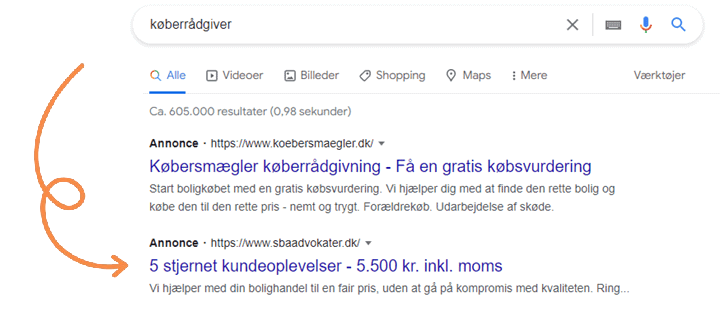
Incorporate numbers into your ads. This can be years, number of cases, percentage increases, and the like. The point is that numbers are eye-catching in search engine results.
Start from your potential customers’ pain points
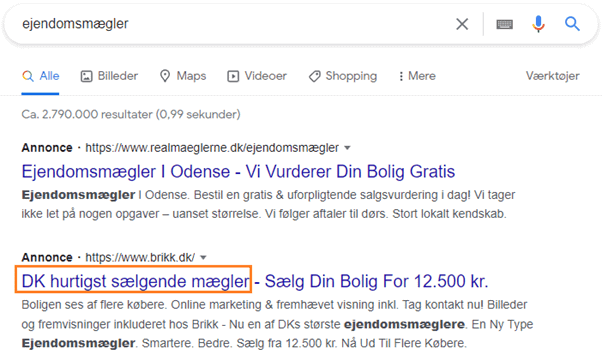
Address the searcher’s pain points. You can benefit from using insights from your sales team about what challenges customers face when choosing to buy your products/services.
This way, you potentially speak directly to the feeling or experience your potential customer is having, thereby increasing the likelihood that they choose to click on you because you “understand their situation”.
Use exact match
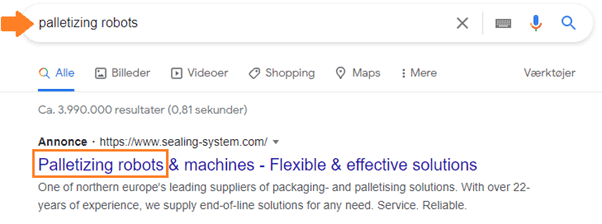
Make sure the exact keyword is used in the Google ads. You can partly ensure this by using a single keyword ad grouping (SKAG) structure i.e., building campaigns so that each keyword has its own ad group, rather than having a long list of keywords in the same ad group.
Use as many ad extensions as possible
Use many extensions so you take up more space in the search results and provide searchers with more information to base their decision on. We particularly recommend sitelinks, images, location, and phone number, as these are easy to set up, are often shown, attract attention, and therefore increase CTR.
Let the algorithm shuffle your Google ads
Avoid “pinning” your headlines and descriptions. We have run some split tests between RSA ads (Responsive Search Ads) where we pinned headlines and descriptions to a fixed position vs. one without.
The ad without pins was prioritized higher by Google and generally achieved a higher impression rate because it made it easier for Google’s algorithm to optimize freely. Of course, this requires you to write headlines that work in any combination, so keep that in mind when writing new ads.
And remember
Write at least 6 headlines and 4 descriptions in each RSA so Google has enough to work with.
I hope this gave you something to work with. Off you go you need to get out there and create some kick a** Google ads.
Enjoy.