


Lead generation
21. February 2020
How do you find the perfect keywords?
Finding the right keywords is perhaps the single most important discipline in Google marketing. Without the right keywords, all technical tweaks are secondary. This blog post is a guide to how you can find the perfect keywords for your business, step by step.

Content
The 7-step model SEO is a process Brainstorm Check the SERP Limited budget Keyword value Does SEO make sense Repeat the process Keyword analysis ConclusionenYou find the perfect keywords by doing the following:
- Start with a rough brainstorm
- Start from your niche
- Get inspiration from your competitors
- Investigate the search intent behind your keywords
- Find synonyms for your primary keywords
- Check the cost per click for your keywords (high CPCs can indicate high value)
- Keep an eye on keyword competition
You find the perfect keywords by conducting a keyword analysis. Keyword analysis is often an overlooked element of search engine optimization (SEO).
That is unfortunate, as it is also one of the most important elements so you should take keyword analysis seriously to achieve the greatest possible success with search engine optimization.
Take keyword analysis seriously
When you conduct keyword analysis, you analyze relevant keywords for your website. In other words, this is the process where you determine which words/phrases you should work on to get your website higher in the search results.
The better you are at finding and analyzing relevant keywords, the better results you can often achieve both in terms of rankings in the search results, but especially in terms of the number of relevant visits and conversions.
The mistake we most often see people make is that they want to be found for very general keywords such as shoes, dresses, or books. These are rarely the best keywords to target and that is exactly what keyword analysis is meant to show you.
Keyword analysis helps show you which keywords are worth spending time on, and which keywords you definitely should not spend time on. In addition, during this process you will often find relevant keywords you would not have thought of if you had not taken the time to do a proper keyword analysis.
That is why it is important that you take keyword analysis seriously and avoid rushing through it.
To conduct a good keyword analysis, you need to use a range of tools so you can find the relevant data and information about your site and the keywords you are analyzing.
We will briefly go through some of the tools that can help you through the process.
SEO is an ongoing process
Keyword optimization is a dynamic and ongoing process that often only pays off after some time therefore, it is important to be thorough and patient.
The SEO process is about getting lots of small gears into place. And once they are in place, it will run on its own for a while. Then it needs new lubrication and new input again.
With a keyword analysis, you have the opportunity to develop new ideas, expand your niche, and explore new trends, so there is always something new to work on.
Point no. 1 – brainstorm and research
Step 1 in keyword optimization is brainstorming.
Start by reviewing your business and your website what is it that makes you special? And what can you do that others cannot?
Here, you should not think negatively about your competitors; you should find out what you do differently why you would choose yourself as a partner.
Your niche is important
Find your niche. Explore it. And share it with the rest of us. For example, furbysofie is a webshop that sells various fur products, including hats. But the word “hats” is far too generic, so we do not really know whether the traffic is relevant for this shop. Whereas the keyword “fur hats” is exactly what the shop sells.
Another example could be Kokken & Jomfruen, who are especially known for their food. In this case, the word “food” would not be particularly interesting, as the traffic is very varied. A more specific keyword here would be “catering”, as this is offered on their website. If you want to make it even more specific, you can use the term “catering kolding”, which also indicates a specific location. Here, it is important to have an appropriate landing page.
BONUS: The more precise the keywords you rank for, the greater the likelihood that your visitors will convert.
Start broad and narrow down
Start your brainstorming process by finding keywords you consider relevant. Make a list by hand, in Excel, or whatever works best for you.
Afterwards, you need to sort your words. You can do this, for example, by checking the search volume for your keywords in Google Ads. Is anyone searching for the terms?
Similarly, you can check whether there are ads for them i.e., whether there is competition for your desired keywords.
If you find it a bit difficult to come up with good, descriptive (and preferably objective) keywords, you can find inspiration in Google Ads under “Ad groups” and “search terms” and in Google Keyword Planner (Søgeordsplanlægning in Danish).
Find the keywords that set you apart from the crowd. The term “real estate agent” is a significantly tougher battle in the dream of becoming no. 1 on Google than, for example, “local real estate agent faaborg” (which is a local keyword).
And sell yourself on your niche products “snakeskin boots” rather than simply “boots”, if you sell footwear or, for example, have written an article about footwear maintenance.
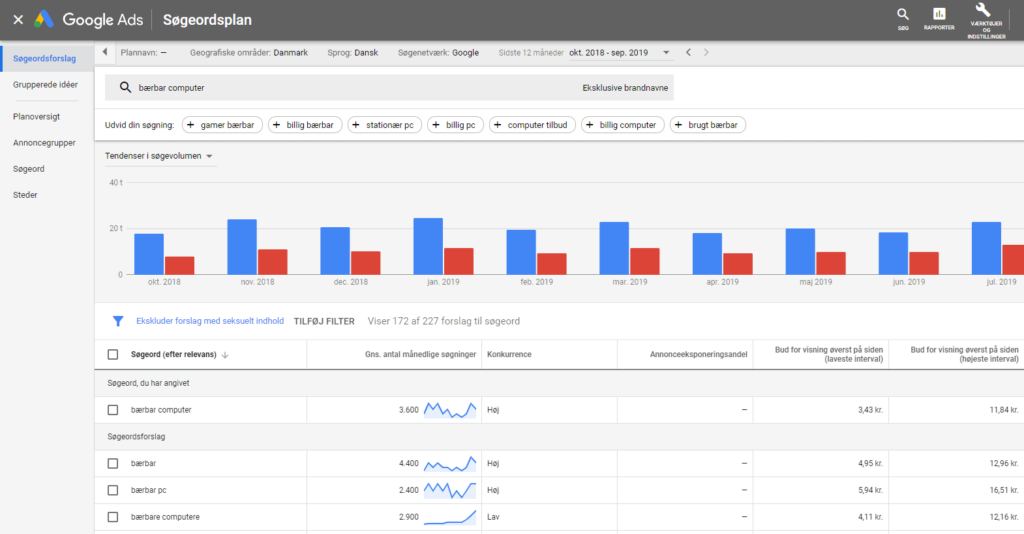
This is Keyword Planner
The downside of Keyword Planner, however, is that to use the tool you must also have an active Google Ads account and have (at least) one active campaign running.
Your keywords can be words, phrases, and categories of various kinds.
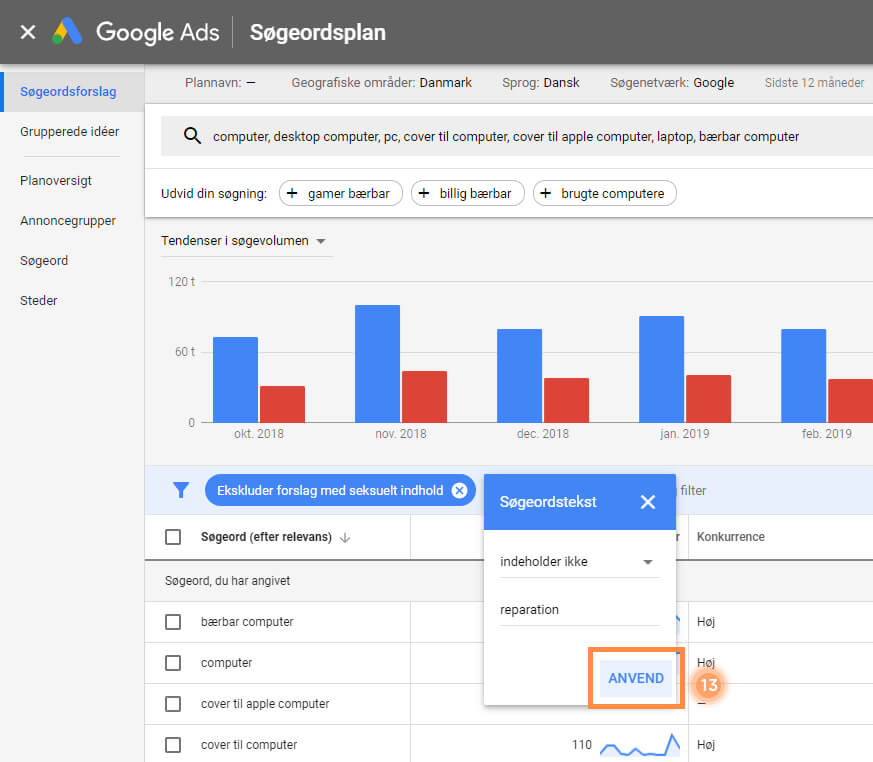
The negative words you can enter in Keyword Planner are the words you do not want to be found for for example, “repair”. Use this feature if you want to avoid getting Google suggestions along those lines.
Review competitors’ websites for inspiration
As part of the brainstorming process, it is also a good idea to review your competitors’ websites. What can they do? And what can you do differently?
Even though you are competitors, you are welcome to find inspiration from them.
You most likely want to rank higher in the search results than your competitors. Therefore, your competitors’ websites can be a good place to find relevant keywords. If you can find the keywords their content is being found for and then do better search engine optimization than they do, you are already well on your way.
Review their website and sales material:
- Do they describe the product or service differently than you do?
- Do they use different wording or terms?
- Have they written blog posts about something relevant that you have not considered?
- Do they have a page with the most frequently asked questions about the product or service that you can answer better than they do?
- Etc.

How to get started with Keyword Planner
Here is a guide on how to use Google Keyword Planner to find relevant keywords for your site.
1. Click “TOOLS AND SETTINGS” (the wrench icon).

2. Click “Keyword Planner” under “PLANNING”.
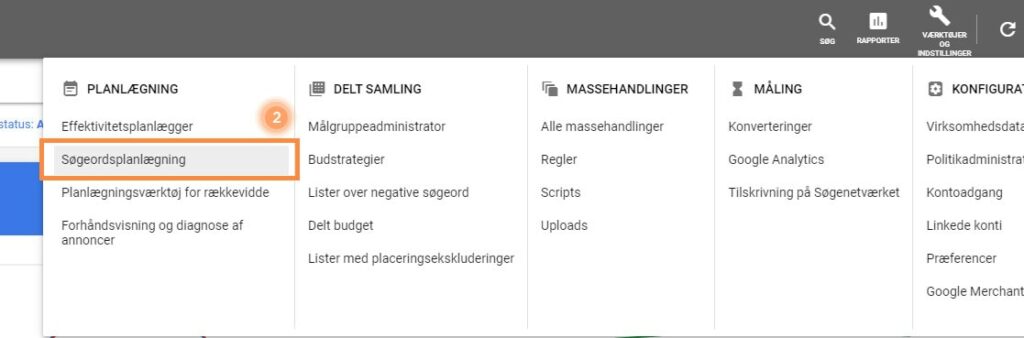
3. Select “Discover new keywords” in the newly opened window.
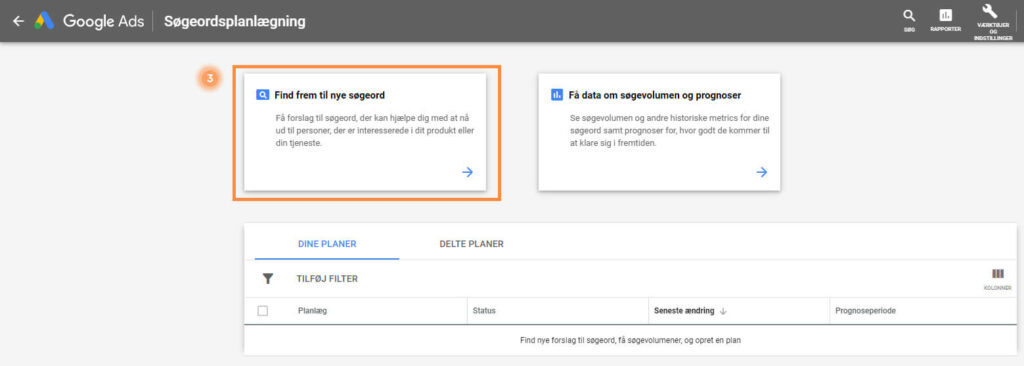
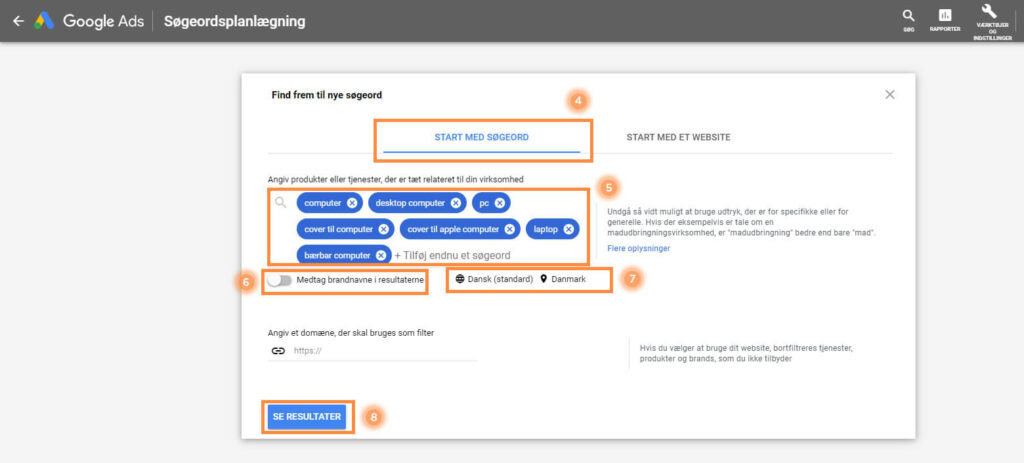
4. Select the “START WITH KEYWORDS” tab in the new window.
5. Enter the keywords you brainstormed in the field below.
6. If you are a beginner, we recommend that you initially turn off “Include brand names in results”. You can always repeat this step later when you feel you have a better handle on your keywords.
7. Double-check that you have selected the correct country and language.
8. Click “VIEW RESULTS”.
9. If you have negative keywords, now is a good time to exclude them. Click “ADD FILTER”. You can always do this later in Excel, but to keep things organized, we recommend adding the filters directly in Keyword Planner.
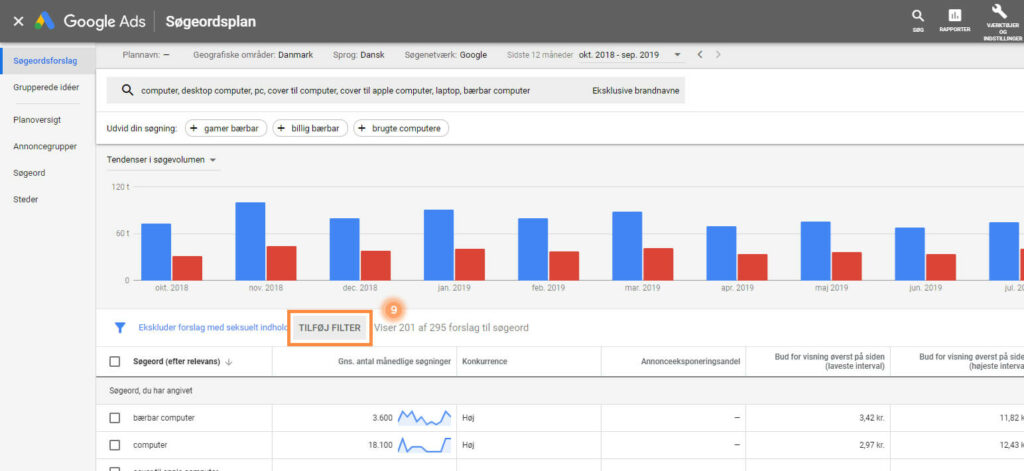
10. Select “Keyword text” in the drop-down menu that appears
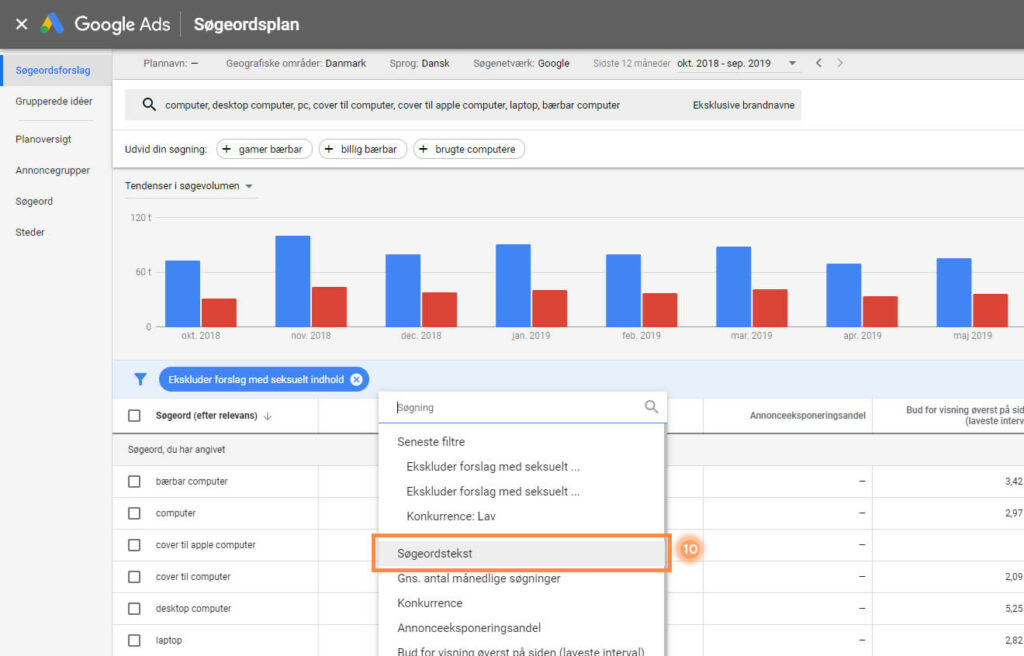
11. Enter the keyword you want to exclude (“repair” from our earlier example) in the second field.
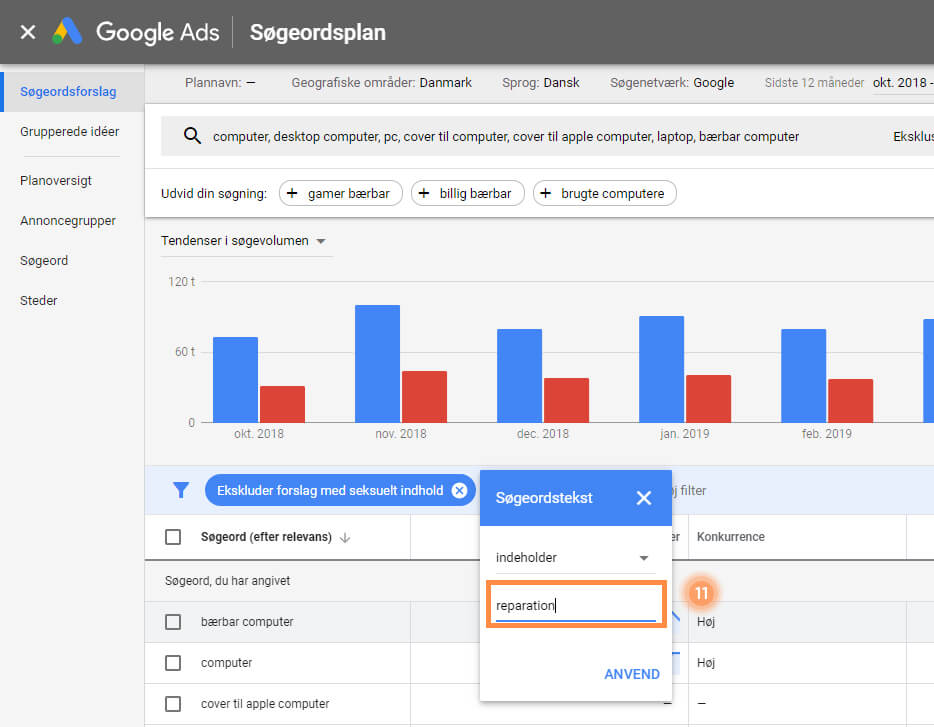
12. Select the first field that says “contains” and change it to “does not contain”.
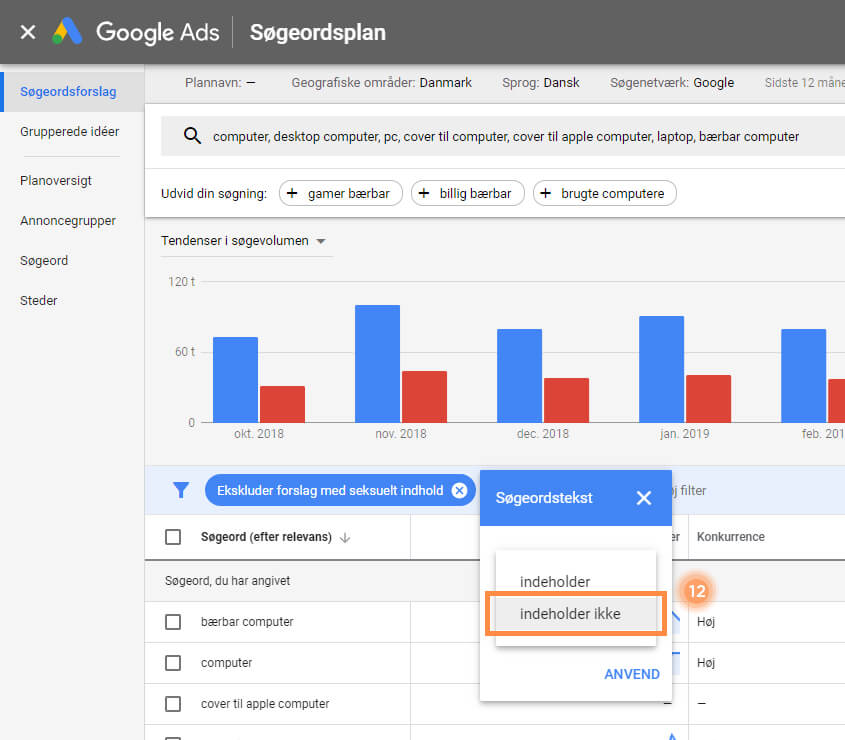
13. Click “APPLY” to see the filtered keywords.
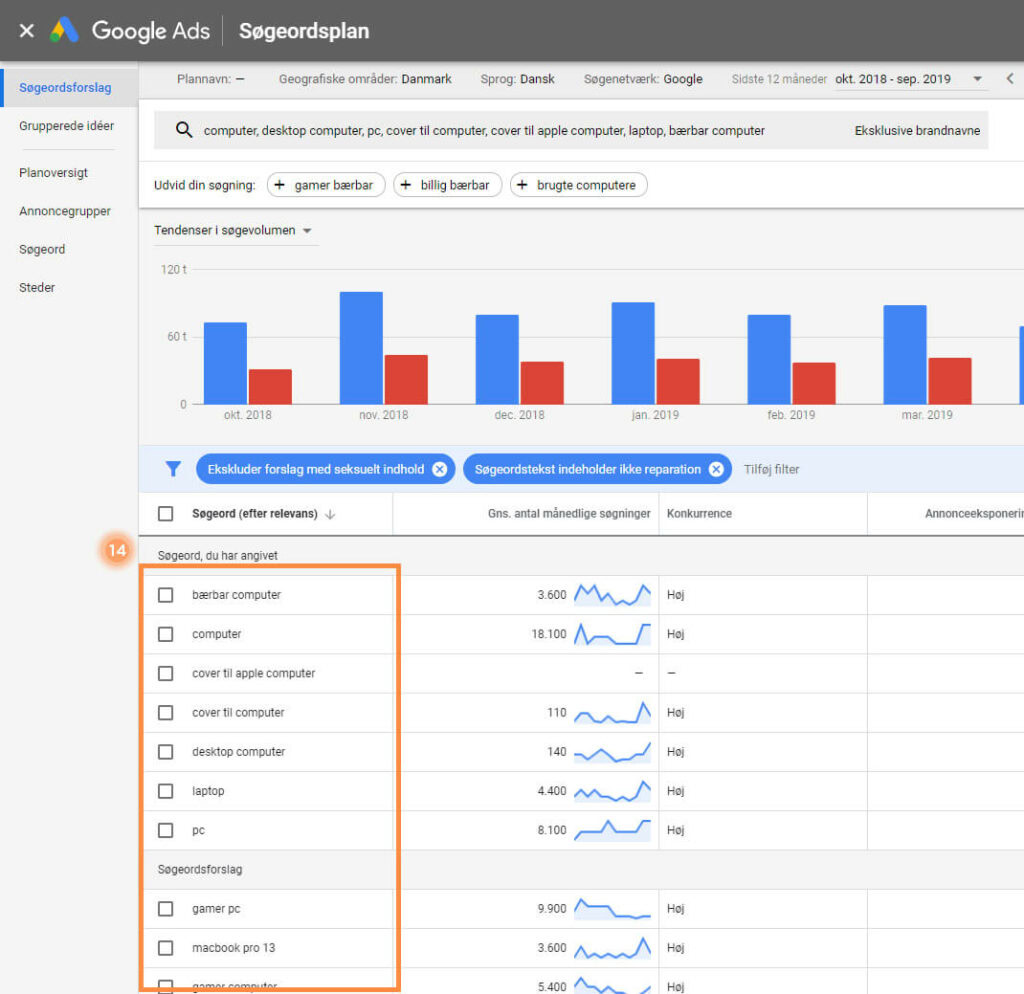
14. That’s it! Now you are done, and you can see all your keywords below.
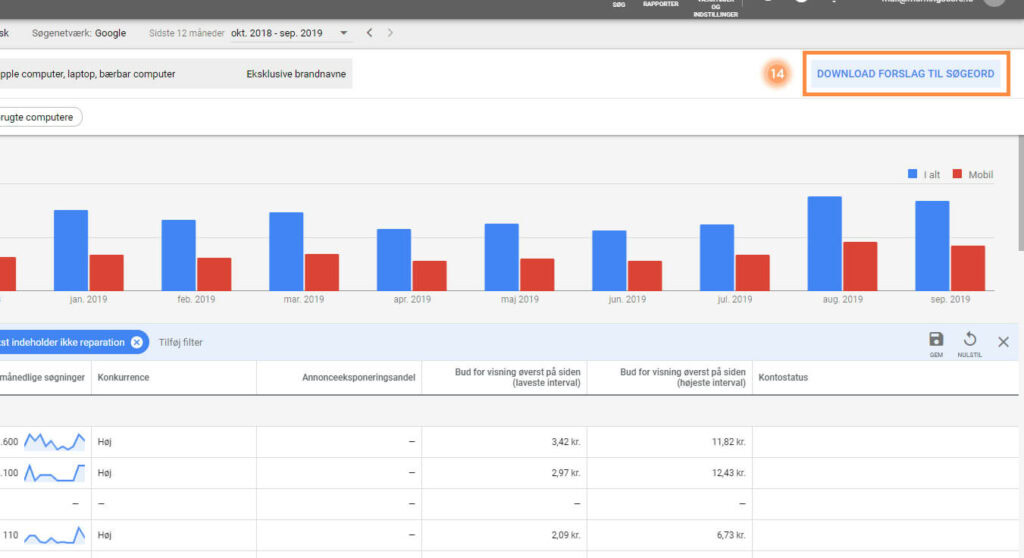
15. You can also export all your keywords to Excel if you want. Click “DOWNLOAD KEYWORD IDEAS” in the upper-right corner.
Point no. 2 – what does your SERP tell you?
Once you have created a list of potential keywords, it is time to test them.
SEO work is, in many ways, a circular process where you continuously narrow down your keywords so you end up with the ones most relevant to you.
Test them in Google Ads, in Keyword Planner, and by Googling them yourself: Enter them and see whether there is a market for the terms you have selected.
Therefore: Identify the keywords that best fit your niche and examine the search volume and the level of existing competition for the keyword.

What should you focus on?
Remember to focus on the fundamentals of good SEO. Your content on your site is crucial and is what drives you forward in organic SEO.
Semantics is interesting in relation to search volume and real ranking factors. In short, it is about search engines not only evaluating your text based on what it literally says, but on what it means.
Search engines examine which words and phrases are most often associated with each other, and based on this information they find relevant results when you and your visitors search.
That is why in-depth content is a good idea; Google can see which articles best elaborate on a topic by analyzing the interplay between different words and phrases and how often they appear together in the article.
In other words, this is the thorough keyword work we are focusing on here.
If you would like to read more about the key fundamentals of SEO content (semantics, density, LSI, and thorough keyword work), technical SEO, and link building you can read more about the topic in this blog post.
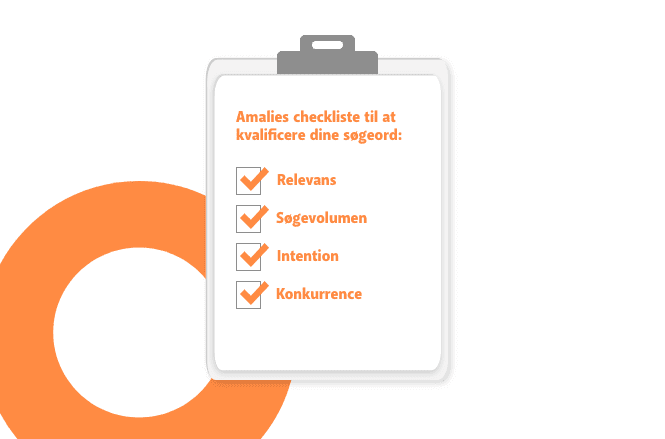
Suggestions if your SEO budget is limited
Your SEO budget most likely depends on the size of your business.
As a small, newly started business, it can be difficult to win the battle for short (head) keywords, because they are usually the most competitive and the CPC is just as often very, very high.
Example: If you work with computers, there is a lot of competition for the keyword “computer”.
Therefore, I (and a large part of the SEO community out there) would encourage you to focus on the long keywords those that in the SEO world are called long tails.
Using the computer example again, it would be better to create keywords such as “Apple computer on sale”.
One thing is that you will rank higher in the SERPs (search engine result pages). Another is that long-tail searches are often more purchase-oriented than head searches, because people who search more specifically typically know what they are looking for and are therefore further along in the buying process than those who are just at the beginning and exploring the landscape on Google or other search engines.
Please note that you will not always be able to find relevant long-tail keywords for the Danish market when using keyword tools. The larger the market, the more people there are to search for highly specific terms and vice versa. In practical terms, this means that many tools do not show keywords with low search volume.
In addition, long tails can sometimes be harder to come up with than head searches, because they are often quite long (3+ words), and there are also not as many people searching for them as for head searches.
Therefore, it can be a good idea to think in terms of LSI keywords (latent semantic indexing) i.e., closely related keywords or phrases.
LSI keywords are a good way to find keywords that others perhaps your competitors have not thought of, but that still have traffic.
Example: LSI keywords in the “computer” example could be terms such as “computer keyboard”, “computer mouse”, “laptop”, “notebook”, “computer charger”.
How to find and use LSI keywords
A combination of synonyms and LSIs helps create good diversity within your niche, which benefits your potential customers, Google, and you.
There are countless good tools to help you along the way when it comes to long tails.
We often work with our own tool, Morningscore, which is a very good tool for searching for both head and long tails. In simple terms, Morningscore is a piece of software that provides you with a range of long tails when you search in it. The same feature exists in the tool ‘Ahrefs’.
Therefore, it is a brilliant solution for inspiration searches. However, a lot can come up that is probably not that relevant to you so once again you should check the results of your brainstorming in Google Ads and Keyword Planner to find the exact right keywords, volumes, and competition opportunities.
In other words, you should only choose the keywords that make sense for you.
Which keywords should you target?
You have now received a brief explanation of the different parts of a keyword and you have probably also guessed that when we say you should be careful with general and overarching keywords, we mean keywords that consist only of the head.
Most often, the most optimal keywords are those that consist of all three types, and even have multiple modifiers and tails (of course only if someone is searching for the keyword). These keywords are also called long-tail keywords.
Of course, it would be nice to have a high ranking for running shoes if that is what you sell. However, it is also simply a difficult term to rank highly for because competition is high but more importantly, people who only search for keywords that consist of the head will usually be much earlier in a decision-making process than people who include the modifier and the tail in their search.
Therefore, you can usually also achieve a higher conversion rate from long-tail keywords, as people are closer to making a purchase.
If you sell running shoes, for example, try adding some modifiers to your keyword, such as:
- Running shoes from Adidas
- Red running shoes from Adidas
- Red running shoes from Adidas in size 43
- Red ZX 750 running shoes from Adidas in size 43
- Etc…
After that, you can also consider adding some tails to your keyword, such as:
- Cheap red ZX 750 running shoes from Adidas in size 43
- Buy cheap red ZX 750 running shoes from Adidas in size 43
- Buy cheap red ZX 750 running shoes from Adidas in size 43 online
- Etc…
It may not be difficult to see that people searching for a specific running shoe with the keyword “Buy cheap red ZX 750 running shoes from Adidas in size 43 online” have already decided that these are the running shoes they want. They just need the right place to buy them.
On the other hand, people searching for “running shoes” do not yet know which running shoes they want and first need to figure that out before they are ready to buy.
Alternatively, you could consider a keyword such as “Good running shoes for men”, which is also a long-tail keyword, but which captures those who have not yet made a decision.
However, you should expect such a keyword to give you a lower conversion rate, as people do not yet know what they want to buy. On the other hand, there may be more visitors to gain, because more people are unsure which running shoes are good and therefore also search for good advice on choosing the right running shoes.
Point no. 3 – is there value in the keywords?
The keywords must create value for you, and therefore they must also be terms that represent you and what you can do.
It does not create much value for you or your website if you market yourself with the wrong keywords that, fundamentally, have nothing to do with your business.
To give an example, it is not a good idea to market yourself as a computer repair technician if you do not repair computers, but only sell them and accessories.
Point no. 4 – does it make sense to do SEO for it?
How can you be sure that you have found the right keywords?
Once you have chosen your keywords, it is a good idea to Google them. That way, you can see the context in which your keywords appear and you can see whether it makes sense for you.
If you have a product or a webshop that sells products, and with your keywords you land on a SERP that is purely informational (e.g., training or courses within a given area), you should probably adjust your SEO work and focus your efforts elsewhere.
Google is quite good at assessing such things, so you do not gain much as a webshop if you land on a SERP that does not include other webshops.
In other words, you should also ask yourself: “According to Google, am I relevant for these terms?”.
It does not make much sense for you to invest effort here if you get traffic but no one makes a purchase. This will affect your bounce rate, which will simply increase as visitors leave and it harms your SEO work.
If, on the other hand, there are often ads for what you are searching for, it is often purchase-oriented and then it is a good idea to be there.
Ultimately, you need to determine whether the number of SEO hours is worth the traffic and it is only worth it if you benefit from your efforts.
Google Shopping results like Google Ads campaigns are good indicators that there is a market for what you sell.
Point no. 5 – repeat the process
Once you have found your keywords terms you are satisfied with and that have a good market you must be patient and see whether they pay off.
SEO work is a long-term process, and it can take a long time before you see results. Nevertheless, it is a good idea to keep track and keep yourself up to date.
As mentioned earlier, SEO is a circular process, so when you start seeing results from your work, you need to go back in and test the keywords again:
– Is there a market for your keywords? Does it generate a return?
– Does anything need to be added/changed? If so, do it.
– Analyze your changes.
Set aside time to evaluate your site and your keywords
Even the terms you otherwise like quite a lot perhaps they are not quite as good as you think.
If you do not update your keywords and your website continuously, you will drop in the search engine results. If the site (and its content) is not updated, it is not dynamic and that will hurt you in the long run.
The more you evaluate, and the more tools you use, the better results you will get.
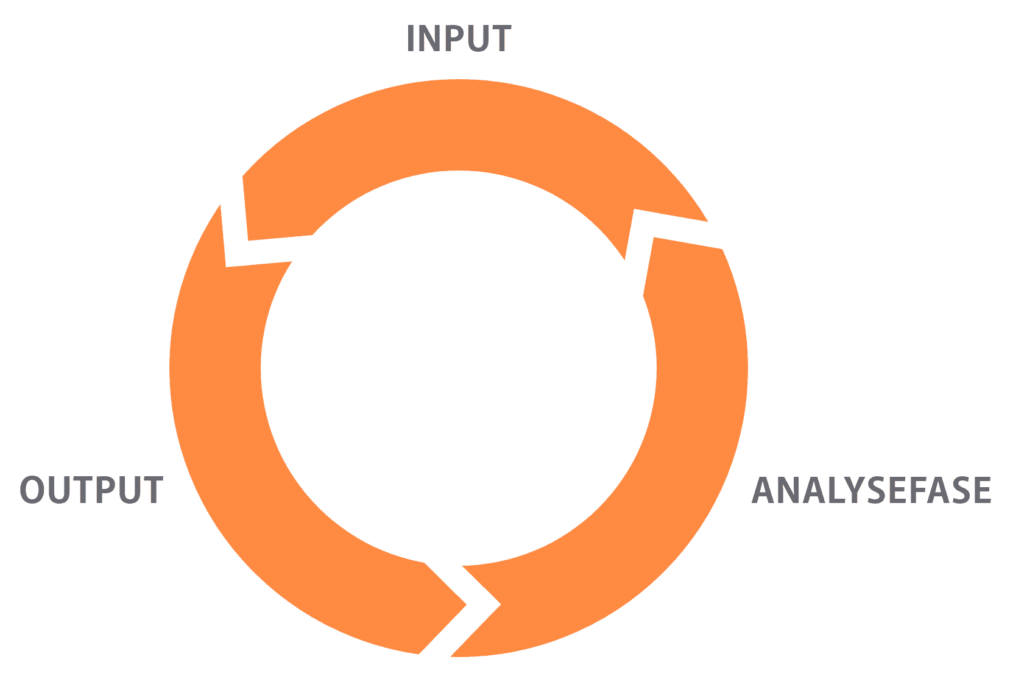
SEO process: input, output, analysis phase
Point no. 6 – keyword analysis
All your SEO work is built on keywords. SEO work equals time.
Time spent on preparation, on the process in between, and on the analysis afterwards.
Target your time and use it correctly. You can spend an infinite amount of time on link building, but it is not always advisable.
There is a niche for everyone also for you.
Ask yourself: “When would I click on my own link?”.
Google Ads allows you to test keywords and find out whether they sell.
It requires many hours of preparation and follow-up work if it is to be done properly and potentially end up with good, revenue-generating results but when it works, it works!
That is why it is a good idea to mix the two efforts also in the preparatory work to find the perfect keywords.
Organic SEO work is also time-consuming, but you can often create compelling content by drawing inspiration from your keywords and keyword analysis.
Conclusion
Are you unsure how to find the right keywords? Hopefully, you have become wiser by reading this blog post.
Be very patient and evaluate the keywords you identify. Analyze the results Google your keywords and see whether there is a market for it, whether you will face resistance and competition, or whether you should have a fair chance.
Your SERPs can tell you a great deal on their own.
And remember the fundamentals of good SEO. It will take you far especially if you have done your groundwork.
If you have questions, are curious, or similar, you are welcome to contact me or my colleagues.